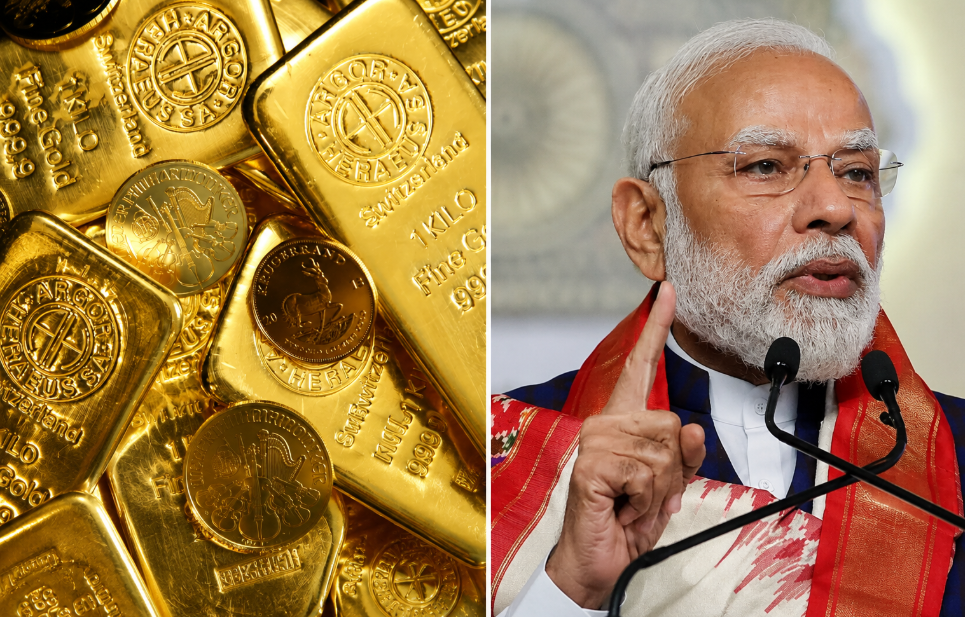
PM Modi’s appeal to avoid buying gold for a year has triggered debate across India’s bullion markets. With gold imports straining foreign exchange reserves amid the West Asia crisis, even a small dip in Delhi gold prices is now being closely watched for larger economic signals.
Published: May 11, 2026
Prime Minister Narendra Modi’s Sunday address in Hyderabad sent an unusual message to the nation: stop buying gold for at least one year. By Monday morning, the bullion market had already started reacting. Gold prices in Delhi fell marginally to Rs 1,52,490 per 10 grams of 24-carat gold on May 11, down from Rs 1,52,500 the previous day. A small dip, but a directionally significant one, arriving the morning after a sitting Prime Minister urged 1.4 billion people to hold off on one of their most deeply ingrained financial habits.
What Modi Said, and What Else He Asked For
The gold appeal was one part of a broader economic advisory that Modi delivered while addressing a public rally in Hyderabad, where he also inaugurated development projects worth nearly Rs 9,400 crore. With the conflict involving Iran, Israel and the United States continuing to escalate and threatening to disrupt global oil supplies, the Prime Minister laid out a set of lifestyle and consumption changes he wanted ordinary Indians to consider.
He urged city dwellers to use the metro over private vehicles, suggested carpooling as a practical way to reduce fuel consumption, and encouraged businesses to shift freight movement from roads to railways wherever possible. He also asked companies to revisit work-from-home arrangements, drawing a direct comparison to the pandemic period when virtual meetings and remote operations worked effectively without burning fuel.
On the agricultural side, Modi asked farmers to reduce dependence on chemical fertilisers and consider shifting toward natural farming, while also encouraging greater use of solar-powered irrigation pumps to cut diesel consumption. He further asked citizens to limit non-essential foreign travel, including overseas vacations and destination weddings, pointing out that spending abroad drains India’s foreign exchange in ways that domestic tourism does not.
These were not political statements. They were economic ones, and they reflected a government increasingly anxious about the pressure the West Asia crisis is placing on India’s import bill.
Why Modi Wants Indians to Stop Buying Gold
India is the world’s second-largest consumer of gold, and the numbers that sit behind that title are staggering. The country imported nearly $72 billion worth of gold in FY26 alone, which works out to close to 10 percent of the country’s total import bill for the year. Almost every gram of that gold is paid for in US dollars, which means every wedding, every investment purchase and every piece of jewellery bought by an Indian household contributes to the outflow of foreign exchange from the country.
India currently holds foreign exchange reserves of approximately $691 billion, down from an all-time high of $728 billion touched earlier this year. The decline has been driven by the Iran conflict pushing crude oil prices higher, a weakening rupee requiring RBI intervention, and a widening current account deficit that the IMF estimates could reach nearly $84.5 billion in 2026.
With crude oil already consuming $174.9 billion, or 22 percent of India’s total import bill in FY26, the government has limited room to absorb additional dollar outflows. Gold, being the second-largest import category, becomes the logical target for demand management. As Modi put it directly: “Gold imports consume a large amount of foreign exchange. In the national interest, we should avoid purchasing gold for one year.”
It is worth noting that this is not just about the quantity of gold being bought. Even as the value of gold imports in FY26 rose sharply, the actual volume of gold imported fell by nearly 5 percent to 721 tonnes, compared to 757 tonnes the previous year. The dollar outflow grew despite fewer tonnes arriving, simply because prices have risen so dramatically. That alone illustrates how exposed India’s forex position is to the current gold price environment.
Gold Price in Delhi Today: A Minor Fall, But Markets Are Watching
On May 11, 2026, the price of 24-carat gold in Delhi stood at Rs 1,52,490 per 10 grams. The 22-carat variant was priced at Rs 1,39,790, while 18-carat gold came in at Rs 1,14,400 per 10 grams. On the Multi Commodity Exchange, 24-carat gold futures fell by Rs 390, a decline of 0.26 percent, to trade at Rs 1,52,140 per 10 grams during Monday morning sessions.
The Indian Bullion and Jewellers Association put 24-carat gold at Rs 1,51,078 per 10 grams on Monday morning, extending a downtrend that had already begun in the previous week. Over the last three trading sessions, 24-carat gold has shed a total of Rs 8,700 per 100 grams, driven by sustained profit booking, a firmer US dollar and a rebound in crude oil prices, which tend to weigh on bullion through their impact on the dollar index.
For context, gold futures hit an all-time high of Rs 1,80,779 per 10 grams on January 29, 2026. The metal has corrected significantly from those peaks, but prices are still extraordinarily elevated by any historical measure. In nearby Faridabad, for instance, 10 grams of 24-carat gold traded at approximately Rs 1,54,645 in early May 2026, up from Rs 95,920 a year earlier in May 2025. That is a near-60 percent jump in 12 months.
Could Modi’s Appeal Signal That Gold Is Getting Cheaper?
This is the question that every prospective gold buyer in India is now quietly asking, and it deserves a serious answer.
From a market standpoint, a one-time appeal from a head of government does not move gold prices in a structural sense. Gold is priced globally, and its direction is determined by dollar strength, US interest rate policy, central bank buying, geopolitical risk premiums and inflation expectations across major economies. Indian retail demand, while significant in volume terms, is not the primary driver of the international gold price.
That said, what Modi’s remarks do signal is the government’s discomfort with gold at these price levels and its desire to see demand soften. When a government starts directing citizens away from a commodity, it often precedes policy-level action. In gold’s case, that could mean higher import duties to discourage purchases, or expanded promotion of paper gold alternatives like Sovereign Gold Bonds and Gold ETFs, which allow investors to benefit from gold prices without triggering physical imports.
There is also a broader macro signal embedded in the appeal. If the West Asia conflict de-escalates, if crude prices ease, if the dollar weakens and geopolitical risk premiums recede globally, gold tends to lose its safe-haven premium and correct. The government’s message may well be anticipating that scenario, nudging citizens not to buy an asset that could be cheaper six to twelve months from now once the current crisis pressure dissipates.
The correction from January’s all-time high of Rs 1,80,779 to current levels already suggests the froth has started to come off. While no analyst is calling a sharp crash, the consensus in bullion markets is that the next significant directional move for gold depends heavily on how the Iran conflict resolves, how quickly the US Federal Reserve signals rate changes, and whether the dollar continues to hold its strength.
For Indian buyers sitting on the fence, Modi’s appeal may actually be well-timed investment advice rather than just an economic policy nudge. Buying gold near multi-year highs, in a period of extreme global uncertainty that is already showing early signs of resolution, carries real price risk. Patience, in this case, aligns neatly with both patriotic duty and financial prudence.
The Bottom Line
Gold prices in Delhi fell marginally on May 11, a day after PM Modi urged Indians to avoid buying gold for a year amid the ongoing West Asia crisis and mounting pressure on India’s foreign exchange reserves. The appeal is rooted in hard economics: India spent nearly $72 billion on gold imports in FY26 alone, and with the country’s forex reserves under pressure from soaring crude oil costs, every dollar saved on non-essential imports matters.
Whether gold prices fall meaningfully in the coming months will depend on global factors well beyond any single government’s control. But the combination of a significant correction already underway from January highs, a government clearly signalling that current price levels are uncomfortably high, and a geopolitical situation that remains deeply uncertain makes the case for waiting, rather than rushing, into gold purchases a reasonable one.
For those who do wish to maintain gold exposure without contributing to the import burden, paper gold in the form of Sovereign Gold Bonds or Gold ETFs remains the route that aligns individual financial interest with the broader national economic position.