A New York Times report has confirmed that the White House reviewed and approved Shehbaz Sharif’s ceasefire appeal before it went live on X. The revelation reframes Pakistan’s self-described mediator role and raises pointed questions about Islamabad’s actual diplomatic independence.
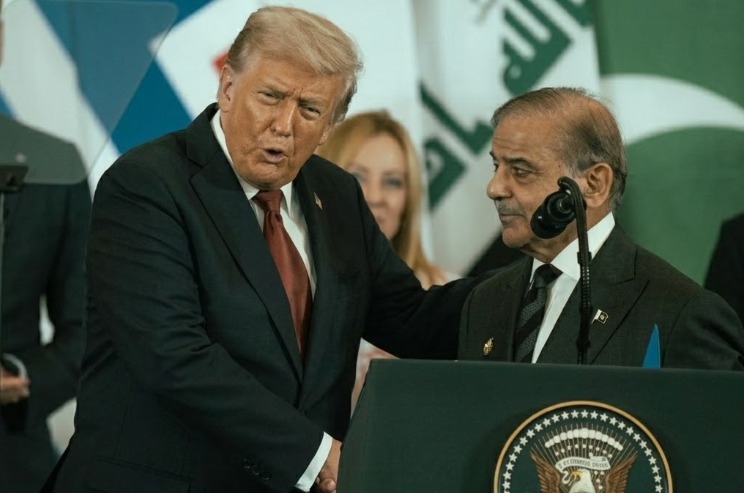
Report Claims US Was Aware of Pakistan PM’s Message Before It Went Public
What looked like a social media blunder has turned into a full-scale credibility crisis for Pakistan’s government. According to the New York Times, the White House had already reviewed and approved the statement posted by Prime Minister Shehbaz Sharif on X before it was made public. A person familiar with the communications told the NYT: “Behind the scenes, the White House had already reviewed and approved the statement before Sharif posted it.”
The White House did clarify that President Donald Trump did not personally draft the message. But that denial does little to resolve the core issue: Pakistan’s “independent” ceasefire appeal to Trump was apparently a pre-cleared diplomatic script, not an autonomous initiative.
A Financial Times report added another layer, revealing that Washington actively pushed Pakistan to present the ceasefire proposal to Iran. The reasoning, per the report, was that Iran was more “likely to accept the US-backed offer if it was delivered by a Muslim-majority neighbour state.” In other words, Pakistan was selected for its optics, not its leverage.
How This Revelation Changes the Narrative Around Sharif’s Draft Post Blunder
When Sharif posted his ceasefire appeal on April 7, the original version included the header “Draft — Pakistan’s PM Message on X,” timestamped just one minute before the edited version went live. Independent journalist Ryan Grim immediately flagged that Sharif’s own staff would never refer to him as “Pakistan’s PM” in a third-person internal label. That phrasing pointed unmistakably to an external author.
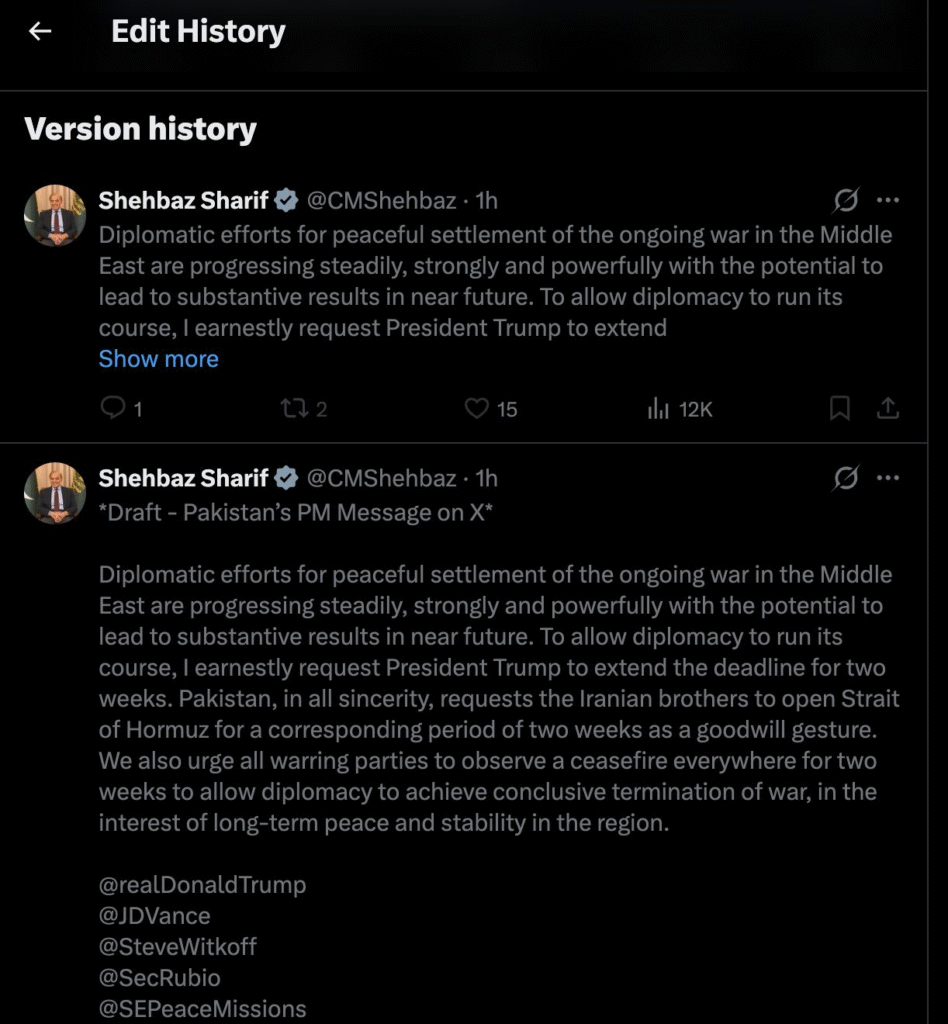
The NYT confirmation now adds institutional weight to what was previously speculation. The draft label was not just a copy-paste error by a careless aide. It was the accidental exposure of a coordinated process in which Pakistan’s public statement was pre-approved by a foreign government before Islamabad’s own prime minister posted it.
The implications are significant. If the content of the post was cleared externally, then Sharif was not speaking on Pakistan’s behalf from a position of independent agency. He was delivering a message whose terms had already been signed off elsewhere. The “blunder” revealed the architecture behind Pakistan’s mediation role.
Timeline: Trump’s Ceasefire Announcement and Sharif’s Message
Sequence of Diplomatic Communications
Pakistan had been engaged in back-channel diplomacy for weeks before the April 7 ceasefire. Army Chief Field Marshal Asim Munir held direct communications with Vice President JD Vance, envoy Steve Witkoff, and Iranian officials. On the final day before Trump’s 8 p.m. deadline, Munir continued engaging both sides behind the scenes. Sharif’s public post came roughly five hours before the deadline, with White House press secretary Karoline Leavitt confirming the President had been made aware of the proposal.
Trump announced the ceasefire approximately 90 minutes before his own deadline, crediting conversations with Sharif and Munir. Iran confirmed acceptance shortly after.
Why the Timing Is Being Questioned
The sequence now looks less like independent Pakistani diplomacy and more like a carefully choreographed public announcement. The White House pre-approving the post means the ceasefire proposal’s public framing was managed from Washington. Sharif posted what amounted to a pre-cleared statement, creating the appearance of a sovereign diplomatic initiative while the substance had already been agreed at another level.
That is a meaningful distinction. It places Sharif in the role of announcer rather than architect.
Social Media Raises Questions About Pakistan’s Diplomatic Credibility
Criticism Over Pakistan’s Foreign Policy Messaging
The reaction online was swift and sharp. Multiple commentators noted that the draft label confirmed what many had suspected: that Pakistan’s diplomatic messaging is not independently shaped. Critics described Islamabad as a “forwarding agent” rather than a genuine mediator, with some observers pointing to the fact that Sharif rushed to claim credit for a ceasefire he had limited structural ownership over.
The embarrassment was compounded by a further contradiction. Sharif publicly stated that Lebanon was included in the ceasefire. Both Trump and Israeli Prime Minister Benjamin Netanyahu promptly dismissed that claim, with Israel continuing its military operations against Hezbollah. Pakistan’s statement on Lebanon was either misinformed or not aligned with what Washington had actually agreed, which raised additional questions about the depth of Islamabad’s involvement in the deal’s actual terms.
Debate Over Islamabad’s Strategic Autonomy
The episode has intensified a long-running debate about whether Pakistan genuinely operates as an independent actor in major geopolitical events or whether it functions primarily as a channel for the interests of more powerful states. The FT report’s framing — that Pakistan was chosen because of its Muslim-majority identity rather than its negotiating capacity — strips away the diplomatic branding Islamabad was constructing around this ceasefire.
Pakistan’s Attempt to Position Itself as a Diplomatic Mediator
Islamabad’s Outreach After Ceasefire Developments
Following the ceasefire announcement, Sharif moved quickly to consolidate Pakistan’s image as a peacemaker. He invited delegations from the US and Iran to Islamabad on April 10 for formal talks, with Vice President Vance leading the American side and Iran’s Speaker of Parliament leading Tehran’s. On the surface, hosting those talks represents real diplomatic currency.
Optics vs Actual Diplomatic Influence
But optics and influence are not the same thing. Sharif was, by multiple accounts, reduced to a secondary role even within Pakistan’s own diplomatic effort, with Munir handling the substantive communications with Washington. The PM was sidelined in the process his government was publicly claiming credit for. A prime minister who posts a pre-approved statement and simultaneously overstates its terms regarding Lebanon is not operating from a position of informed diplomatic centrality.
Pakistan’s value to the US in this episode was its identity as a Muslim-majority state with lines to Tehran, not its independent strategic weight. That distinction is worth noting the next time Islamabad describes itself as an indispensable regional broker.
Why This Controversy Matters Beyond a Social Media Error
Digital Diplomacy and Global Perception
Diplomatic credibility today is built and destroyed in real time. A single post with an accidentally visible draft label, followed by a report confirming the post was pre-cleared by the White House, produces a lasting reputational signal that no subsequent statement can easily walk back. Countries watching this episode — including Iran, Gulf states, and China, which also played a behind-the-scenes role in pushing Tehran toward talks — now have concrete evidence that Pakistan’s diplomatic voice can be scripted by Washington.
Communication Discipline in Geopolitics
There is also a structural failure here beyond messaging. The fact that a draft with a visible internal header made it to the official account of a sitting prime minister, without basic quality control, points to a communications infrastructure that does not match the ambitions of the role Pakistan wants to play globally. States that want to be taken seriously as mediators cannot afford to have their official diplomatic statements exposed as externally cleared documents through a copy-paste mistake.