AAP MP Raghav Chadha’s removal as Rajya Sabha deputy leader has triggered debate over his growing independent political profile and tensions within the party. While his Parliament interventions on middle-class issues have gained attention, critics question whether his politics has translated into governance outcomes when his party held power.
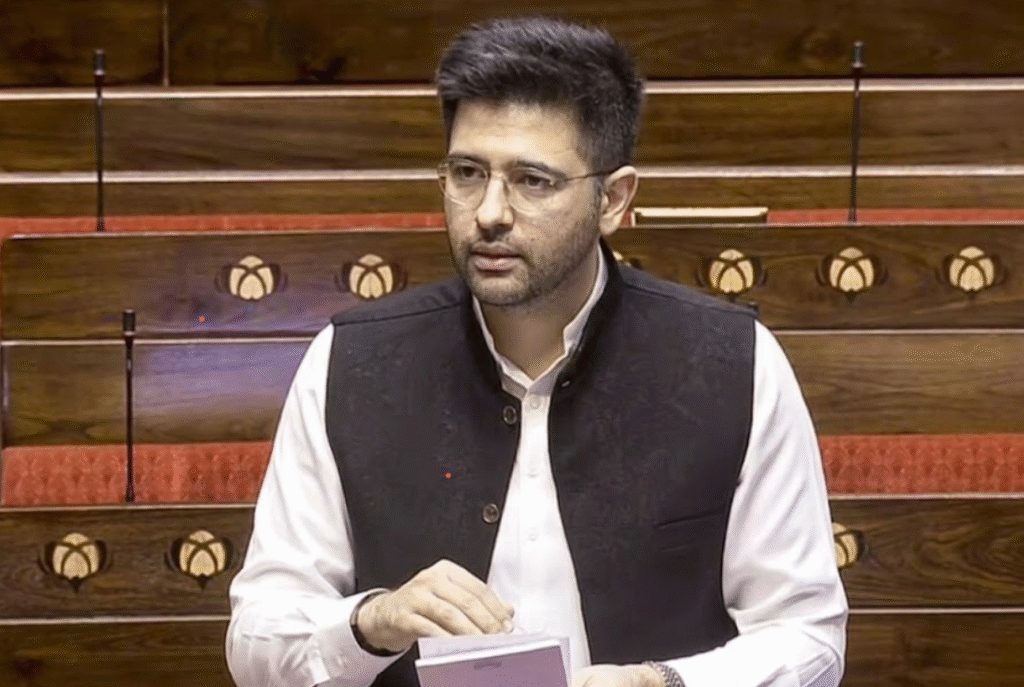
Image – Raghav Chadha in Rajya Sabha
Why Raghav Chadha Is Back in the News
On April 2, 2026, the Aam Aadmi Party wrote to the Rajya Sabha Secretariat doing two things simultaneously: replacing Raghav Chadha as its deputy leader in the Upper House with Ashok Mittal, founder of Lovely Professional University, and requesting that Chadha not be allotted speaking time from AAP’s parliamentary quota. That second part is what made political observers sit up.
Replacing a deputy leader is routine housekeeping. Formally blocking an elected MP from speaking under his own party’s quota is something else entirely. It is a public signal, and it was read as one.
Chadha, 37, responded within hours. In a video posted from outside the Samvidhan Sadan, he asked: “Is raising public issues a crime? Have I committed any sin, anything wrong?” He posted on X with the words “Silenced, not defeated.” His wife, actor Parineeti Chopra, shared a compilation of his parliamentary speeches. The episode quickly became one of the most watched political moments of the week.
AAP’s Punjab Chief Minister Bhagwant Mann called Chadha “compromised.” Delhi unit president Saurabh Bharadwaj said it was “more important to talk about the country’s larger issues rather than samosas,” a jab at one of Chadha’s most prominent parliamentary interventions. AAP has provided no formal explanation for the removal.
Raghav Chadha’s Recent Parliament Interventions
The irony of Bharadwaj’s samosa remark is that the airport food issue Chadha raised in Parliament actually produced a measurable government response. After Chadha highlighted predatory food pricing at Indian airports, the central government opened 11 UDAN Yatri cafes across airports where tea is available for Rs 10. That is parliamentary activism generating a policy outcome.
His Rajya Sabha speeches since 2022 have covered a consistent set of concerns: high food prices at airports, the exploitation of gig workers on platforms like Zomato and Blinkit, telecom companies forcing consumers into 13 recharges in 12 months by using 28-day validity cycles instead of monthly, daily mobile data expiry that denies users what they have paid for, bank charges and toll plaza pricing, the tax burden on the salaried middle class, and the case for an Inflation-Linked Salary Revision Act to protect private sector workers whose real wages fell 16% between FY18 and FY26.
On gig workers specifically, he spent a night working as a delivery partner before raising their cause in Parliament. His advocacy contributed to the government asking food delivery firms to drop the 10-minute delivery rule. He also raised menstrual hygiene, paternity leave, air pollution, paper leaks, and food adulteration.
These are not abstract policy debates. They are granular, everyday issues that resonate with India’s urban middle class and young workforce, and Chadha has used social media effectively to amplify them beyond the chamber.
The Political Strategy Behind This Approach
Chadha’s parliamentary style is deliberate and calculated. As a Chartered Accountant who has worked with Deloitte and Grant Thornton, he brings a technocratic framing to consumer and economic issues. His speeches are data-backed, often going viral precisely because they articulate a frustration that millions of people share but rarely hear articulated in Parliament.
The issues he chooses are also strategically non-divisive. Topics like telecom charges, airport food pricing, gig worker rights, and the middle-class tax burden are difficult to oppose publicly. They position Chadha as a “people’s champion” without requiring him to take the partisan positions that typically define parliamentary debate. This has helped him build a national profile independent of AAP’s brand, which is part of what appears to have unsettled the party.
Criticism: Questions Without Solutions
Chadha’s parliamentary record is real, and some interventions have had tangible outcomes. But a fair analysis requires asking a harder question: how much of this is opposition politics, and how much reflects a genuine commitment to governance change?
Critics point out that Chadha was not a bystander during the years when AAP held power. He served as a Delhi MLA from 2020 to 2022, as vice chairman of the Delhi Jal Board, and as an adviser to Punjab Chief Minister Bhagwant Mann after AAP’s 2022 Punjab victory. During those years in executive positions, the same middle-class concerns he now raises in Parliament were largely unaddressed by AAP governance. Delhi’s air pollution, which Chadha has spoken about in Parliament, was a persistent crisis throughout AAP’s time in power. The issues facing gig workers and the salaried middle class he now spotlights existed just as acutely when his party was running the government.
Punjab, where AAP has been in power since 2022 with Chadha having played a key role in that election campaign and then as an adviser to the CM, has not seen legislative progress on the consumer and worker protections Chadha advocates from the Rajya Sabha. He questions telecom companies and banks from Parliament while AAP governments in Delhi and Punjab made no visible effort to push for these changes through their own legislative powers or policy channels.
Raising issues is valuable. It shapes public discourse and, occasionally, forces the central government to act. But the gap between Chadha’s parliamentary voice and his party’s executive record on the same issues is a legitimate political question, and one his critics are entitled to ask.
Growing Signs of Internal Tensions Within AAP
The tension between Chadha and AAP leadership did not arrive suddenly. Sources say things began changing from 2024, particularly after Arvind Kejriwal’s arrest. Chadha reportedly refused to sign a notice against the Chief Election Commissioner and was absent during several key opposition walkouts. His name was dropped from AAP’s list of star campaigners for Assam. He maintained distance from party events while continuing to raise his own parliamentary profile.
AAP is a tightly centralised party built around Kejriwal’s personal brand. In that framework, a young, independently popular parliamentarian who is building a national following based on issues rather than party ideology presents an internal problem regardless of loyalty. The elevation of Ashok Mittal, a low-profile figure by comparison, underscores that AAP appears to prefer predictability over prominence in its parliamentary leadership right now.
Raghav Chadha’s Political Journey So Far
Chadha has been with AAP since its inception, working on the 2012 Delhi Lokpal Bill with Kejriwal. He became the party’s national spokesman and youngest treasurer, lost the 2019 South Delhi Lok Sabha seat, won the 2020 Delhi assembly election from Rajinder Nagar with 57% of the vote, served as vice chairman of the Delhi Jal Board, played a central role in AAP’s 2022 Punjab campaign (which produced a 92-seat landslide), became one of the youngest Rajya Sabha MPs in 2022, and served as deputy leader since 2023. His Rajya Sabha term runs until 2028.
That record is substantive. The question now is what comes next.
What This Means for Chadha’s Political Future
Chadha is not out of Parliament. His Rajya Sabha term continues regardless of his party position. Whether this marks the beginning of a formal split with AAP, an eventual reconciliation, or something in between will likely become clearer over the coming months as AAP prepares for Punjab elections in 2027.
His issue-based, social media-driven political style has genuine appeal with urban India. But political capital built through parliamentary speeches has limits when it is not backed by executive delivery or electoral wins. His one Lok Sabha contest, in 2019, ended in defeat. The challenge for Chadha is to translate a growing public profile into something more durable, whether inside AAP or outside it.
Conclusion: Political Messaging vs Governance Delivery
The Raghav Chadha episode raises a debate that runs well beyond one politician’s internal party dispute. It asks a question that Indian voters increasingly ask of their leaders: is raising the right questions enough, or does credibility require showing you can deliver answers when you have the power to do so?
Chadha has raised real issues. Some of his interventions have produced real outcomes. But the credibility of a politician who questions airport food prices from the Rajya Sabha while his party governed Delhi for years without addressing the same class of consumer grievances is not beyond scrutiny. Being silenced by your own party is a compelling political narrative. Turning that narrative into lasting influence requires something more than questions.
FAQ’S
Why was Raghav Chadha removed as AAP’s Rajya Sabha deputy leader?
AAP has provided no official explanation. The party wrote to the Rajya Sabha Secretariat on April 2, 2026, replacing Chadha with Ashok Mittal and requesting that Chadha not be allotted speaking time from the party’s quota. Media reports and political observers suggest the reasons relate to Chadha distancing himself from key party activities since 2024, building an independent political profile, and tensions within AAP’s centralised leadership structure. Punjab CM Bhagwant Mann publicly called him “compromised.”
What issues has Raghav Chadha raised in Parliament recently?
His recent parliamentary interventions span several consumer and middle-class concerns: airport food pricing, gig worker rights and the 10-minute delivery model, telecom companies using 28-day recharge cycles instead of monthly ones, mobile data expiry, bank charges, toll pricing, the middle-class tax burden, paternity leave, menstrual hygiene, air pollution, and an Inflation-Linked Salary Revision Act for private sector workers. Several of his interventions have generated government responses, most notably the UDAN Yatri airport cafes and the scrapping of the 10-minute delivery rule.
What role did Raghav Chadha play in the Delhi government?
Chadha served as a Delhi MLA from the Rajinder Nagar constituency from 2020 to 2022 and as vice chairman of the Delhi Jal Board during AAP’s government. He was also Punjab co-incharge for AAP during the 2022 Punjab election campaign and subsequently served as an adviser to Punjab Chief Minister Bhagwant Mann. Critics note that the consumer and middle-class issues he now highlights from the Rajya Sabha were not substantively addressed by AAP during the years he held these executive and advisory positions.
Is there a rift between Raghav Chadha and AAP leadership?
Yes, and it has been building since at least 2024. Chadha reportedly distanced himself from key party events, refused to sign a notice against the Chief Election Commissioner, was dropped from AAP’s star campaigner lists, and continued to pursue an independent political identity through his parliamentary work. His removal as deputy leader and the formal request to block his speaking time from AAP’s quota are the most visible manifestation of what has been a slow-building internal estrangement.
Disclaimer: This article is based on publicly reported information from multiple Indian news sources as of April 3, 2026. It does not represent the views of any political party.