A viral internal document from Lenskart explicitly banned bindis, tilaks, and kalawas while permitting hijabs. Founder Peyush Bansal’s response shifted from “inaccurate” to “outdated” within 24 hours. Neither explanation holds up to scrutiny. Here is what the document actually said and why the controversy refuses to die.

Main News: Lenskart Style Guide Sparks Religious Bias Debate
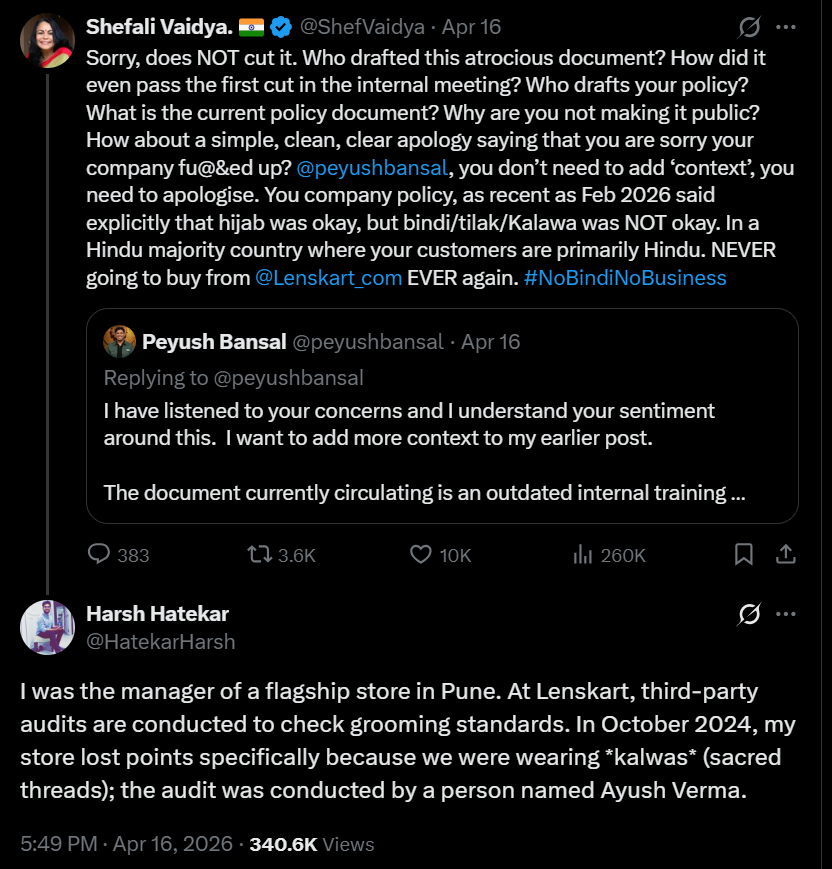
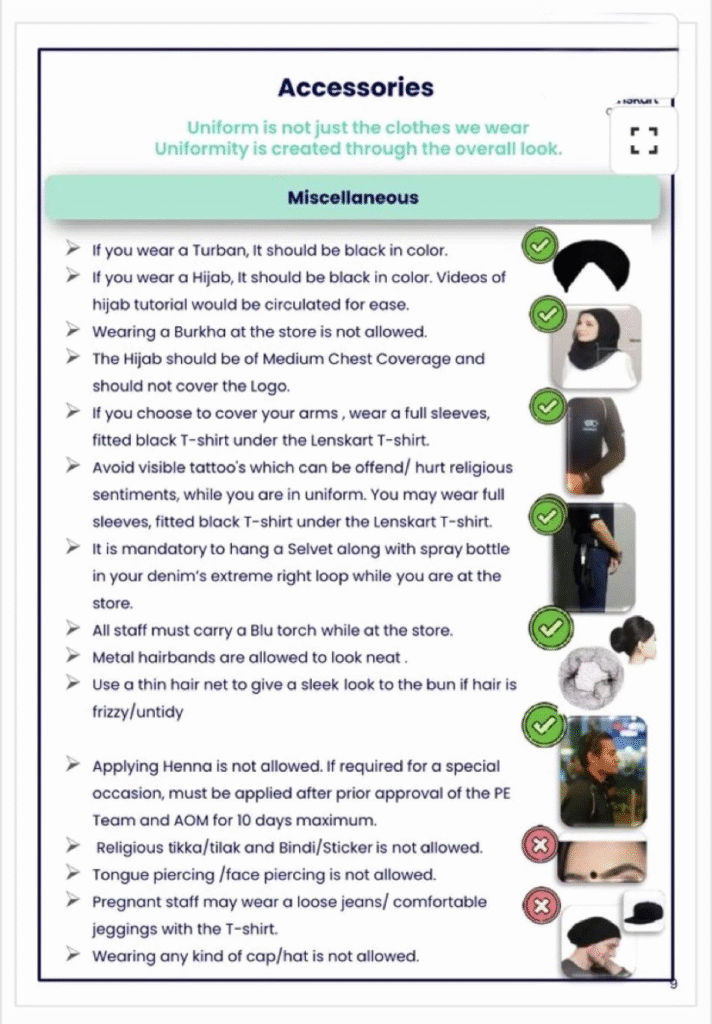
A 23-page internal training document titled the “Lenskart Academy Style Guide” (Version 11.1, dated February 2, 2026) began circulating on social media in April 2026. Pages 7 and 10 of the document contained explicit grooming rules for store staff. The document stated: “Religious tikka/tilak and Bindi/Sticker is not allowed.” It simultaneously permitted hijabs, specifying only that they must be black and “moderately cover up to the chest.” Black turbans were also allowed. Kalawas (sacred wrist threads worn by Hindus) were listed under prohibited items. The document was first flagged publicly by commentator Shefali Vaidya, triggering immediate and widespread backlash.
What Did the Lenskart Document Actually Say?
Explicit Restrictions
The style guide prohibited bindi, tilak, and kalawa from being visibly worn. Sindoor was technically permitted but with conditions: it had to be applied in a very small amount and must not spread across the forehead. Coloured gemstone rings were also banned. These are not vague or implied restrictions. They are written instructions with explicit named prohibitions.
Why It Triggered Outrage
The asymmetry is the issue. One community’s visible religious expression was welcomed with detailed accommodation instructions including colour and coverage specifications. Another community’s most basic and common symbols of faith were listed under prohibited items. In a country where the overwhelming majority of both employees and customers are Hindu, this framing generated immediate and justifiable anger.
Peyush Bansal’s Clarification
“Outdated Document” Defence
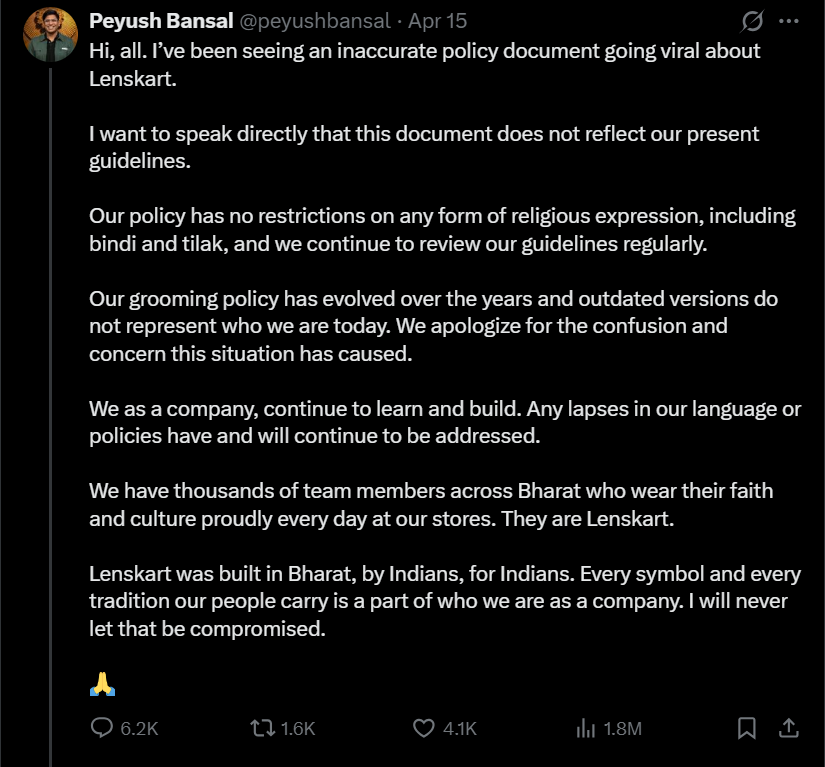
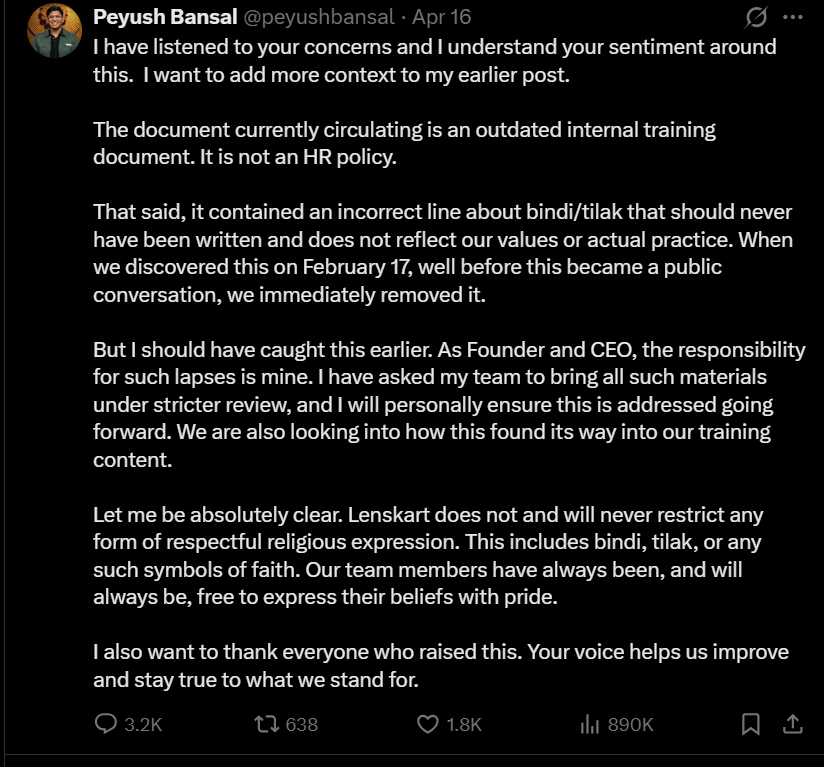
Bansal posted on X on April 15, initially calling the document “inaccurate” and claiming it did not reflect current guidelines. This first response was factually incorrect. An X Community Note quickly surfaced confirming that the Lenskart Style Guide Version 11.1 bore a date of February 2, 2026. The document was not old. It was two months old.
Facing this contradiction, Bansal issued a follow-up post on April 16 in which he shifted position. He acknowledged the document was real but described it as an “outdated internal training document” that was “not an HR policy.” He claimed the offending line had been identified and removed on February 17, well before the public controversy. He took personal responsibility as CEO and stated that such restrictions would never be allowed.
Shift in Narrative
The shift from “inaccurate” to “outdated” in under 24 hours is not a minor clarification. It is a contradiction. The first post attempted to deny the document’s authenticity. The second post confirmed it was real. This sequencing matters because it shows the initial response was not transparency but damage management, and it failed publicly.
Critical Analysis: Why the Explanation Falls Short
Timeline Problem
Bansal claims the document was removed on February 17. The document in circulation is dated February 2 of the same month. If the fix happened fifteen days after the document was issued, why was a version bearing a February 2026 date still being distributed to store staff in April? Bansal has provided no explanation for this gap.
Policy vs Training Document Argument
Bansal repeatedly emphasised that this was a “training document” rather than an “HR policy,” as if the distinction reduces its significance. It does not. Training documents are how companies communicate expected behaviour to employees at the ground level. What employees are trained to enforce is functionally indistinguishable from policy, regardless of what the internal classification label says. A ground report by OpIndia visiting a Delhi Lenskart store in April 2026 confirmed this: a store employee confirmed that the rules were actively being enforced, that employees wearing a bindi were asked to leave and return only after compliance, and that those insisting on wearing a kalawa were told to hide it inside their sleeve.
Core Question Remains
Bansal has not published the corrected version of the document. The public has no way to verify that any correction was actually made. His statements amount to asking people to take his word for it. After the original post called the document “inaccurate” when it was demonstrably authentic, that request for trust has limited credibility.
Public and Online Backlash
The response online was unusually unified across political lines. Users demanded that Lenskart publish its current policy in full. Many pointed out that there is no rational operational reason why a bindi or tilak would interfere with selling eyewear at a retail counter. No similar operational logic was applied to restrict hijabs.
Larger Issue: Corporate Neutrality vs Selective Sensitivity
The Lenskart controversy arrived in the same week as the TCS Nashik case and raised the same broader question: are Indian corporations applying their stated inclusivity frameworks consistently, or is one community’s identity systematically being treated as an accommodation requirement while another’s is treated as a grooming problem? The pattern across two high-profile corporate cases in a single week has made that question harder to dismiss as coincidence.
Conclusion: Damage Control vs Accountability
Bansal’s response was reactive, contradictory, and incomplete. Calling the document “inaccurate,” then “outdated,” while never publishing the corrected version, constitutes crisis communication rather than accountability. The trust deficit created by this episode will not be closed by assertions that Lenskart is “built in Bharat, by Indians, for Indians,” especially when ground-level enforcement reportedly continued right through the controversy. What is needed is the release of the actual current policy in full, a clear explanation of how a February 2026 document with this content was approved and distributed, and a commitment that no version of this asymmetry, however labelled, will be permitted in Lenskart’s training materials going forward.