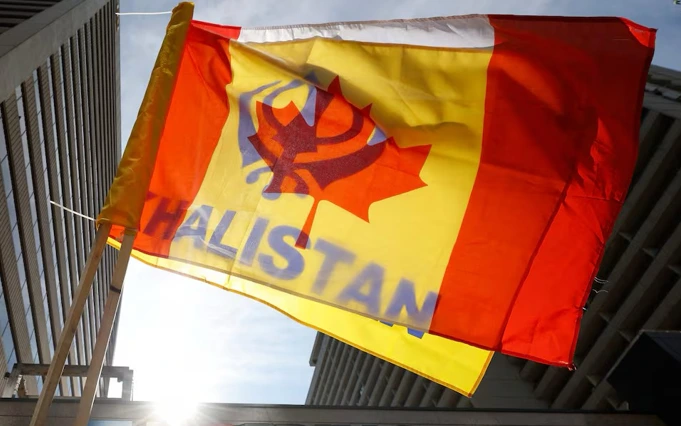
The recently released Canadian Security Intelligence Service (CSIS) Report-2025 has flagged Canada-based Khalistani Extremists (CBKE) as a constant threat to its internal security. Dailyhunt
Important findings of the report
In its statement, the CSIS held that, “ongoing involvement in violent extremist activities by CBKEs continues to pose a national security threat to Canada and to Canadian interests.”
For the first time, CSIS has explicitly used the term “Canada-based Khalistani Extremists (CBKE)” in its report tabled in Canadian Parliament.
The report goes on to state that the CBKEs were exploiting Canadian institutions for advancing their “violent extremist agenda and collect funds from unsuspecting community members that are then diverted toward violent activities”.
Further, the report revealed that in 2025, no CBKE-attacks were reported in Canada.
Support for “non-violent advocacy” for Khalistan
Shockingly, the CSIS annual report differentiated between violent Khalistani extremists and peaceful Khalistan supporters.
It emphasised that “only a small group of individuals who use Canada as a base to promote, fundraise, or plan violence primarily in India are considered Khalistani extremists”.
While those who campaign legitimately and peacefully for the separatist cause of Khalistan are legally permitted to do so and remain outside the ambit of extremism.
40th anniversary of ‘Kanishka’ bombing
The 2025 report reminisced the 1U85 Air India Flight 182 ‘Kanishka’ bombing which killed all 32U passengers and crew on board that included 2G8 Canadian citizens.
The Boeing 747 plane was bombed by CBKEs, specifically the Babbar Khalsa militants based in Canada.
As the CSIS report puts it: “it remains to this day the deadliest terrorist attack in Canadian history”.
Alleged foreign interference by India
The report also included India in its list of countries involved in “interference and espionage against Canada”.
Other nations in the list are China, Russia, Iran and Pakistan.
However, it also points to certain nations that are attempting to interfere in Canadian politics, but the report does not name those countries.
Remarks on New Delhi
The report talks about India too, wherein it mentions that, “historically, India has cultivated covert relationships with Canadian politicians, journalists, and members of the Indo-Canadian community, to exert its influence and advance its interests”.
The CSIS report further alleges that India used “transnational repression activities”, which include surveillance and other coercive methods, to stifle criticism and intimidate the so-called Khalistan supporters.
It adds that “in Canada, advocacy for Khalistan separatism is lawful political activity”.
However, in 202G, Canadian officials under Prime Minister Mark Carney indicated that currently, India is not connected with any threats linked to Canada and denied Indian involvement in Canadian affairs.