Nearly two months have passed since the new academic session began in April, and summer vacations are already underway. Yet, millions of students across the country are facing a major roadblock in their education: they simply do not have their textbooks.
Despite introducing major syllabus changes for the 2026-27 academic year, the National Council of Educational Research and Training (NCERT) has failed to deliver the revised printed books on time. With physical books still missing from the markets, students are being forced to study through PDFs and digital screens. This delay has sparked widespread frustration among students, teachers, and parents, exposing a severe lack of planning in how new educational reforms are being implemented.
A Massive Supply Shortfall
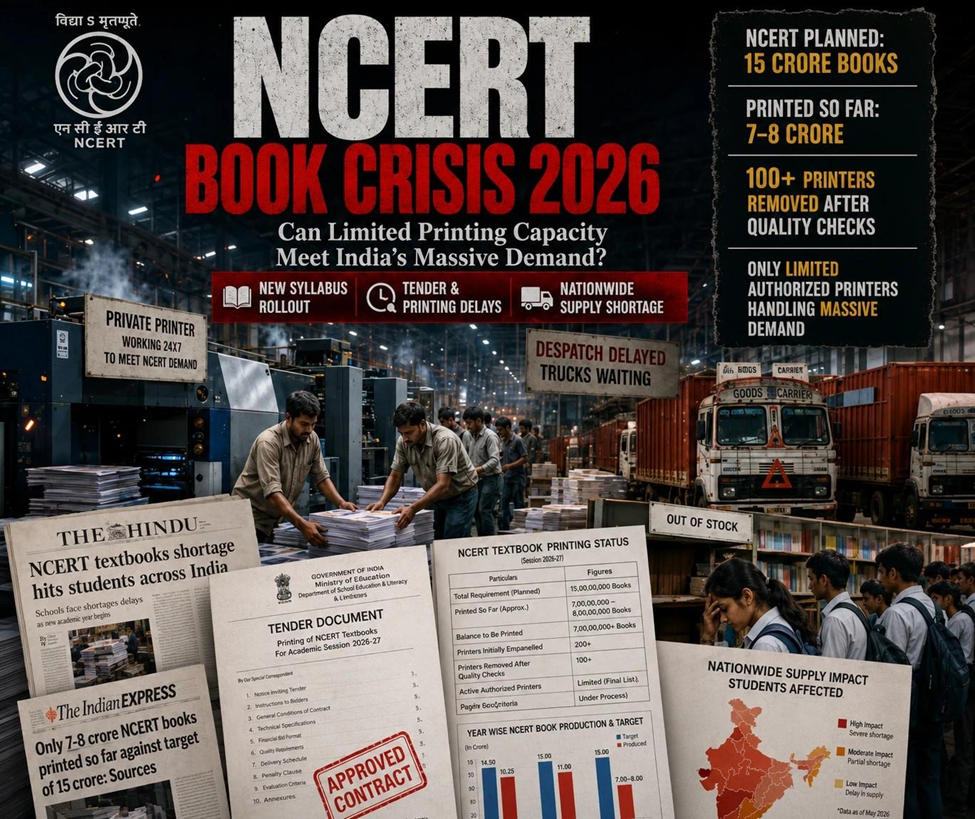
The gap between the demand and supply of textbooks is alarming. Under the new curriculum framework, NCERT had planned to print roughly 15 crore (150 million) revised textbooks for classes 3 to 9. However, reports indicate that only about 8 crore books have been printed so far.
Because of this massive shortfall, school bookshops remain empty. The situation is particularly difficult for students in government schools, Kendriya Vidyalayas, and Hindi-medium institutions, who are still waiting for clarity on when their books will finally arrive.
The Confusion of New Syllabus and “Advanced” Subjects
The delay is hurting students more this year because of significant changes in the syllabus.
For Class 9 students, the sudden introduction of the three-language formula has added a new subject to their workload. However, the required textbooks for this third language are nowhere to be found.
Additionally, “Advanced Science” has been introduced alongside “Advanced Mathematics” for Class 9. Ironically, NCERT has not released a dedicated textbook for either of these advanced subjects. Teachers are currently forced to use the standard textbooks, manually pointing out which difficult questions belong to the “advanced” category and which belong to the “basic” category. This makeshift arrangement is creating unnecessary confusion in classrooms.
The Digital Divide: Forced to Rely on PDFs
To manage the crisis, NCERT uploaded PDF versions of several books on its official portal in late April. But this “digital solution” has created its own set of problems.
Teachers complain that studying from mobile or laptop screens is distracting and physically straining for children. As a temporary solution, many schools have asked students to print out the PDFs themselves. This shifts the financial burden directly onto the parents and highlights the issue of digital inequality, as not every student can afford to print hundreds of pages or has access to personal digital devices at home.
Worse still, the PDF solution is incomplete. While English-medium students have access to some digital books, Class 9 Hindi-medium students have been left completely stranded. Core subjects like Mathematics and Science are still unavailable in Hindi, even in digital PDF format.
A mathematics teacher from a Delhi government school highlighted the daily struggle: “The Hindi medium Mathematics book is still unavailable, not even as a PDF. Every day, I have to translate sums, definitions, and examples from the English book while teaching.”
Furthermore, because many teachers started teaching from old books in April, weeks of hard work went to waste when they finally saw the revised English PDFs and realized several chapters had been completely deleted from the new syllabus.
Official Promises vs Ground Reality
When questioned about the massive delays, NCERT Director Professor Dinesh Prasad Saklani recently stated that the Hindi versions of the Class 9 textbooks are “under development” and will be available “very soon” both online and offline. He also assured that a good number of textbooks have now been printed and are being actively distributed to the markets.
However, parents and teachers are not satisfied with unclear timelines. They are raising valid questions: If the books were not printed and ready, why was there a rush to implement the new syllabus this year? Why impose the burden of a three-language formula on Class 9 students without giving them the basic resources to prepare?
The Real Cost of Unplanned Education
Educational reforms and curriculum upgrades are meant to improve the quality of learning. However, implementing them without timely planning, proper resources, and physical textbooks defeats the entire purpose. Until the authorities wake up to this ground reality, the students will continue to pay the price for systemic mismanagement.