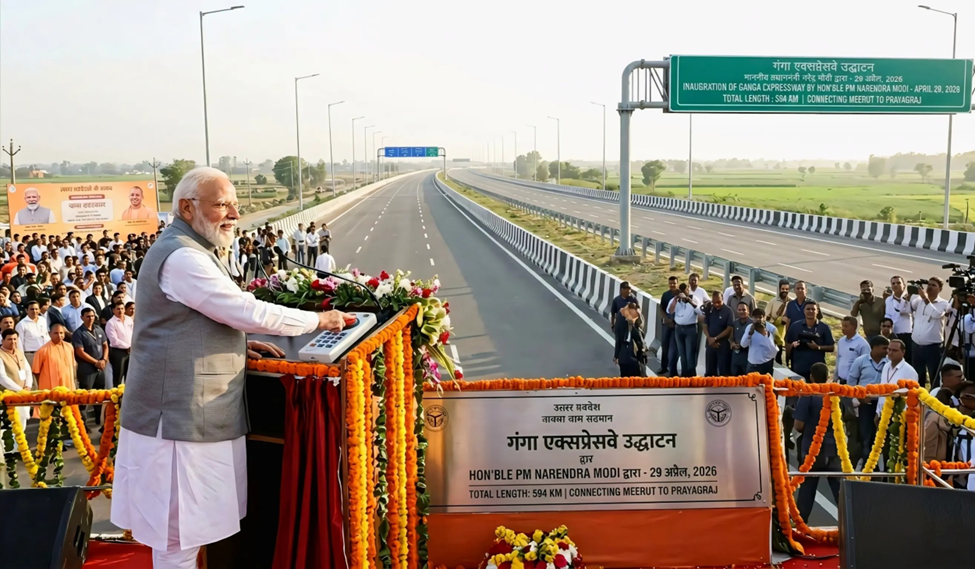
The Ganga Expressway will be inaugurated by Narendra Modi on April 29, marking the completion of one of Uttar Pradesh’s largest infrastructure projects that aims to reshape the logistical and economic landscape of Uttar Pradesh.
Stretching an impressive 594 kilometres, this greenfield mega-corridor isn’t just an engineering milestone; it’s a strategic move to seamlessly stitch the western and eastern halves of the state together, fundamentally altering trade routes and travel times.
The Speed of Progress: Halving Travel Times
Traveling from Meerut to Prayagraj can often take a long time (10-12 hours), and the journey can be difficult for both freight and commuter transportation; however, with the introduction of the Ganga Expressway this calculation has changed greatly. With a cruising speed limit of 120 km/h, the Ganga. The expressway will be a six-lane access-controlled highway, designed for future expansion to eight lanes. When it opens, the new highway will reduce the total travel time to only six hours.
Key Features of the Mega Corridor
- Massive Investment: Executed at a cost of roughly ₹36,230 crore, it stands as one of India’s most ambitious infrastructure undertakings, completed efficiently through a multi-package development model.
- Extensive Reach: The route begins at Bijauli village in Meerut and ends at Judapur Dandu in Prayagraj. It passes through 12 key districts, bringing over 500 villages directly into its economic fold.
- Strategic Defense Integration: In a calculated nod to national security, the expressway features a fully operational 3.5-kilometre airstrip in Shahjahanpur. Outfitted with nearly 250 cameras, it is built specifically for emergency take-offs and landings by the Indian Air Force.
- Engineering Feats: The project overcomes major geographic hurdles with a 960-metre bridge traversing the Ganga River and a 720-metre bridge over the Ramganga.
A Catalyst for Trade and Logistics
Beyond commuter convenience, the expressway is being developed as a dedicated economic backbone. It will operate on a closed tolling system with two main toll plazas at the entry and exit points.
By connecting agricultural hubs, regional industries, and logistics parks directly to broader national markets—and eventually linking to the National Capital Region—the corridor is perfectly positioned to capture massive freight volumes. With manufacturing clusters already planned along its path, the Ganga Expressway isn’t just a road; it is the new engine of Uttar Pradesh’s growing economy.