A nine-judge Constitution Bench of the Supreme Court began hearing review petitions in the Sabarimala temple entry case on April 7, 2026, with the Centre defending the restriction as a religious practice.
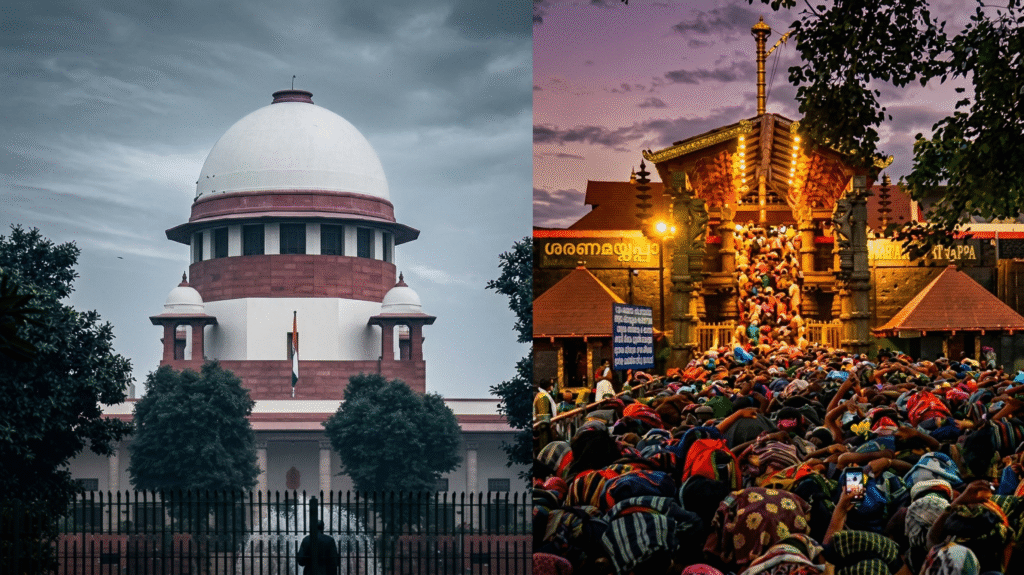
What the Centre Told the Supreme Court
Appearing for the Union government, Solicitor General Tushar Mehta presented a strong defence of the temple’s practices, arguing that the Sabarimala issue is intrinsically linked to the nature and attributes of the deity, Lord Ayyappa, and that such matters fall outside the scope of judicial examination. The Centre strongly objected to attempts to equate the Sabarimala issue with untouchability under Article 17, arguing that such comparisons are legally and conceptually flawed, as the temple practice does not involve caste-based exclusion.
A key argument was that the Sabarimala practice is “sui generis” meaning unique, and cannot be compared with other cases or broadly applied constitutional doctrines. Mehta also drew a distinction between limited restrictions and sweeping bans, saying the Constitution requires a balanced approach, and that denominational customs must be respected.
Why Women Aged 10 to 50 Are Traditionally Restricted
The Solicitor General argued that the restriction on women of menstruating age is based on the deity Lord Ayyappa’s celibate nature, not on notions of impurity. Mehta clarified that his argument was not centred on menstruation, maintaining that the restriction is based on age, not the idea of impurity. “I will defend Sabarimala in my own different way; it does not mean 4 days, it means a particular age group,” he said. He further noted that Lord Ayyappa temples elsewhere in India are open to women, underlining that the Sabarimala case is specific to this shrine’s distinct tradition.
The Legal Background of the Sabarimala Dispute
The Indian Young Lawyers Association approached the Supreme Court in 2006 challenging the customary ban on entry of women aged 10 to 50 to the Sabarimala temple, arguing it violated the right to equality under Article 14 and the right to practice religion under Article 25. In September 2018, a five-judge Constitution bench delivered a landmark 4:1 majority verdict striking down the ban, holding that treating women as “children of a lesser god” was unconstitutional and violative of Articles 14, 15, and 25. The ruling triggered widespread protests across Kerala and led to dozens of review petitions being filed. In November 2019, the Supreme Court pronounced its judgment on the review petitions but did not decide the matter, instead referring certain overarching constitutional questions to a larger nine-judge bench.
Questions Raised by the Supreme Court During Hearings
Justice B.V. Nagarathna stated that courts have the right to intervene when “social evils are branded as religious practice.” Justice Nagarathna also raised a pointed question about standing, asking whether the original writ petitioners are even devotees of Lord Ayyappa, noting that no devotee had approached the court challenging the custom. The bench has repeatedly returned to how far constitutional courts can go in examining matters of faith.
What Happens Next in the Case
The nine-judge Constitution Bench is currently examining seven important legal questions concerning religious rights and freedoms in India, and the verdict will have a major impact on various individual cases, including the Sabarimala temple entry question. The ruling is also expected to affect similar disputes involving the entry of women at other religious sites across different faiths in India.
FAQs
1. What is the Sabarimala case about?
The Sabarimala case concerns whether women between the ages of 10 and 50 can be restricted from entering the Sabarimala temple in Kerala. The dispute centres on whether this restriction violates constitutional rights to equality or is a protected religious practice.
2. What did the Supreme Court rule in 2018?
In 2018, the Supreme Court ruled in a 4:1 majority that the restriction on women of menstruating age was unconstitutional and violated their right to equality. However, review petitions were filed and the matter was referred to a larger bench.
3. Why is the Central government involved in this case?
The Central government has appeared before the Constitution bench to submit its position on the legal questions being examined. The government’s stance supports the view that courts should be cautious in interfering with established denominational religious practices.