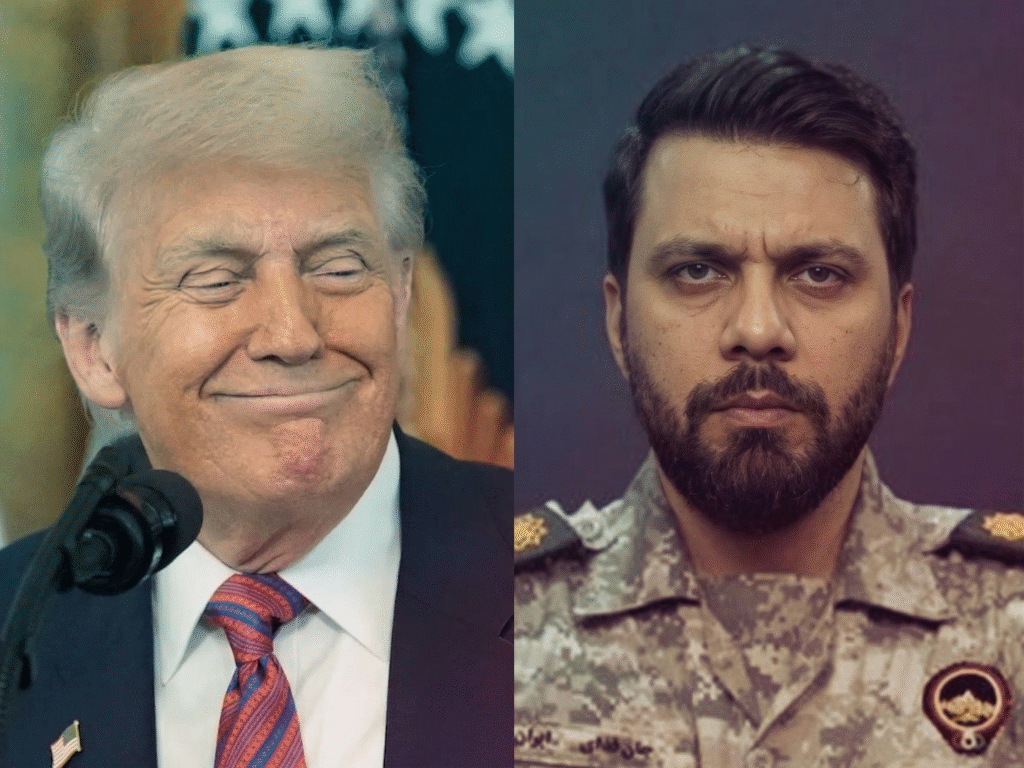
A social media blunder by Pakistan’s Prime Minister has triggered serious questions about Islamabad’s claim of mediating the US-Iran ceasefire. A mistakenly posted “draft” message has raised speculation about external scripting and whether Pakistan’s diplomatic narrative was exaggerated.
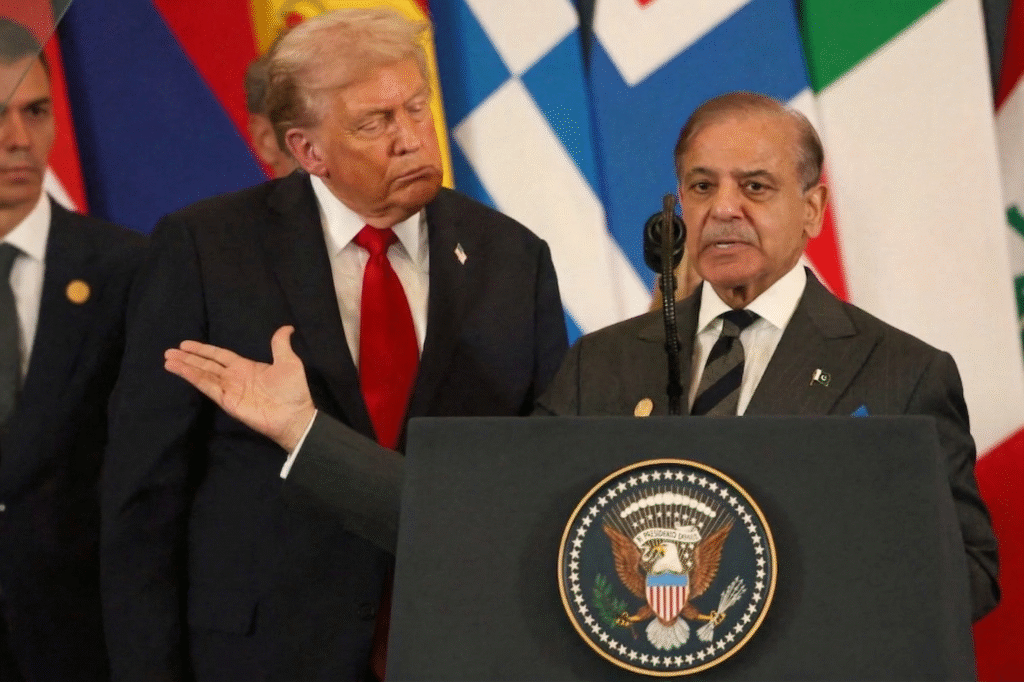
Pic – PM Shehbaz Sharif praising Trump
Pakistan PM’s Draft Tweet Goes Viral — What Exactly Happened?
On April 8, 2026, Pakistan’s Prime Minister Shehbaz Sharif posted a message on X urging US President Donald Trump to extend his Iran deadline by two weeks. The post called for a ceasefire, requested Iran to reopen the Strait of Hormuz, and framed Pakistan as an active diplomatic bridge between Washington and Tehran.
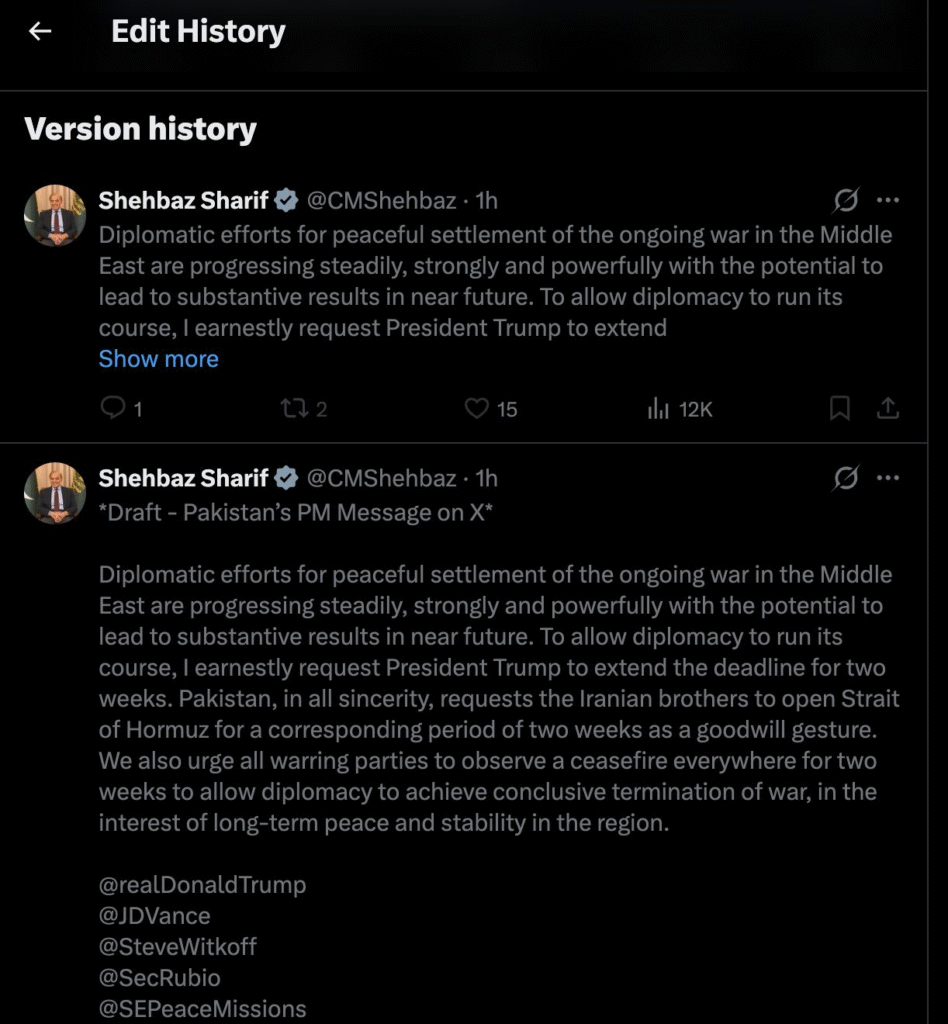
Source – X (formally, Twitter)
Routine enough — until users checked the edit history.
The original version of the post, timestamped just one minute before the final, included a stray internal heading at the top: “Draft – Pakistan’s PM Message on X.” That line was quickly removed before the final version went live. But X’s publicly visible edit history preserved it. Screenshots spread rapidly, and the question that followed was impossible to ignore: who actually wrote this?
The “Draft” Label Destroys the Mediation Narrative
Here is the core problem. No sitting prime minister’s communications team would label their own leader’s official statement as “Pakistan’s PM Message.” That is third-person language. That is how someone outside the Pakistani government would refer to Sharif.
Independent journalist Ryan Grim of Drop Site News put it plainly: Sharif’s own staff would simply call him “prime minister” or “PM” — not “Pakistan’s PM.” The label is a tell. It strongly suggests the message was drafted externally and sent to Islamabad for publication, not authored in-house.
One widely circulated theory framed it directly: Trump wanted a diplomatic off-ramp without appearing to initiate it, so the message was drafted for Pakistan’s PM to deliver. Someone simply forgot to strip the header before posting.
If that is true, Pakistan was not a mediator. It was a mouthpiece.
Trump Announced the Ceasefire — Pakistan Announced Itself
The sequencing here matters. Sharif’s post requested a two-week extension. Trump then announced the ceasefire on Truth Social, crediting conversations with Sharif and Pakistan’s Field Marshal Asim Munir. Sharif followed up by inviting US and Iranian delegations to Islamabad for talks on April 10.
Pakistan’s narrative: we mediated a historic ceasefire.
The reality: Trump made the call. Trump set the deadline. Trump announced the pause. Pakistan relayed a request — possibly one it was handed — and Trump responded. That is the role of a facilitator at best, a messenger at worst. Describing that as decisive mediation is a significant stretch, and the draft blunder makes it even harder to defend.
Pakistan’s Pattern of Diplomatic Overreach
This is not the first time Islamabad has moved quickly to insert itself into a global crisis and amplify its role beyond what the facts support. Pakistan has historically sought diplomatic relevance through conflict — offering itself as a venue for talks, positioning its military leadership as back-channel brokers, and leveraging proximity to volatile regions as a bargaining chip for international goodwill and economic relief.
The Iran episode fits that pattern precisely. With Pakistan facing serious domestic economic pressure and a persistent credibility deficit in the West, being seen as the country that helped avert a Middle East war carries enormous strategic value. The incentive to overstate the role is obvious.
Narrative vs Reality — Who Was Really Driving Diplomacy?
The draft incident does not just embarrass Sharif personally. It cuts directly at the architecture of Pakistan’s diplomatic positioning.
Owning the messaging of a diplomatic act is not the same as owning the negotiation. If the statement posted under Sharif’s name was written by someone else, handed to him, and published with the author’s label accidentally left in, then Pakistan’s role was essentially performative. It was asked to say something, said it, and then claimed credit for the outcome.
Real diplomatic weight comes from leverage — economic, military, or relational. Pakistan has limited leverage over Iran and even less over the United States in its current financial condition. What it has is geography, a willing military establishment, and a strong desire to matter on the global stage. That combination makes Islamabad useful as a conduit. It does not make it an architect.
The draft label, in a single accidental line, made that hierarchy visible.
Conclusion: A Diplomatic Misstep That Raised Bigger Questions Than It Answered
What began as a copy-paste error has become a case study in the gap between diplomatic optics and diplomatic reality. Pakistan claimed a mediator’s role in one of the most significant US-Iran moments in years. But the edit history of a single X post suggests the country may have been reading from a script it did not write.
The ceasefire may hold or collapse on its own terms. But Pakistan’s credibility as an independent broker took a genuine hit — not from a rival’s criticism, but from its own prime minister’s account.
In geopolitics, perception is leverage. And right now, Pakistan’s perception problem is entirely self-inflicted.