Two cruise ship outbreaks involving Hantavirus and Norovirus have revived memories of the COVID-era Diamond Princess crisi. But how dangerous are these viruses, how do they spread, and should the public actually be worried? Here’s a detailed comparison of the two outbreaks and the real level of risk.
The recent outbreaks of Hantavirus and Norovirus, which occurred on different cruise ships within a matter of a few days, bring back the grim memory of the COVID-19 outbreak on the Diamond Princess cruise ship. This COVID outbreak was detected in February 2020, where at least 712 passengers caught the virus and 14 others died due to infection.
The Hantavirus outbreak on MV Hondius and the Norovirus outbreak on Caribbean Princess have ignited apprehensions of a COVID-like scenario, mass casualties and global lockdowns, however, to what extent are these fears justified? And which outbreak should you worry about?
But first, an in-depth look at the recent cruise ship outbreaks.
The Hantavirus Outbreak on MV Hondius
On May 2, the world came to know of the spread of a fatal strain of Hantavirus, the Andes strain, on the Dutch luxury ship MV Hondius. Among the 149 passengers, 8 people are infected, with 3 other passengers already dead. 2 Indian nationals, part of the crew, are also aboard the luxury cruise. The infection reportedly began from a Dutch couple who had returned from a bird watching trip in Ushuaia, Argentina.
The Norovirus Outbreak on Caribbean Princess
The Caribbean Princess cruise ship was hit by a Norovirus outbreak that infected 115 people, comprising 102 passengers and 13 crew staff. There are a total of 4,247 people aboard, with 3 fatalities reported. The US Centre for Disease Control and Prevention informed of the outbreak after the infected cases on the ship surpassed the 3% limit for public notification under the Vessel Sanitation Program on May 7.
Hantavirus vs Norovirus: A Comparison
Host and Subsequent Disease Caused
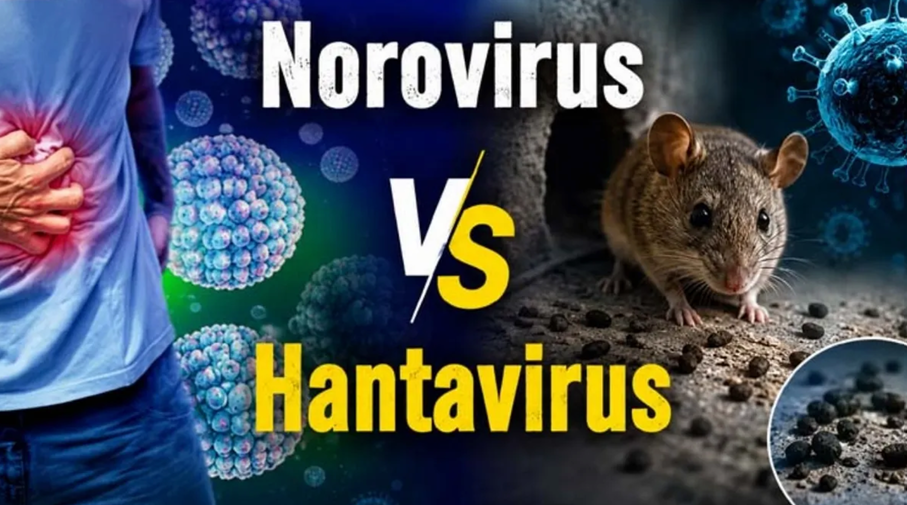
Hantavirus is a family of rodent-borne viruses that targets the lungs (Andes strain), causing Hantavirus Pulmonary Syndrome (HPS), or infects the kidneys (Old-world strains) leading to Hemorrhagic Fever with Renal Syndrome (HFRS). On the other hand, Norovirus is a human stomach virus, also known as the “winter vomiting bug”, which induces inflammation of the stomach and intestines, a condition that is technically called gastroenteritis.
How a Person Catches the Virus
Hantavirus typically infects humans when they come in contact with surfaces contaminated with rodent droppings like urine, faeces and saliva. Infection via air is also possible if the inhaled air is contaminated with infected rodents’ waste, as explained by the US Centre for Disease Control and Prevention. Norovirus, on the other hand, causes infection through the human-to-human fecal-oral route, that is, either by coming in contact with contaminated food, water or surface, or via proximity with the infected patient. Airborne infection is also possible through inhalation of air contaminated with suspended droplets of an infected patient’s vomit.
The Transmission Rate
Due to the presence of an outer-lipid coating on Hantavirus (enveloped virus), it does not spread easily, making it less contagious. Conversely, there is no outer-lipid coating on Norovirus (naked virus), which makes it a highly contagious virus that spreads easily from person to person.
Chances of Mortality
It is noteworthy that Hantavirus is more lethal than Norovirus, especially the Andes Hantavirus which attacks the lungs. Dr. Rajeev Jayadevan, the Co-Chairman of the National COVID Task Force, points out that, “The hantavirus outbreaks are exceptionally rare but the strain we are talking about here is one that affects the lungs. They are more likely to cause pulmonary syndrome or lung affliction, which can become life-threatening.” On Norovirus, he explains that, “A concern with norovirus is that it’s going to incapacitate a lot of people really quick. But it rarely kills people unless they are already very frail, critically ill or unable to access medical care.”
Symptoms
The symptoms produced by these viral infections are as follows:
| Hantavirus Symptoms (appear in 1–8 weeks) | Norovirus Symptoms (appear in 12–48 hours) |
|---|---|
| Fever | Vomiting |
| Muscle aches | Stomach cramps |
| Fatigue | Diarrhoea |
| Headache | Nausea |
| Nausea | Body aches |
Disinfection
Hantavirus can be inactivated using regular soap and water, but Norovirus requires strong disinfectants to eliminate.
Cure/Vaccine
To date, no cure or vaccine exists for either Hantavirus or Norovirus. The body is provided medical care, such as antivirals and antibiotics, to fight the symptoms and support the body in killing the virus on its own.
Should You Be Concerned?
When it comes to outbreak potential, Hantavirus, due to its low transmission rate, may either cause no global outbreak or, in the worst case, cause a small-scale outbreak. Whereas Norovirus can cause a large-scale infection, but owing to its low fatality rate, any potential deaths can be minimised.
Additionally, the World Health Organisation (WHO) has termed the Hantavirus spread on the MV Hondius as low-risk, affirming that the “overall public health risk remains low.”
Nonetheless, Dr. Jayadevan adds that Hantavirus does not transmit like COVID-19 or Norovirus, but it can be fatal in patients with severe infection. On Norovirus, he raised concerns that, “from a community standpoint, norovirus can be pretty devastating because it can make a lot of people sick very quickly. Imagine a wedding party where 100 people suddenly fall sick. Where do they all go? Everyone may need IV drips and medical attention at the same time.”
So, while a COVID-like scenario perhaps looks far-fetched, guard cannot be lowered. The infected passengers on both cruise ships should be monitored, simultaneously tracing their movements to detect and prevent any spread of the said viruses on the mainland.