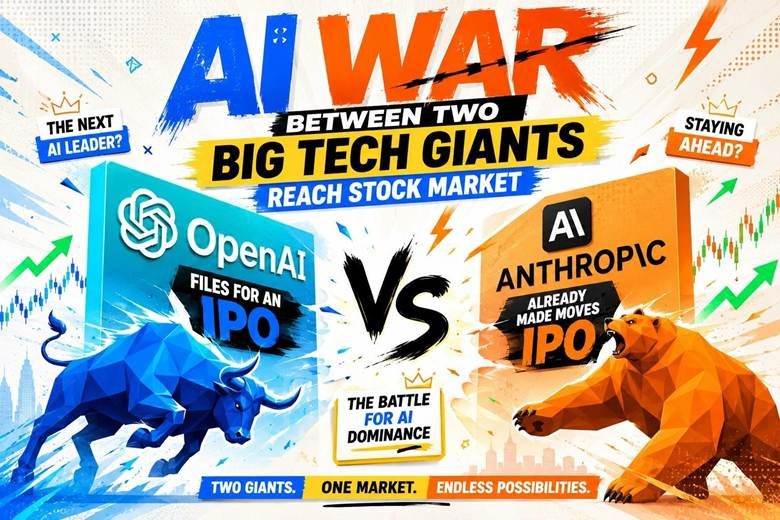
The battle for artificial intelligence has officially moved from Silicon Valley laboratories to the global stock market. In an unprecedented move, the world’s two most powerful AI companies—OpenAI (maker of ChatGPT) and Anthropic (maker of Claude)—have both filed for Initial Public Offerings (IPOs) within eight days of each other.
This simultaneous push to go public is set to become the biggest financial event of the decade, testing exactly how much the “AI era” is truly worth.
The Events: A Historic Eight-Day Race
The rivalry between the two tech giants reached a new level this June. Here is how the events unfolded:
- Anthropic Strikes First: On June 1, 2026, Anthropic confidentially filed draft registration papers with U.S. regulators. Backed by a recent $65 billion funding round, Anthropic’s private valuation soared to $965 billion, making it the most valuable private AI company. They are targeting an October 2026 public listing.
- OpenAI Responds: Just days later, OpenAI confirmed it had also submitted a confidential S-1 filing to the Securities and Exchange Commission (SEC). OpenAI is aiming for a September 2026 debut, hoping to achieve a valuation of over $1 trillion. If successful, they could raise $60 billion, which would easily double the size of the 2019 Saudi Aramco listing to become the largest IPO in history.
The Financial Battlefield
While both companies are growing at record speeds, their financial realities tell a complex story. Anthropic recently overtook OpenAI in sales, currently tracking to generate $40 billion in annual revenue compared to OpenAI’s $30 billion.
Looking closely at the numbers, Anthropic holds a slight edge with a private valuation of $965 billion following a recent $65 billion cash raise, as it prepares for an October 2026 IPO. OpenAI, on the other hand, is privately valued at $852 billion despite securing a staggering $122 billion in recent funding, and hopes to beat its rival to the market with a September 2026 debut.
Despite these massive revenue numbers, profitability remains a major challenge. OpenAI is currently losing $1.22 for every single dollar of revenue it earns, and the company does not expect to become profitable until 2030.
Why is This Happening Now?
The decision to go public is driven by one simple reality: artificial intelligence is incredibly expensive to build.
Training advanced AI models requires billions of dollars for specialized computer chips, massive physical data centers, and massive cloud computing power. Private venture capital is no longer enough to fund these soaring costs. Both companies need the deep pockets of the public stock market to survive and grow.
Additionally, financial experts note that both companies want to “strike while the iron is hot.” Investor enthusiasm for AI is at an all-time high, and both OpenAI and Anthropic are rushing to secure funding before market conditions change.
The Consequences: Why It Matters
For years, the AI industry has operated behind closed doors. Success was measured by leaked valuations, private funding rounds, and software benchmark scores. This IPO race changes everything.
Going public requires strict financial transparency. Once listed, these companies will be forced to open their financial books to the public. Every retail investor, pension fund, and Wall Street analyst will finally get to put a real, hard price on artificial intelligence. This will answer the ultimate question: Are these AI giants sustainable businesses, or just highly funded research projects?
Effects on the End Consumer
For the everyday user, this stock market rivalry will have direct and immediate impacts:
- A Chance to Own a Piece of AI: OpenAI has already announced plans to reserve a portion of its stock specifically for retail investors. This means everyday consumers will have the chance to own shares in the company behind ChatGPT.
- Faster, Better Products: As both companies fight to impress public shareholders, the competition will become even fiercer. Consumers can expect faster updates, smarter AI models, and more capable versions of ChatGPT and Claude as the companies battle for market dominance.
- Fewer “Side Quests” : To reach profitability, AI companies will have to focus on products that actually work and generate value. Consumers will see these platforms shift away from experimental features and focus heavily on reliable, high-quality tools that improve daily life and work.
The AI era is finally going public. Whether the market believes these companies are worth a combined $2 trillion is a question that will be answered on Wall Street in September and October of this year.