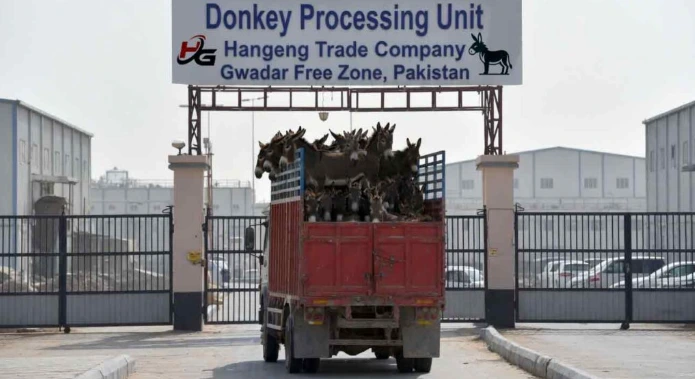
A Chinese company has permanently shut down its donkey slaughterhouse in Pakistan’s Gwadar port city and issued a stark warning to other foreign investors, saying the country’s regulatory environment makes sustained business operations nearly impossible.
Hangeng Trade Company also referred to as Hag Geng Trade formally announced the permanent closure of its Pakistan operations after facing serious difficulties with government regulations and obtaining export approvals, despite claiming it had fulfilled all international food safety standards, including Hazard Analysis and Critical Control Point (HACCP) requirements.
In its official statement released on May 1, 2026 International Labor Day the company said it was “forced” to shut down due to ongoing non-market factors and operational barriers that made it impossible to sustain normal operations.
A Promising Venture Gone Sour
Hangeng Trade Company had invested $7 million in the Gwadar slaughterhouse, with an ambitious plan to supply over 300,000 donkey hides annually for ejiao a traditional Chinese medicine believed to enrich blood, enhance immunity, and treat various ailments. With China’s ejiao market estimated at $8 billion, Pakistan had hoped to tap into the lucrative demand.
The company operated in the Gwadar North Free Zone, focusing on exporting agricultural and animal products specifically donkey meat and hides to China. The facility was once projected as a key export hub, expected to strengthen economic ties between Pakistan and Chinese markets. However, its abrupt shutdown has highlighted deeper structural issues that continue to hinder foreign ventures in the region.
Export approvals for the company had been pending for months, raising serious questions about the bureaucratic difficulties affecting foreign-backed projects in Pakistan. Despite meeting international standards, the company found itself trapped in a web of regulatory delays involving the Ministry of National Food Security, the Finance Ministry, and the Cabinet Division.
Last-Minute Government Scramble
The shutdown triggered a frantic last-minute response from Islamabad. After the company’s public announcement, the Pakistani government moved urgently, and all approvals including that of the federal were secured within hours. On May 1, emergency instructions were issued from the Prime Minister’s Office to immediately circulate a summary for cabinet approval. As a consequence, the cabinet considered and ratified the Economic Coordination Committee (ECC) decision to resolve issues related to the export of donkey meat and hides from the Gwadar facility.
An export approval that had been pending for months was granted within hours from late Friday evening to midnight on Saturday solely due to the intervention of the Prime Minister’s Office. The speed of resolution only underscored how long the matter had been unnecessarily delayed.
However, the emergency measures came too late to reverse the company’s decision to leave. The government also pointed fingers back at Hangeng, alleging the firm had not met agreed terms for export, including breeding animals to meet international quality standards. Chinese customs authorities had raised concerns over meat quality and product origin, adding another layer of complexity to an already troubled operation.
A Warning Shot to Foreign Investors
In perhaps the most damaging aspect of the episode, Hangeng did not leave quietly. The company publicly advised prospective foreign investors to carefully evaluate how policies are enforced and what regulatory problems exist in Pakistan before committing their funds. It also called on Pakistani officials to develop a stable, transparent, and investor-friendly policy framework pointedly timing its remarks ahead of Prime Minister Shehbaz Sharif’s upcoming visit to China for an investment forum.
The company expressed deep regret over the termination of both its Pakistani and Chinese employees, who lost their livelihoods as a direct result of the closure. The public statement served as a cautionary tale that reverberated well beyond the walls of a single slaughterhouse in Balochistan.
Gwadar’s Broader Investment Proble
Gwadar holds immense strategic importance as a key node of the China-Pakistan Economic Corridor (CPEC), designed to connect Chinese trade routes to the Arabian Sea and envisioned as a major regional economic hub. Yet, the collapse of the Hangeng project reveals the vast gap between strategic ambition and ground-level reality.
Pakistan’s foreign direct investment figures tell a troubling story. FDI plunged by half a billion dollars to just $1.4 billion during the first nine months of the current fiscal year a sharp reduction of 27% according to the State Bank of Pakistan. The broader investment climate has been further complicated by security concerns in Balochistan, bureaucratic inefficiencies, and inconsistent policy enforcement that leaves foreign businesses in a state of chronic uncertainty.
Pakistan currently exports approximately 216,000 donkeys annually for meat and hides, mainly to China, and the sector has the potential to generate around $300 million per year according to government estimates revenue that now hangs in the balance without a reliable, stable regulatory environment to support it.
The Bigger Picture
The closure of the Gwadar donkey slaughterhouse is more than a quirky business story it is a symptom of a deeper malaise. It reflects systemic failures in regulatory governance, administrative follow-through, and the capacity to deliver on promises made to foreign investors. The fact that months of bureaucratic paralysis were resolved in a matter of hours only when political pressure mounted speaks volumes about where priorities lie.
As Pakistan courts Chinese investment under the CPEC framework and seeks to strengthen economic partnerships, the Hangeng episode serves as an uncomfortable reminder: investor confidence is not built on grand announcements and corridor agreements alone. It is built on consistent, transparent, and enforceable policy something Pakistan has yet to fully deliver.
Until those structural issues are addressed, cautionary tales like this one will continue to find their audience not just in boardrooms in Beijing, but in capitals around the world weighing the risks of doing business in Pakistan.
Sources: Opindia