In one of the biggest political upheavals in AAP’s history, seven Rajya Sabha MPs including Raghav Chadha, Sandeep Pathak, and Swati Maliwal have formally quit the party and announced a merger with the BJP. Papers have been submitted to the Rajya Sabha Chairman. AAP has effectively been wiped out in the Upper House.
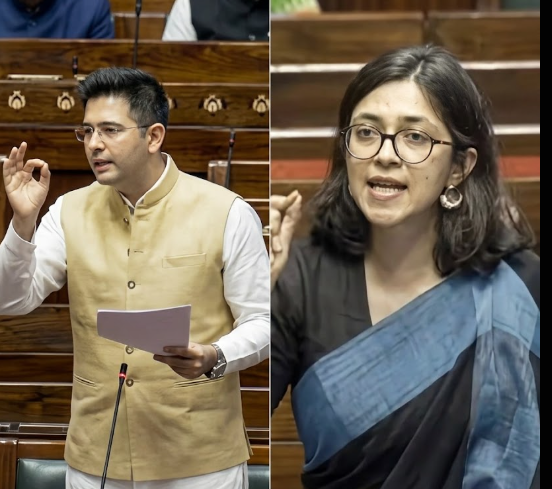
7 AAP MPs Quit, Merge with BJP
On April 24, 2026, Rajya Sabha MPs Raghav Chadha, Sandeep Pathak, and Ashok Mittal held a joint press conference in New Delhi and announced their formal departure from AAP and merger with the BJP. Chadha stated that the move covers more than two-thirds of AAP’s 10-member Rajya Sabha group, invoking constitutional provisions for a merger. Letters and signed documents were submitted to the Rajya Sabha Chairman on the same morning.
The seven MPs joining BJP are: Raghav Chadha, Sandeep Pathak, Ashok Mittal, Swati Maliwal, Harbhajan Singh, Rajinder Gupta, and Vikramjit Singh Sahney.
What Happened: The Rift That Broke AAP’s Upper House
Chadha’s Exit Triggers Exodus
The break had been building for weeks. On April 2, AAP removed Chadha as its deputy leader in the Rajya Sabha, accusing him of avoiding Opposition walkouts and engaging in “soft PR” rather than challenging the Centre in Parliament. Chadha publicly rejected all three accusations as “white lies” in a video posted to X. He had also shared an Instagram video titled “Voice Raised Price Paid,” signalling that the internal conflict had become public and irreversible.
At the press conference, Chadha was direct: “The Aam Aadmi Party, which I nurtured with my blood and sweat and to which I gave 15 years of my youth, has now completely deviated from its principles, values, and core morals. Now this party does not work in the interest of the nation but for its personal benefits. For the past few years, I could feel that I was the right man in the wrong party.”
Multiple MPs Follow Suit
Chadha confirmed that seven of the ten AAP Rajya Sabha MPs have signed and submitted merger documents to the Rajya Sabha Chairman, with Harbhajan Singh, Rajinder Gupta, Vikram Sahney, and Swati Maliwal joining Chadha, Pathak, and Mittal in the move.
Who Are the Key Leaders Involved?
The seven departing MPs represent a cross-section of AAP’s Rajya Sabha profile. Raghav Chadha, 36, was one of AAP’s most prominent national faces and a key spokesman during the Delhi elections. Sandeep Pathak was AAP’s Rajya Sabha deputy leader after Chadha’s removal. Ashok Mittal had replaced Chadha in that role. Swati Maliwal, a former Delhi Commission for Women chief, had previously been publicly at odds with the Kejriwal household. Harbhajan Singh, the former Indian Test cricketer, was one of AAP’s highest-profile Punjab appointments to the Upper House. Rajinder Gupta and Vikramjit Singh Sahney round out the seven.
Political Impact: Major Blow to AAP
Rajya Sabha Strength Gutted
AAP had 10 Rajya Sabha MPs going into today. With seven now formally merging with BJP, the party is left with just three. The constitutional two-thirds threshold invoked by Chadha is significant: under the anti-defection law, a merger of at least two-thirds of a party’s legislative group is treated as a formal merger rather than defection, meaning the MPs are not disqualified. AAP’s national legislative presence has been reduced to a rump in a single morning.
BJP Gains Strategically
The BJP absorbs seven MPs from a principal opposition party without a by-election or political cost. For the ruling party, this consolidates Upper House numbers and visibly demonstrates AAP’s internal collapse, particularly damaging given Punjab, where AAP still governs, is heading into its own electoral cycle.
Is AAP “Wiped Out”? Ground Reality
AAP retains its Punjab government under Chief Minister Bhagwant Mann, and its legislative presence in that state remains intact. Punjab Police withdrew Chadha’s Z+ security within hours of his defection, a pointed signal from Mann’s government. AAP still has MPs at the state level and a grassroots base in several cities. However, at the national parliamentary level, the party has lost its organised Upper House voice in a single stroke. Arvind Kejriwal, who only recently returned to active leadership after bail in the liquor policy case, faces the sharpest internal crisis of AAP’s 13-year existence.
Conclusion: A Turning Point for AAP Politics
This is not a routine defection. It is a constitutionally structured merger of two-thirds of AAP’s Rajya Sabha group, announced publicly, with documents already filed. For Kejriwal, it raises the central question of whether AAP can survive as a national political force or is destined to consolidate as a regional party confined to Punjab. For BJP, it is a strategic acquisition with minimum effort. The fallout will define Indian opposition politics heading into the next electoral cycle.