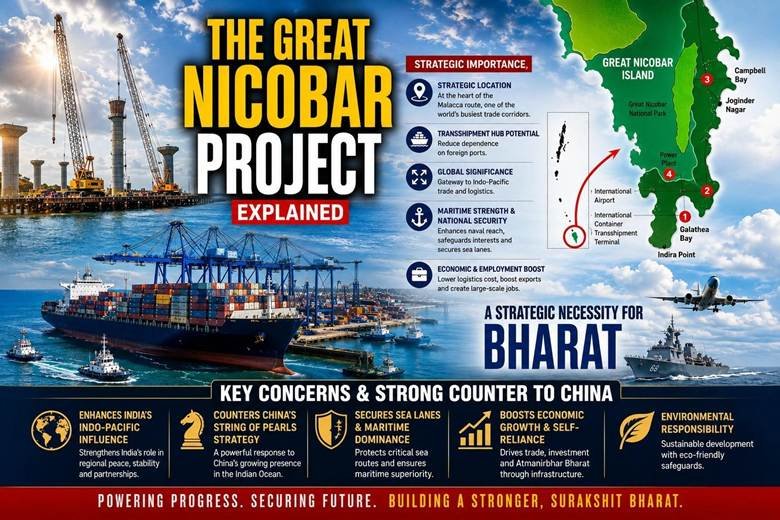
In a decisive move to secure India’s maritime future, the Central Government has officially approved a massive Rs 13,000 crore greenfield airport project on Great Nicobar Island. In a significant strategic shift, the government has decided to drop earlier plans to expand the existing INS Baaz military airbase, choosing instead to build a brand-new, world-class facility from scratch.
This decision marks a major milestone for India’s defense and economic ambitions. The new dual-use airport—designed to handle both military and civilian operations—will emerge as a key maritime focal point, strengthening India’s forward presence in the Indian Ocean Region (IOR) amidst rapidly changing global geopolitics.
Why the Shift from INS Baaz?
For years, upgrading INS Baaz—the Indian Navy’s forward operating base located at Campbell Bay—was viewed as the logical next step for island security. However, strategic planners and policymakers ultimately determined that simply extending the existing military runway would come with severe operational and spatial limits.
The government opted for a new greenfield airport for three critical reasons:
- True Dual-Use Capability: Unlike a purely military base, the new greenfield airport will be structurally designed to handle advanced military fighter jets alongside large commercial passenger and cargo aircraft.
- Future-Proof Infrastructure: Building on fresh land allows engineers to construct longer runways and modern terminal facilities without being boxed in by the geographical limitations of the current naval base.
- A Broader Economic Vision: The new airport is a foundational pillar of the larger Rs 72,000 crore Great Nicobar Holistic Development Project, which includes an International Container Transshipment Terminal (ICTT) and a new smart township. An expanded INS Baaz would simply lack the capacity to support this massive commercial vision.
Strengthening India’s “Forward Posture”
Great Nicobar Island sits at a highly strategic location, positioned just a short distance from the *Strait of Malacca*—one of the world’s busiest and most critical global trade routes. By establishing a Rs 13,000 crore mega-airport here, India is taking a proactive step to secure its maritime borders and interests.
Defense analysts note that this new facility will vastly improve India’s “forward posture.” It will allow the Indian Armed Forces to keep a closer, continuous watch on the Indian Ocean, protect essential sea lines of communication, and deploy forces rapidly during a crisis. With growing concerns over foreign naval presence and “string of pearls” strategies in the region, a fully equipped airbase at India’s southernmost tip ensures that New Delhi remains the dominant security provider in its maritime neighborhood.
A Maritime Hub for Trade and Tourism
While national security is the primary driving force behind the project, the civilian benefits are equally game-changing. The new airport is set to transform the economic landscape of the region:
- Global Cargo Connectivity: It will serve as a vital air-link for the upcoming mega transshipment port, making Great Nicobar a major hub for international trade and logistics.
- Tourism Boost: A modern, high-capacity airport will finally make the pristine Andaman and Nicobar Islands easily accessible to international and domestic tourists, creating thousands of local jobs and boosting local revenue.
- A Lifeline for Locals: Residents of the remote island will benefit from faster, highly reliable connections to mainland India, vastly improving access to emergency healthcare, education, and essential supplies.
Leveling Up: India’s Oceanic Masterplan
The clearance of the Rs 13,000 crore Great Nicobar airport project is much more than an infrastructure upgrade; it is a bold declaration of India’s maritime aspirations. By dropping the limited expansion of INS Baaz in favor of a visionary greenfield project, the government has chosen long-term regional dominance over short-term fixes.
As the project takes shape, Great Nicobar is on track to evolve from a quiet island outpost into a dynamic maritime and strategic fortress—ensuring India’s interests remain safe, secure, and prosperous for decades to come.