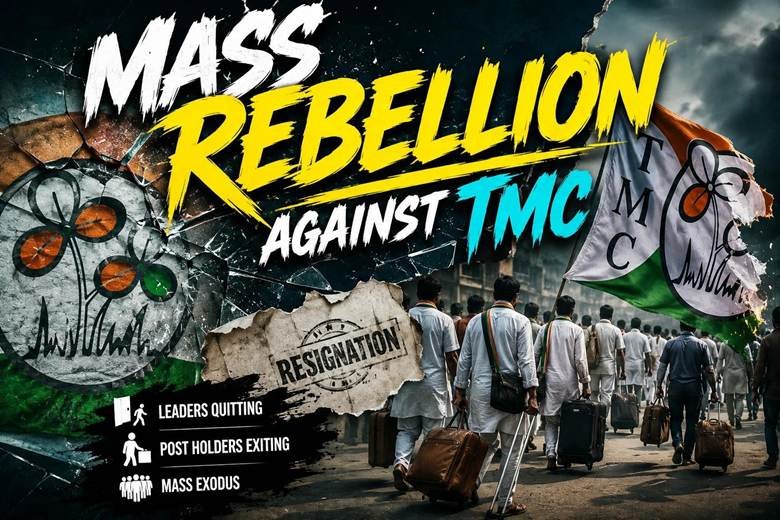
The All India Trinamool Congress (TMC) is currently facing the most severe internal crisis in its history. From local municipal councillors to Members of the Legislative Assembly (MLAs) and senior Members of Parliament (MPs), political leaders are quitting the party in a massive wave.
But why is this happening so suddenly? The reality is that this rebellion did not happen overnight. It is the result of built-up frustration, internal divisions, and recent political events.
Here is a simple and comprehensive breakdown of why there is a massive wave of exits from the TMC.
- The Shock of the 2026 Election Defeat
The primary trigger for the current mass exodus is the party’s devastating performance in the 2026 West Bengal Assembly elections. For years, the TMC appeared unbeatable in Bengal. However, after their massive loss, the party failed to look inward or reflect on its mistakes. Veteran leaders, such as recently resigned Rajya Sabha MP Sukhendu Sekhar Roy, publicly pointed out that the party showed “no introspection” after the defeat. Without a clear plan to recover, panic has set in, causing leaders to jump ship to save their political careers.
- A Shift in Power and Leadership Style
A major source of tension within the TMC is the shift in internal power. Many veteran leaders are deeply unhappy with the leadership style of National General Secretary Abhishek Banerjee. Resigning leaders, including the state Minority Cell leader Mohammed Ajmal Siddique, have cited a “dictatorial attitude” within the party’s new management. The party is clearly divided between the old guard—who are loyal to Chief Minister Mamata Banerjee—and the new leadership. Dedicated, long-serving workers feel ignored and marginalized.
- No Platform for Internal Grievances
When political leaders feel unheard, they eventually leave. Several rebel leaders have complained about a complete lack of internal democracy. Former MLA Ritabrata Banerjee, who recently led a massive breakaway group of 58 TMC MLAs to form a new opposition bloc, stated clearly: “There was no way to raise our grievances within Trinamool.” Leaders felt they had no safe space or forum within the organization to discuss political, social, or internal issues.
- The Shadow of Scandals and Unrest
The party has been heavily damaged by back-to-back controversies and public anger. The tragic R.G. Kar Hospital doctor rape and murder case sparked massive protests, and many insiders felt the party mishandled the situation. Furthermore, local-level corruption and extortion charges have ruined the party’s image on the ground. Just recently, 17 TMC councillors and local leaders were arrested. As public trust drops, politicians are distancing themselves from the party banner.
- A Complete Grassroots Collapse
This rebellion is not just happening at the top; the foundation is cracking. Over 101 local councillors across various West Bengal municipalities have resigned. Even in Diamond Harbour—the stronghold of Abhishek Banerjee—eight councillors recently quit together. When the local support system collapses, it signals deep trouble for the state-level leadership.
- The Pull of the NDA and BJP
With the TMC weakening, rival parties like the Bharatiya Janata Party (BJP) and the National Democratic Alliance (NDA) have offered a safe landing spot. The rebellion has now reached New Delhi. Around 20 of the 28 TMC Lok Sabha MPs, reportedly led by senior leader Kakoli Ghosh Dastidar, are planning to form a separate bloc to support the central NDA government. The opportunity to be on the winning side nationally is a massive attraction for leaders looking to secure their future.
Is This the End of the TMC Era?
The mass exodus in the Trinamool Congress is an explosion of poor election results, ignored complaints, leadership friction, and public scandals. From the grassroots level to the halls of Parliament, the party is struggling to keep its members together. Unless the top leadership urgently changes its working style and listens to its ground-level workers, the TMC risks losing its position as a major political force.