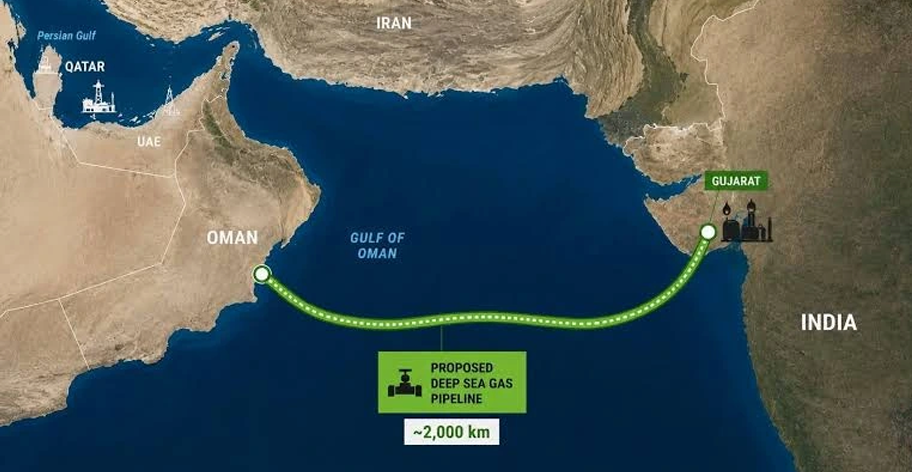
In a strategic development destined to secure India’s energy supplies in the long-term, the Gujarat-Oman undersea gas pipeline proposal gains fresh momentum amidst protracted tensions in the Gulf.
The proposed 2,000-km (1,243-miles) subsea pipeline, first conceived more than 3 decades ago, is estimated to cost nearly ₹40,000-crore ($4.8 billion), suppling natural gas directly to India from Oman across the Arabian Sea.
Also known as the Middle East-India Deepwater Pipeline, this project could potentially circumvent the strategic chokepoint of Strait of Hormuz, on which India is currently reliant for around 90% of its liquified petroleum gas (LPG) imports.
Key Details Of The Proposed Pipeline
The Middle East-India Deepwater Pipeline (MEIDP) was first proposed in 1993, under an official Memorandum of Understanding (MoU) signed between New Delhi and Muscat, to construct a subsea energy pipeline from Sur (Oman) to Gujarat (India).
Thereafter, in September 1993, initial oceanographic surveys showed a workable construction of the pipeline at depths of more than 3,000 metres (9,842 ft). If the project is successfully completed, it will be one of the world’s deepest undersea pipelines ever-built.
This highly ambitious pipeline proposal has an estimated capacity of supplying about 31 million metric standard cubic metres (MMSCMD) of natural gas per day. Around 5-7 years will be needed for the project completion once both nations gave their approval for the MEIDP.
The project is promoted by South Asia Gas Enterprise (SAGE), with Indian Public-Sector Undertakings (PSUs), including GAIL, Indian Oil Corporation and Engineers India Limited, asked to provide feasibility report of the proposed pipeline by India’s Petroleum Ministry.
Possible Hurdles In The Project
Certain challenges obstruct the development of the pipeline, that also contributed to its delay for 30-years. The depth at which the pipeline will be constructed and its subsequent maintenance raises concerns about its commercial viability.
Technical hindrances also arise due to the difficult seabed terrain and underwater pressure, where the pipeline will be laid. Additionally, the project, if further delayed, could run into cost overruns.
The funding of the MEIDP is also a barrier since capital investors mandate long-term supply contracts to de-risk their investments and ensure financial viability of the project.
Geo-Strategic Significance Of The Undersea Pipeline
Despite these challenges, the proposed project is profoundly crucial for India because it secures uninterrupted natural gas supplies, while avoiding the geopolitical chokepoint of Strait of Hormuz, that constrained India’s energy security during the Israel/USA-Iran conflict.
Therefore, the project also safeguards India against any future conflict in the region, concurrently advancing New Delhi’s relations with the Gulf countries.
Consequently, India will be energy secure, with reduced dependence on the volatile maritime corridors as well as shipping tankers.
Lastly, natural gas supply through the pipeline will also save New Delhi billions of dollars since LPG imports needed complicated liquefaction and re-gasification processes.
This proposed pipeline could lead to a greater undersea pipeline project, connecting India to other Gulf countries of UAE, Saudi Arabia and Qatar, safeguarding India’s energy security.