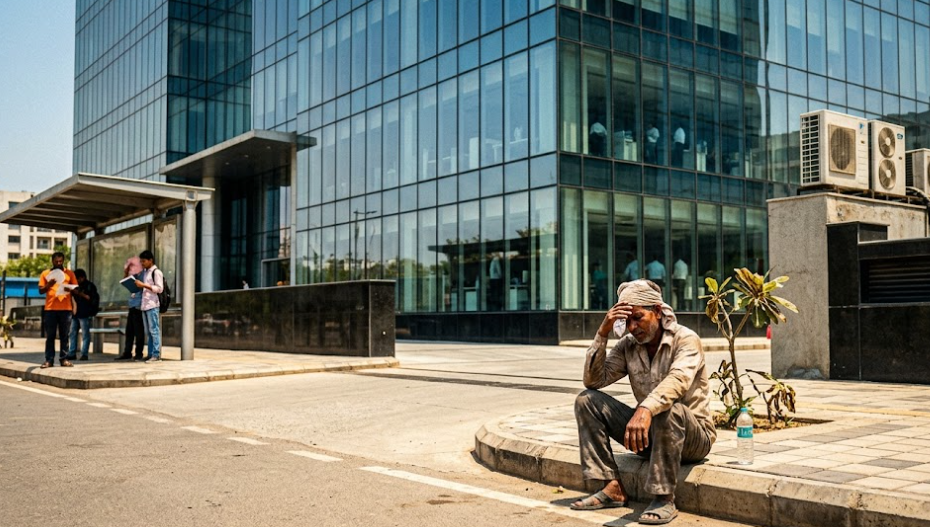
As summer temperatures soar to record-breaking highs across India, a silent crisis is unfolding on our city streets. Indian cities are undergoing a rapid transformation, marked by the explosive rise of massive corporate buildings, commercial parks, and glass towers. While these structures are celebrated as symbols of economic growth, they hide a dark and uncomfortable reality: the complete disappearance of public resting spaces.
For the millions of everyday citizens who work, walk, and commute under the harsh sun, finding a simple patch of shade has become an everyday struggle. In our sweltering cities, relief from the extreme heat is no longer a basic right—it has become a luxury.
The Hidden Inequality of Urban Design
Modern urban design in India is exposing a deep and hidden inequality. If you walk through affluent neighbourhoods or high-end corporate districts, you will find well-maintained gardens, tree-lined avenues, and climate-controlled environments.
However, step into the busy public streets, and the picture changes entirely. For the masses—street vendors, delivery personnel, daily wagers, and regular commuters—there is almost no respite from the blazing sun. Shade is unevenly distributed, kept safely within wealthy enclaves, while the common man is left to survive in a concrete furnace with no place to sit, rest, or cool down.
Corporate Buildings and the “Heat Island” Effect
The rapid construction of giant corporate buildings has directly worsened this crisis. To build these massive structures, natural green cover and old shade-giving trees are often butchered. They are replaced with concrete, asphalt, and glass—materials that heavily absorb and trap the sun’s heat.
This creates what environmental experts call an “Urban Heat Island.” Because of this trapped heat, Indian city centres are now running 2°C to 10°C hotter than their surrounding rural areas.
There is also a bitter irony in this development. These towering glass buildings rely on thousands of heavy-duty air conditioners to keep indoor temperatures comfortable. Paradoxically, while they cool the privileged office workers inside, these machines pump massive amounts of hot waste air directly onto the streets, making the outdoors even more unbearable for the poor who have nowhere else to go.
The Human Cost of Missing Rest Spaces
The lack of resting places is not just a matter of discomfort; it is a severe public health and economic crisis. India relies heavily on its informal sector, meaning millions of people have no choice but to work outdoors.
Without shaded spots to sit, drink water, or catch their breath, outdoor workers face severe dehydration, exhaustion, and fatal heatstrokes. Recent studies have shown that outdoor workers exposed to extreme heat in Indian cities are facing up to a 45% drop in productivity. They are taking longer to finish tasks and are losing daily wages due to heat-related illnesses. Bus stops lack proper roofs, footpaths are fully tiled over, and the traditional roadside trees that once acted as natural umbrellas are gone.
Concretisation: The Silent Killer
In our race to build “world-class” cities, we have paved over the earth. Concretisation is suffocating our urban spaces. When every inch of the ground is covered in cement or pavement blocks, the soil cannot cool down naturally, and groundwater cannot recharge. Instead of slow, thoughtful urban planning that uses porous materials and creates shaded public walkways, city planning has focused entirely on making room for more cars and bigger buildings.
The Path Forward: What Needs to Change?
Building a modern city should never mean sacrificing the health and well-being of its people. To fix this urgent crisis, city planning must change immediately:
- Mandatory Public Shade: Corporate developers should be legally required to build and maintain accessible, shaded public resting areas around their large properties.
- Reclaiming Green Cover: Municipalities must stop the endless cutting of trees. Planting wide, native shade-giving trees must be prioritized over planting small, decorative shrubs that offer no relief from the sun.
- Smart Urban Materials: Cities need to enforce the use of reflective building materials that do not trap heat.
- Worker Protection: Outdoor workers and delivery agents need official guidelines that guarantee access to shaded resting zones and clean drinking water during the peak heat hours of the afternoon.
Redefining Growth: Why Our Cities Need to Breathe
A truly great city is not measured by the height of its corporate skyscrapers or the chill of its indoor air conditioning. It is measured by how it treats its most vulnerable citizens. As temperatures continue to climb year after year, providing accessible, shaded resting spaces is no longer optional—it is a matter of basic human survival. It is time we redesign our cities to offer a place to rest for everyone, not just those who can afford it.