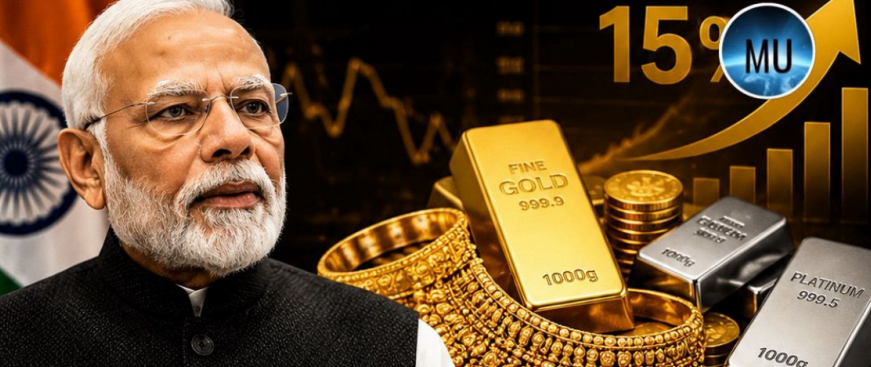
The Government of India has announced higher import duties of 15% on gold, silver, platinum
and jewellery components (earlier 6%), in effect from May 13, 2026, in order to shield the Indian
economy.
This move comes amidst the geopolitical concerns of a renewed US/Israel-Iran war in West Asia,
after the American President Donald Trump refuted the peace plan proposed by Iran.
Apprehensions stem from the long-term blockade of the Strait of Hormuz, which has disrupted
supply chains and wreaked havoc in the global trade.
The vicious cycle of economy
India aims to safeguard its economy from oil price shocks and obstruct any further depreciation
of Indian Rupee because it directly leads to inflation in the domestic markets, which causes
capital flight from the Indian economy.
The outgoing Foreign Institutional Investors (FIIs), again weaken the Rupee, where the Reserve
Bank of India (RBI) steps in to arrest the fall by releasing US Dollar from the foreign exchange
reserves. It strains the reserves and enlarges the trade deficit further since the value of imports
rises.
Hence, this creates a vicious cycle, which the Government of India is attempting to tackle in
order to prevent an economic crisis.
Constituents of the import duty
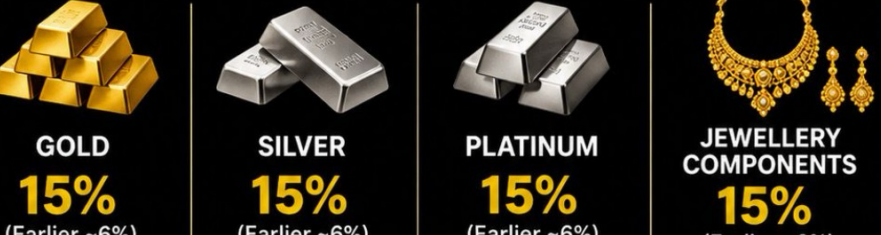
The import duty comprises 10% Basic Customs Duty (BCD) and 5% Agriculture Infrastructure
and Development Cess (AIDC), which brings the total tax amount to 15%.
The previous import duty of 6% had consisted of 5% BCD and 1% AIDC, which now stands
increased.
PM Modi’s back-to-back appeal to avoid purchasing gold
Prime Minister Narendra Modi, in both his Hyderabad and Vadodara addresses, appealed to the
general public to postpone buying gold for one year to reduce pressure on India’s forex reserves,
where he said, “Gold imports consume a large amount of foreign exchange. In the national
interest, we should avoid purchasing gold for one year.”
As a result, albeit a minuscule drop, the 24-carat gold futures had fallen by Rs 390 on the Multi
Commodity Exchange on May 11.
Further, PM Modi had appealed for using public transportation and electric vehicles, limit nonessential foreign travel, opt for organic farming and shift to work-from-home and online school
classes to ease the forex burden on Indian exchequer by reducing fuel imports
Reasons behind the policy-decision
India’s massive gold imports
In FY26, India imported nearly $72 billion worth of gold, a 25% jump from the previous financial
year (see table). Although the total volume of gold imported declined by 4.76%, the import bill
grew due to rising gold rates, which increased by 40% last year.
The following table showcases the upward trend in gold imports by India:
Financial Year (FY) Imports ($Bn) Quantity (Tonnes)
FY26 71.97 721.04
FY25 58 757.09
FY24 45.54 795.32
FY23 35.01 678.3
(Source: Ministry of Commerce and Industry)
More imports equals more outflow of forex making gold the second-most imported commodity
after oil. It puts inflationary pressure on Indian economy because it increases the trade deficit
and weakens the Indian Rupee, as explained ahead.
Treaty with UAE
India-United Arab Emirates (UAE) bilateral Comprehensive Economic Partnership Agreement
(CEPA), signed in 2022, has also led to a surge in gold imports from the UAE owing to the
concessions given by India on the imports of finished bullion from UAE.
As per the “Strategic Acquisition and Value Addition of Gold Resources for India” working paper
by IIIM Ahmedabad, “the UAE trade deal agreement has inadvertently incentivised bullion
imports over doré by creating a more favourable tariff structure for the former,” raising the gold
import bill.
Geopolitical costs
The current crisis in Gulf has skyrocketed Brent crude prices globally, where one barrel of crude
oil is trading at $106–$107 per barrel as of May 13, 2026. This negatively affects Indian economy
as India imports nearly 85% of its crude oil.
A weak Rupee makes these hydrocarbon imports costlier, causing inflation domestically.
Therefore, the hiked bullion import tax eases the burden on forex, making room for indispensable
fuel imports by keeping the value of Rupee stable due to lower imports of gold.
Widening trade deficit
Forex reserves are also stressed due to the ever-increasing trade deficit of India. The
International Monetary Fund (IMF) has projected India’s Current Account Deficit (CAD) to widen
to 2% of Gross Domestic Product (GDP) in FY27, which is equivalent to $84.5 billion in value.
CAD refers to the economic situation where a country imports more goods and services than
what it exports. In simple terms, CAD occurs when imports exceed exports, adversely affecting
the country’s balance of payments account, that is trade imbalance with other nations.
Soaring oil prices and a weakened Rupee pressurise the CAD, bringing about food and fuel
inflation, which harms households’ savings and yields less investments (both domestic and
foreign). Consequently, this lowers India’s economic growth. Thus, the government measure for
raising bullion import duties to cede stress on the CAD by curbing the forex outflow.
Depreciating Indian Rupee
West Asian geopolitical tensions have dealt a blow to the Indian Rupee, that currently stands at a
historic low of ₹95.72 per USD, exerting pressure on the foreign exchange (forex) reserves used
to arrest the Rupee’s fall. The Iran war has propelled capital flight to the US Dollar (USD),
weakening the Rupee since demand for Rupee fell vis-a-vis the USD.
Bullion imports further lower the demand for Indian Rupee as most of it is imported (as seen
above) and paid for in USD. So, in order to prevent further depreciation of Rupee, hiking import
duties on gold and silver is a practical step.
Impact on the bullion market
In the short run, jewellery companies may face decline in sales as the import tax will increase the
bullion rates, leading to less purchases. However, as gold is often necessary in Indian traditions,
in the long term, at least the gold purchases might remain relatively stable.