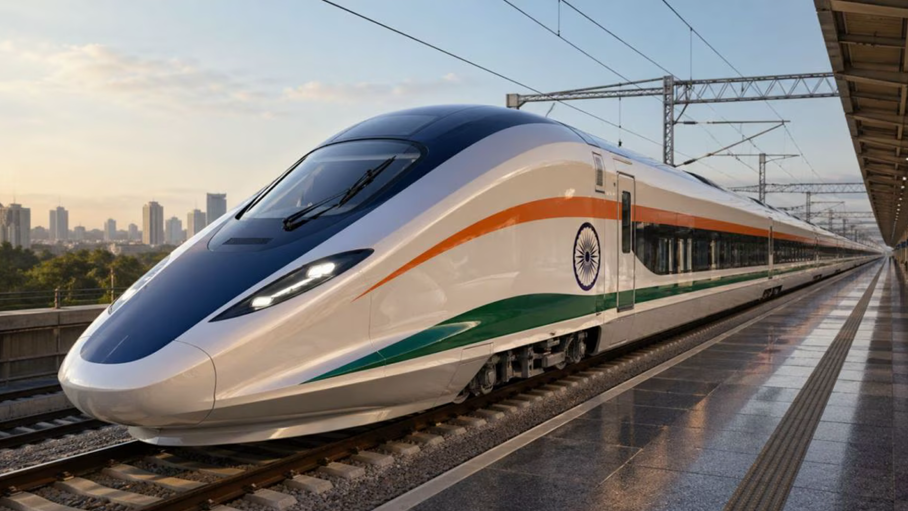
In a major boost to Make in India and Atmanirbhar Bharat, India’s first indigenous bullet train—B28 (Bharat-made Bullet, 280 kmph)—has entered production at Bharat Earth Movers Limited’s Aditya plant in Bengaluru. The development marks a significant step forward in India’s ambition to achieve self-reliance in high-speed rail technology.
BEML Aditya Plant Inaugurated
The Aditya train-set manufacturing facility at BEML’s Tippasandra campus in Bengaluru was inaugurated on April 25 by Union Railway Minister Ashwini Vaishnaw.
Vaishnaw highlighted that the plant has been established specifically for the development and production of B28 coaches, praising India’s growing capability in handling complex high-speed rail engineering.
Collaboration with Integral Coach Factory
The B28 project is being jointly developed with Integral Coach Factory in Chennai. In October 2024, the ICF awarded BEML a contract worth ₹866.9 crore to design, manufacture, and commission two high-speed train sets (8 cars each).
Project Timeline
According to the Ministry of Railways:
- The first prototype is expected by Q1 2027
- Trials and testing will follow
- Commercial deployment is targeted for August 2027
Initial Deployment Route
The B28 will initially operate on the Surat–Vapi stretch (97 km) as part of the Mumbai-Ahmedabad High-Speed Rail Corridor—India’s flagship bullet train project.
Key Features of B28 Bullet Train
- Designed speed of 280 kmph, operational speed of 250 kmph
- Microprocessor-controlled braking systems for enhanced safety
- Pressurised cabins for smoother high-speed tunnel travel
- Passenger capacity of over 500
- Built specifically for the Mumbai–Ahmedabad corridor
Strategic and Geopolitical Significance
The B28 project is not just an engineering milestone—it carries significant strategic and geopolitical importance.
In a global environment where technology access and supply chains can be weaponised—such as disruptions in key routes like the Strait of Hormuz—developing indigenous capabilities reduces India’s dependence on foreign technology.
The project strengthens:
- Technological sovereignty in high-speed rail
- Domestic manufacturing ecosystems
- Supply chain resilience
It also contributes to:
- Job creation
- Reduced import dependency
- Improved balance of payments
Economic and Global Impact
Beyond domestic benefits, the B28 opens doors for India to:
- Participate in international rail infrastructure projects
- Expand its global soft power
- Attract foreign and domestic investment in rail technology
Transforming Mobility in India
As highlighted by Ashwini Vaishnaw, high-speed rail has the potential to transform connectivity by making cities feel like extensions of each other.
For instance, the proposed Chennai–Bengaluru bullet train corridor could reduce travel time to just 73 minutes, significantly boosting economic integration and mobility.