
Introduction
The stock market is home to thousands of companies across different sectors, sizes, and growth stages. To help investors make sense of this vast universe, stocks are classified into four major categories based on their Market Capitalization Small-Cap Mid-Cap Large-Cap and Blue-Chip.
Each category carries a distinct risk profile, growth potential, dividend yield, and suitability for different types of investors. Understanding these categories is not just useful it is essential for anyone who wants to invest with clarity and purpose.
Why This Classification Matters
- Helps investors build diversified portfolios that balance growth and stability across market cycles.
- Allows for better risk management by aligning investments with personal risk appetite and financial goals.
- Enables meaningful comparison between companies of different sizes and sectors.
- Forms the foundation of mutual fund categories, index construction, and institutional portfolio mandates.
- Gives beginners a clear framework for deciding where to start their investment journey.
Common Beginner Mistakes
Many beginners assume a high share price means a large company this is incorrect. A company’s share price alone says nothing about its size. Market Cap is what determines size.
Another common mistake is treating Large-Cap and Blue-Chip as synonyms. They are related but distinct. Large-cap is a measure of size. Blue-chip is a measure of quality and track record.
What Is Market Capitalization?
Definition
Market Capitalization commonly shortened to Market Cap is the total market value of all outstanding shares of a company. It is the most widely accepted measure of company size, used by investors, analysts, fund managers, and regulators worldwide.
The Formula
Market Cap = Share Price × Total Outstanding Shares
Worked Example
Company A has 10 crore shares outstanding, and the current share price is ₹500.
Market Cap = ₹500 × 10 crore = ₹5,000 crore → Mid-Cap
Now consider Company B with a share price of ₹2,000 but only 20 lakh shares. Its market cap is just ₹400 crore making it a small-cap, despite the high share price. This is the most important concept to internalize: share price does not equal company size.
SEBI Market Cap Categories (India)
| Category | Market Cap Range | SEBI Classification | Approx. No. of Companies |
| Large-Cap | Above ₹20,000 Cr | Top 100 by market cap | ~100 |
| Mid-Cap | ₹5,000 – ₹20,000 Cr | 101st–250th by market cap | ~150 |
| Small-Cap | Below ₹5,000 Cr | 251st onward by market cap | 5,000+ |
Note: Blue-Chip is not a SEBI-defined category. It is a qualitative label used by investors and analysts to identify the highest-quality companies within the large-cap space.
Why Market Cap Matters More Than Share Price
- Share price can be adjusted through stock splits and bonus issues without changing the company’s actual value.
- Market cap gives a true picture of how much the public market believes the company is worth.
- It allows fair comparison between companies across industries even if their share prices are vastly different.
- Institutional investors use market cap to determine portfolio weightage and position sizing.
Blue-Chip Stocks

Definition & Origin
The term ‘blue chip’ originates from poker, where blue chips hold the highest value at the table. Applied to investing, blue-chip stocks are shares of companies that are financially robust, nationally or globally recognized industry leaders with a long and consistent record of earnings, dividends, and stability across economic cycles.
These are businesses that have survived recessions, market crashes, and decades of competitive pressure and have consistently delivered value to shareholders throughout. Blue-chip status is not given; it is earned over decades.
Key Characteristics
- Market Leadership: Dominant players in their sector often holding the #1 or #2 position by revenue or profit.
- Consistent Earnings: Generate profits reliably year after year, including during recessions and economic downturns.
- Regular Dividends: Have a strong, unbroken history of paying and often growing dividends to shareholders.
- Strong Balance Sheets: Low or well-managed debt, healthy cash flows, and robust profit margins.
- High Investor Trust: Held by mutual funds, insurance companies, pension funds, and FIIs as core long-term positions.
- Index Membership: Almost always part of major indices like Nifty 50 or BSE Sensex.
- High Liquidity: Among the most actively traded stocks easy to buy and sell in large quantities without price impact.
Advantages
- Capital Safety: The relative stability of the business protects investors from catastrophic price declines.
- Reliable Passive Income: Regular, growing dividends provide consistent cash flo ideal for income-seeking investors.
- Low Emotional Stress: Smaller price swings allow investors to hold comfortably through market downturns.
- Transparent & Researched: Extensive analyst coverage and public information makes evaluation straightforward.
- Compounding Power: Reinvesting dividends from blue-chips over decades can create substantial compounding wealth.
Disadvantages
- Slower Capital Growth: Already mature and large limited room for the kind of explosive growth smaller companies offer.
- Premium Valuations: Often trade at high P/E ratios, meaning you pay a premium for the quality and stability.
- Underperform in Bull Markets: During aggressive rallies, mid and small-caps typically outperform blue-chips significantly.
Best Suited For
- Conservative investors who prioritize capital safety above all else.
- Retirees or near-retirement individuals seeking reliable dividend income.
- Long-term investors building a retirement corpus through disciplined investing.
- First-time investors who want a low-risk entry into equity markets.
Indian Examples (Illustrative)
Companies commonly cited as blue-chip in India include Reliance Industries, Tata Consultancy Services (TCS), HDFC Bank, Infosys, Hindustan Unilever (HUL), ITC, Asian Paints, Bajaj Finance, and Larsen & Toubro. This is illustrative not investment advice.
Large-Cap Stocks

Definition
Large-cap stocks represent companies with a market capitalization above ₹20,000 crore the top 100 companies in India by market cap as per SEBI’s classification. These are well-established businesses with broad market presence, strong revenues, and deep institutional participation. They are the economic heavyweights of the stock market and form the anchor of most indices.
Key Characteristics
- Financial Stability: Strong balance sheets, robust cash flows, and manageable debt levels.
- Lower Volatility: Price movements are comparatively muted they don’t spike or crash as dramatically as smaller companies.
- High Institutional Ownership: FIIs, DIIs, mutual funds, and insurance companies hold significant positions, adding stability.
- Extensive Analyst Coverage: Dozens of research teams track every announcement, making these stocks highly transparent.
- Easy Liquidity: High daily trading volumes mean investors can enter and exit positions smoothly.
Advantages
- Stable, Predictable Returns: Grow steadily in line with the broader economy over the long term.
- Safer During Downturns: Fall less than mid and small-caps in market corrections and recover faster.
- Beginner-Friendly: Lower volatility, greater information availability, and index fund options make them accessible.
- Index Funds: Nifty 50 and Nifty 100 index funds offer low-cost, diversified large-cap exposure.
Disadvantages
- Limited High-Growth Potential: Already large and mature cannot grow at the same percentage rates as smaller companies.
- Underperform in Strong Bull Markets: Mid and small-caps often outperform large-caps significantly during rallies.
- Crowded Trade: Many investors already hold large-caps, reducing the chance of finding significantly undervalued opportunities.
Investment Approach
Large-caps work well for both lump-sum and SIP investments. For most investors, a low-cost Nifty 50 or Nifty 100 index fund is the most efficient and cost-effective way to get diversified large-cap exposure without needing to pick individual stocks.
Mid Cap Stocks

Definition
Mid-cap stocks are shares of companies with market capitalization between ₹5,000 crore and ₹20,000 crore roughly the 101st to 250th largest companies in India. These companies have survived the risky early stages of business but have not yet reached the scale or stability of large-caps. They are in the active expansion phase of their lifecycle.
The Sweet Spot of Investing
Mid-caps are often called the ‘sweet spot’ of equity investing because they balance two extremes. They have demonstrated enough business viability to reduce existential risk, while still having significant room for growth. Many of India’s most celebrated large-cap companies Bajaj Finance, Avenue Supermarts, Titan, Asian Paints were mid-caps not long ago. Investing in the right mid-cap before that transition is how substantial wealth is created.
Key Characteristics
- Expansion Phase: Actively growing revenues, entering new markets, scaling operations, and capturing market share.
- Improving Fundamentals: Revenue and profitability trending upward, though not yet as consistent as large-caps.
- Moderate Volatility: More price movement than large-caps, but far less extreme than small-caps.
- Rising Analyst Coverage: Increasingly tracked by institutional investors as the company grows in relevance.
Advantages
- Wealth Creation Potential: Successfully identified mid-caps growing into large-caps can deliver 3x 10x returns over a decade.
- Early Mover Advantage: Invest in future leaders before they become household names and expensive.
- Better Risk-Reward: More upside than large-caps without the extreme uncertainty of small-caps.
- Strong Mutual Fund Coverage: Many well-managed mid-cap funds allow retail investors to participate professionally.
Disadvantages
- Economic Sensitivity: More vulnerable to interest rate changes, slowdowns, and sector-specific headwinds than large-caps.
- Execution Risk: Growth plans may fail due to competition, management gaps, or capital constraints.
- Steeper Falls in Bear Markets: Can fall 40–60% in severe downturns compared to 20–35% for large-caps.
Best Investment Approach
SIP (Systematic Investment Plan) is the most effective strategy for mid-cap investing. By investing a fixed amount monthly, you automatically buy more units when prices are low and fewer when prices are high this is called Rupee Cost Averaging. It removes the pressure of timing the market and smooths out the impact of volatility over time.
Small-Cap Stocks

Definition
Small-cap stocks are shares of companies with market capitalization below ₹5,000 crore the 251st company onward in India. These are typically smaller, often niche businesses in early or growth stages. They carry the highest potential returns of any stock category, but also the highest risk of permanent capital loss.
The High-Risk, High-Reward Proposition
Small-cap investing is a search for hidden gems companies that are small today but could grow into significant businesses over the next decade. This is where ‘multibagger’ stocks originate companies that return 2x, 5x, or even 10x the original investment. However, for every multibagger, there are many small-cap companies that fail, stagnate, or cause major losses. The challenge and skill lies in identifying the winners early.
Key Characteristics
- High Growth Ambition: Targeting disruptive or emerging niches where they can scale rapidly if successful.
- High Volatility: Price swings of 10–20% in a single session are not unusual. Downturns of 60–80% are possible.
- Limited Analyst Coverage: Few research analysts track small-caps creating information gaps that are both a risk and opportunity.
- Low Liquidity: Thin trading volumes mean it can be difficult to buy or sell large quantities at desired prices.
- Management Risk: The company’s trajectory is often tightly tied to the decisions and integrity of key founders or promoters.
Advantages
- Multibagger Potential: The highest return potential of all categories exceptional wealth creation is possible.
- Early Investment Advantage: Get in before institutional investors notice and drive up the price.
- Undervaluation Opportunities: Limited coverage means prices can lag fundamentals, creating genuine bargains.
- Agility: Smaller companies can pivot faster, adapt quicker, and innovate more freely than large firms.
Disadvantages
- High Capital Loss Risk: Many small-caps never realize their potential. Permanent loss of capital is a real possibility.
- Liquidity Risk: In market panics, small-cap stocks can become very difficult to sell at any reasonable price.
- Governance Risk: Weaker oversight structures increase the risk of fraud, mismanagement, or promoter misconduct.
- Research Intensive: Identifying good small-caps requires deep fundamental analysis not suitable for passive investors.
- Emotional Difficulty: Watching a holding fall 40–50% requires extraordinary conviction and patience to hold through.
Who Should Invest in Small-Caps?
Small-cap investing suits investors who have a high risk tolerance, a stable financial situation, a minimum 7–10 year investment horizon, the ability to conduct or access deep research, and the emotional discipline to hold through major volatility. Small-caps should form only a carefully sized portion of a diversified portfolio never the whole.
Blue Chip vs. Large Cap The Key Distinction

This is one of the most misunderstood concepts in equity investing. Many investors use these terms interchangeably — but they measure fundamentally different things.
The Core Difference
Large-Cap = How BIG the company is | Blue-Chip = How GOOD the company is
Large-cap is a purely quantitative measure a company qualifies simply because its market cap exceeds ₹20,000 crore. It says nothing about the quality, consistency, or trustworthiness of the business.
Blue-chip is a qualitative distinction earned through decades of consistent financial performance, market leadership, dividend payments, and investor trust. You cannot become a blue-chip overnight it takes 15–20+ years of proving yourself across economic cycles.
The Relationship
- Most blue-chip companies ARE large-cap decades of strong performance naturally produces a large market cap.
- NOT all large-cap companies are blue-chip a recently large company may lack the track record needed for blue-chip status.
- A company can enter the large cap club quickly (e.g., a high-valued IPO) but cannot earn blue-chip status quickly.
What Earns Blue-Chip Status?
- 15–20+ years of consistent, growing profitability across economic cycles including recessions.
- An unbroken history of paying and growing dividends to shareholders.
- A dominant, defensible market position that competitors struggle to challenge.
- Trusted, experienced management with strong corporate governance and transparency.
- A recognized and trusted brand among consumers, investors, and institutions alike.
Practical Implication
When building a portfolio, simply buying all large-cap stocks does not guarantee blue-chip quality. If your goal is maximum stability and income, evaluate each large-cap holding against the blue-chip criteria above. If your goal is broad market exposure, a Nifty 50 index fund covering all large-caps is more appropriate and cost-effective.
Side-by-Side Comparison
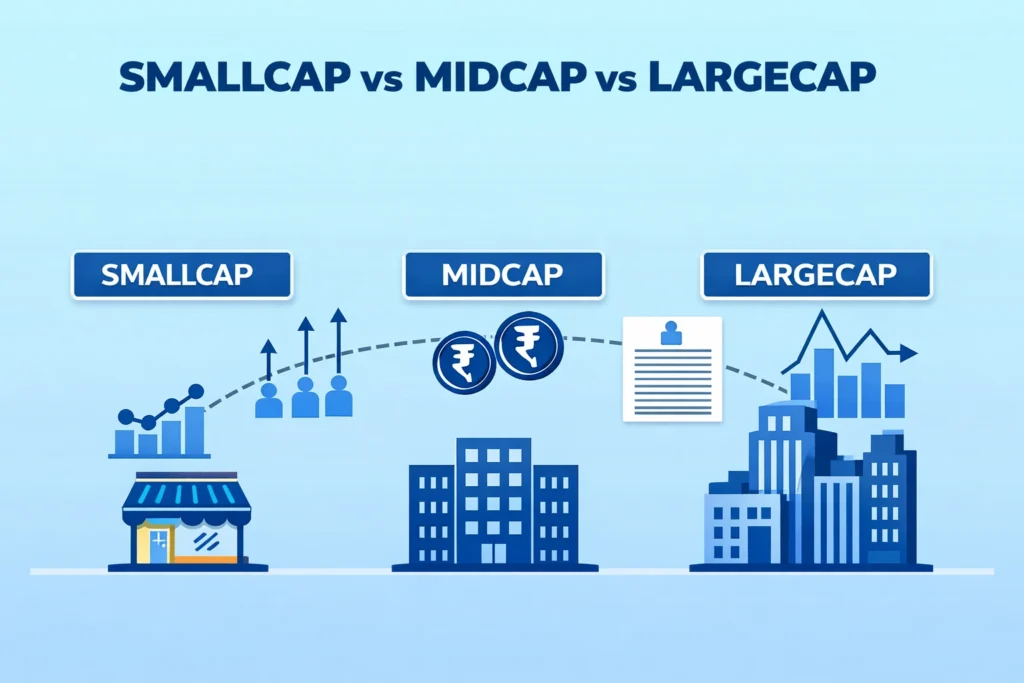
The table below summarizes the key differences across all four stock categories to help you quickly assess which category suits your needs:
| Feature | Blue-Chip | Large-Cap | Mid-Cap | Small-Cap |
| Market Cap (India) | Usually >₹20K Cr | >₹20,000 Cr | ₹5K–₹20K Cr | <₹5,000 Cr |
| Stability | Very High | High | Medium | Low |
| Growth Potential | Moderate | Moderate | High | Very High |
| Risk Level | Very Low | Low | Medium | High |
| Dividend Yield | High & Consistent | Moderate | Low | Rare |
| Volatility | Very Low | Low | Medium | High |
| Liquidity | Very High | High | Moderate | Low |
| Analyst Coverage | Extensive | Extensive | Moderate | Limited |
| Institutional Hold | Very High | High | Moderate | Low |
| Bear Market Fall | 10–25% | 15–35% | 30–55% | 50–80% |
| Ideal Hold Period | 10+ years | 7+ years | 5–10 years | 7–10+ years |
| Ideal Investor | Conservative | Conservative | Moderate | Aggressive |
Goal-Based Investment Strategy
Every investor is different. Age, income, existing assets, financial obligations, and personal comfort with risk all shape the right investment approach. Here is a practical, goal-based framework to help you decide:
Capital Preservation Blue-Chip Focus
If your primary goal is to protect accumulated wealth for a child’s education, a home purchase, or approaching retirement — blue-chip stocks should dominate your equity allocation. Their stability, dividends, and low downside risk are purpose-built for capital preservation goals.
Steady Long-Term Growth Large-Cap / Index Funds
If you want reliable, market-linked returns over 10–15 years without taking excessive risk, large-cap stocks or Nifty 50 index funds are the most sensible approach. They grow with the economy, require minimal management, and are broadly diversified. This strategy works well for most middle-class investors building a retirement corpus.
Wealth Multiplication Mid-Cap + Small-Cap Mix
If your goal is to grow wealth aggressively from a younger starting point, mid and small-cap stocks offer the return potential needed. This requires patience (7–10+ years), emotional resilience, and ideally a systematic approach through SIP. The payoff for those who stay disciplined can be exceptional.
Passive Income Blue-Chip Dividend Stocks
For investors seeking a regular income stream from their equity holdings, dividend-paying blue-chip stocks are the best option. Over years, as dividends grow alongside profits, this can become a meaningful and reliable income source often superior to fixed deposits on a post-tax basis over the long term.
Balanced Portfolio Mix of All Four
For most investors, a thoughtfully weighted combination of all four categories creates the most resilient, all-weather portfolio. You benefit from the stability of large-caps in bad times and the growth of mid and small-caps in good times — without being fully exposed to the extremes of either.
Ideal Portfolio Allocation Models
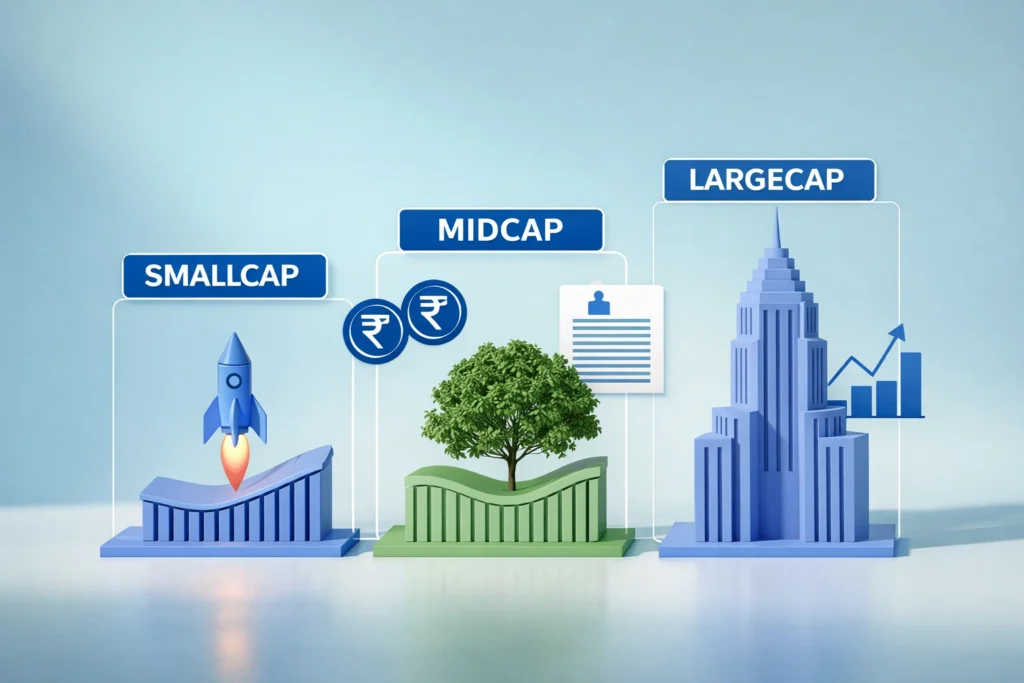
Here are three model portfolio frameworks based on risk appetite. These are starting-point guidelines — actual allocations should be personalized based on your age, income stability, financial obligations, and investment goals.
| Risk Profile | Blue-Chip & Large-Cap | Mid-Cap | Small-Cap | Primary Goal |
| Conservative (Age 50+) | 65% | 25% | 10% | Safety + Dividend Income |
| Moderate (Age 35–50) | 45% | 35% | 20% | Balanced Growth + Stability |
| Aggressive (Age 20–35) | 30% | 35% | 35% | Maximum Wealth Creation |
The Age-Based Thumb Rule
% in Blue-Chip & Large-Cap ≈ Your Age | % in Mid + Small-Cap ≈ 100 minus Your Age
A 30-year-old might hold 30% in large/blue-chip and 70% in mid/small-cap. A 60-year-old might reverse this 60% large/blue-chip, 40% mid/small. This is a general guideline, not a rigid formula.
Annual Rebalancing
Portfolio allocation is not a set-and-forget exercise. Over time, a category that has performed well will constitute a larger share than intended. Annual rebalancing trimming the over-represented category and topping up the under-represented one keeps your risk level in check and enforces the discipline of buying relatively low and selling relatively high.
Running SIPs Across Categories
Setting up separate monthly SIPs into large-cap, mid-cap, and small-cap funds is the most practical way to maintain allocation over time. This automates discipline, ensures you invest consistently regardless of market conditions, and leverages rupee cost averaging to reduce the impact of volatility.
Smart Investing Principles

These principles apply universally across all market cap categories and are backed by decades of investment wisdom:
Diversify Intelligently
Never concentrate all your capital in one category, sector, or stock. A well-diversified portfolio across market caps, sectors, and asset classes (equity, debt, gold) reduces the impact of any single investment failing without significantly reducing overall long-term returns.
Focus on Fundamentals
Always evaluate companies based on their business model, revenue growth, profit margins, return on equity, debt levels, and management quality regardless of market cap category. A poor-quality large-cap is a worse investment than a high-quality mid-cap. Category is context; fundamentals are the content.
Think Long Term
Equity markets are volatile in the short term but have consistently rewarded patient, disciplined investors over the long term. The power of compounding works most powerfully over 10, 15, or 20-year periods. Short-term price movements are noise — business value growth over time is the signal that matters.
Control Your Emotions
The biggest destroyer of investment returns is investor behavior buying during euphoria and selling during panic. Develop the discipline to hold through downturns (especially in mid and small-caps) and to continue investing consistently even when markets feel frightening. The best returns are often earned by those who do the least.
Keep Costs Low
Investment fees compound just like returns — but against you. For large-cap exposure, low-cost index funds (expense ratios of 0.10–0.20%) are almost always superior to expensive active funds over long periods. For mid and small-cap active funds, ensure the expense ratio is reasonable relative to long-term performance.
Never Invest Money You Cannot Lock Away
Equity especially mid and small-cap equity requires time to deliver returns. Never invest your emergency fund, short-term savings, or money needed within 2–3 years in equity markets. Always maintain a separate emergency fund of 6–12 months of expenses in a liquid, safe instrument before beginning equity investing.
Review Annually, Not Daily
Checking your portfolio every day leads to emotional decision-making based on noise rather than signal. Daily price movements are largely meaningless for long-term investors. Review your portfolio quarterly to assess fundamentals, and conduct a comprehensive rebalancing review once a year. This discipline protects your returns from your own worst impulses.
Frequently Asked Questions
Q1. What is the difference between small-cap, mid-cap, and large-cap stocks?
Small-cap stocks (below ₹5,000 Cr) are smaller companies with high growth potential but high volatility and risk. Mid-cap stocks (₹5,000–₹20,000 Cr) are in the expansion phase offering a balance of growth potential and reasonable stability. Large-cap stocks (above ₹20,000 Cr) are established companies providing stable, predictable returns with lower risk.
Q2. Are blue-chip stocks the same as large-cap stocks?
No. Large-cap is a size classification based on market cap. Blue-chip is a quality classification based on decades of consistent earnings, dividends, and leadership. While most blue-chips are large-cap, many large-cap companies are not blue-chip because they lack the long track record and quality indicators that blue-chip status requires.
Q3. Which stocks are best for beginners?
Blue-chip and large-cap stocks or a Nifty 50 index fund are ideal for beginners. They offer lower volatility, transparent information, strong institutional backing, and an easy-to-evaluate track record. Once comfortable, beginners can gradually add mid-cap exposure, and eventually small-caps if their risk tolerance warrants it.
Q4. Do small-cap stocks always give higher returns?
Not always. While small-cap stocks carry the highest return potential, they also carry the highest risk. In reality, most small-cap companies underperform or fail. Only a small fraction deliver the exceptional multibagger returns that attract investors to the category. Patience, research, and diversification are essential to succeed.
Q5. Are mid-cap stocks good for long-term investing?
Yes mid-cap stocks can be outstanding long-term wealth creators. Many of today’s large-cap leaders started as mid-caps. Investing in quality mid-caps during their expansion phase and staying invested through the growth journey can generate significant returns. A minimum 7–10 year horizon and SIP discipline are key.
Q6. Which stocks are best for dividend income?
Blue-chip and large-cap stocks are best for dividend income. They have mature, profitable businesses and a strong, consistent history of paying and growing dividends. Mid-cap companies occasionally pay dividends, but small-caps rarely do they typically reinvest all profits back into business growth.
Q7. Are small-cap stocks riskier during market crashes?
Yes significantly more so. Small-cap stocks typically fall the most during downturns (often 60–80%) due to low liquidity, weaker balance sheets, lower investor confidence, and thin trading volumes. Recovery also takes far longer. This is why a long time horizon and emotional discipline are non-negotiable for small-cap investors.
Q8. Can mid-cap companies become large-cap?
Absolutely and this is precisely what makes mid-cap investing exciting. Companies like Bajaj Finance, Avenue Supermarts, and Titan were mid-caps before growing into large-cap powerhouses. Identifying such companies early before institutional investors pile in is one of the most powerful wealth-creation strategies available.
Q9. How should I diversify my portfolio across market caps?
The right mix depends on your age, risk tolerance, and financial goals. See Section 10 for detailed model allocations. As a general rule: younger investors with longer horizons and higher risk tolerance should tilt toward mid and small-caps. Older investors approaching retirement should tilt toward blue-chip and large-cap for stability and income.
Q10. How long should I hold these stocks?
A minimum of 5 years for any equity investment. For blue-chip and large-cap, 7–10 years is ideal to capture compounding returns. For mid and small-cap stocks, 10 years or more is recommended this gives sufficient time for business growth to be fully reflected in share prices and for market cycles to average out.
Q11. What is Rupee Cost Averaging and why does it matter?
Rupee Cost Averaging happens when you invest a fixed amount regularly through SIP. When prices are high, you buy fewer units. When prices are low, you buy more. Over time, this averages down the cost of your investment and reduces the impact of market volatility making it the most recommended strategy for mid and small-cap investing.
Q12. Should I invest in direct stocks or mutual funds?
This depends on your expertise, time, and interest. Direct stock picking requires significant research, monitoring, and emotional discipline. For most investors, mutual funds particularly index funds for large-caps and actively managed funds for mid and small-caps are the more practical and often more effective approach. Both can work well when approached with discipline.
Conclusion
We have covered the full landscape of stock market capitalization categories from foundational concepts to deep category analysis, portfolio frameworks, and practical investing principles.