Vellayan Subbiah is quietly reshaping how legacy NBFCs compete in India’s fintech era. Through digital lending partnerships, technology investments and capital discipline, his strategy at Cholamandalam Finance offers a blueprint for how traditional financial institutions can evolve without losing their institutional strengths.
Why Vellayan Subbiah Is Being Seen as a New-Age Financial Services Leade
Business Icon Recognition and Leadership Reputation
Not many business leaders in India can point to a portfolio spanning manufacturing, power, and consumer finance and claim meaningful transformation across all three. Vellayan Subbiah, Executive Chairman of Cholamandalam Investment and Finance Company and Chairman of CG Power and Industrial Solutions, has quietly built a reputation as one of the most credible operators in Indian corporate history. In 2024, he was named Outstanding Business Leader of the Year at the India Business Leader Awards and EY Entrepreneur of the Year, recognising not just scale but the quality of institutional renewal he has driven.
Role Across Murugappa Group Companies
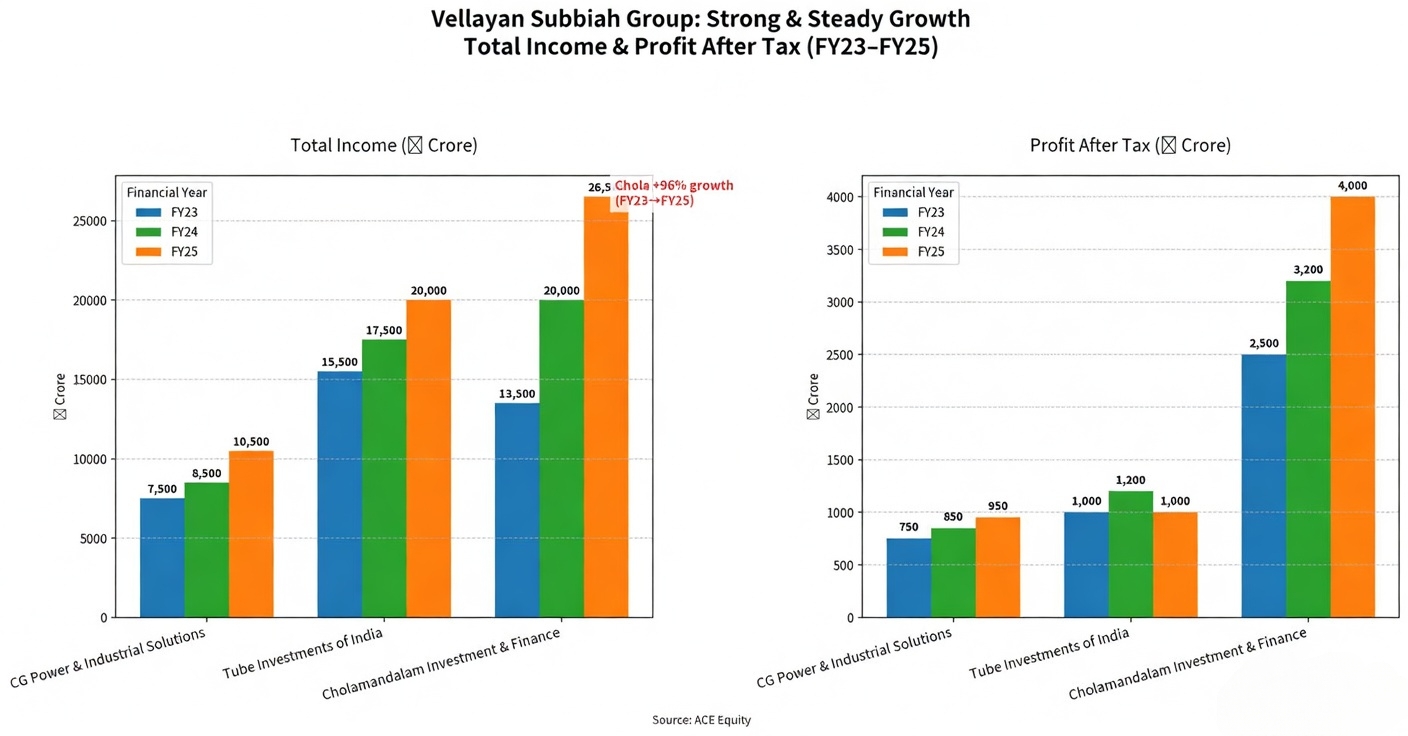
Subbiah sits at the intersection of three critical Murugappa businesses: Cholamandalam Finance (the group’s NBFC flagship), Tube Investments of India, and CG Power. An IIT Madras and University of Michigan alumnus with prior experience at McKinsey and 24/7 Customer, he brings an unusual combination of strategic consulting rigour and operational depth. His April 2025 reappointment as Executive Chairman of Cholamandalam for a five-year term signals long-term continuity of direction.
Why His Leadership Matters in India’s Fintech Evolution
India’s lending landscape is being reshaped by digital-first challengers, regulatory complexity, and a vast underserved rural population. In this environment, leaders who can straddle legacy institutional credibility and modern technological agility are rare. Subbiah represents a case study in exactly that balance, making his approach worth studying closely.
The Murugappa Group Legacy and Its Financial Services Expansion
Origins of the Murugappa Group
Founded in 1900, the Chennai-based Murugappa Group is one of India’s oldest and most respected business conglomerates, now valued at over Rs. 90,200 billion. What distinguishes it from flashier Indian business houses is its operating style: methodical, governance-focused, and patient with compounding. The group spans fertilisers, engineering, cycles, sugar, and financial services, and is known internally for its emphasis on free cash flow discipline over headline growth.
Entry into Financial Services Through Cholamandalam
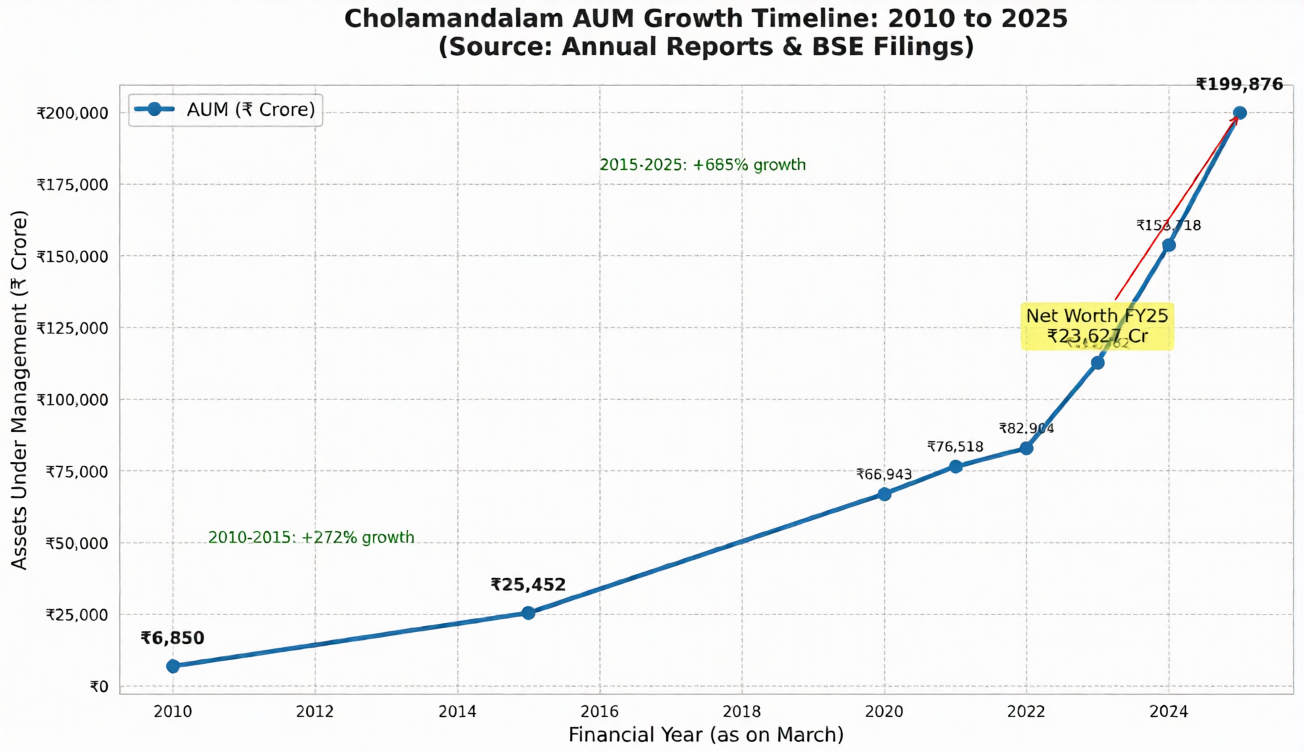
Cholamandalam Investment and Finance Company was incorporated in 1978 as the group’s financial services arm, initially as an equipment financing company. Over four decades, it evolved into a comprehensive NBFC offering vehicle finance, home loans, loan against property, SME loans, and rural credit. When Subbiah joined its board in August 2010, the company had an AUM of Rs. 6,850 crore and a profit after tax of Rs. 15 crore. Within five years, AUM crossed Rs. 25,000 crore and PAT grew to Rs. 435 crore.
Scale of the Conglomerate and Financial Services Footprint
Today, Cholamandalam operates across vehicle finance, home equity loans, consumer durable lending, gold loans, and SME credit. By FY25, the company reported a net worth of approximately Rs. 23,627 crore and total assets of around $23.6 billion, making it one of the largest NBFCs in India by asset base. Its consumer durables arm had presence across 22 states and roughly 54,000 dealer touchpoints by late 2025.
Importance of NBFCs in India’s Credit Ecosystem
NBFCs serve segments that scheduled commercial banks cannot reach efficiently. Their ability to customise underwriting, operate in semi-urban and rural markets, and move faster on credit decisions makes them structurally important. According to RBI data, NBFC loans and advances grew 18.5% in FY24, led primarily by larger institutions. In a country where a significant portion of first-time borrowers and new-to-credit customers still lack formal credit histories, NBFCs like Cholamandalam serve as the bridge between aspiration and access.
Building Cholamandalam Into a Digitally Driven NBFC
Transition from Traditional Lending to Tech-Enabled Finance
The most visible expression of Subbiah’s fintech vision at Cholamandalam is the pace and depth of its technology investment. In FY24, the company spent Rs. 106 crore on technology, a 49% increase and the first time it crossed the Rs. 100 crore mark. Working with AWS and DevOps partner Minfy, Chola achieved a 40% reduction in time to market for new features including AI-powered underwriting rules, CRM enhancements, and its Smart Sales app. In 2025, a treasury migration to Finacle Treasury consolidated fund flows, borrowing operations, and compliance into one real-time platform.
Digital Customer Acquisition Strategies
Cholamandalam has built a fintech-style partner ecosystem for digital acquisition. Through its newer divisions covering secured enterprise loans, small business products, and SME credit, it is using analytics-driven underwriting to enter segments like personal loans and BNPL via partnerships with platforms such as BankBazaar, KreditBee, MoneyTap, and Lendingkart. This co-lending and referral architecture lets Chola access digital-native customer bases without building the origination stack from scratch.
Rural Lending and Financial Inclusion Strategy
A defining thread in Subbiah’s leadership is the emphasis on financial inclusion without sacrificing credit discipline. Cholamandalam’s loan book explicitly targets first-time borrowers and new-to-credit customers, particularly in Tier-2 and Tier-3 cities. The company lends to women entrepreneurs, school operators in smaller cities, and e-rickshaw dealers, widening access in segments that pure digital fintechs often underserve due to data scarcity.
Customer-First Fintech Approach
Subbiah’s model at Chola is not tech-for-technology’s-sake. The company uses gamification and predictive analytics in its sales CRM, AI models for lead routing, and mobile-first apps for field teams. The result is faster loan processing and shorter customer turnaround times without sacrificing the human touchpoints that remain important in rural credit markets. This hybrid approach, part fintech and part relationship banking, is the clearest signature of the Subbiah era.
“Cholamandalam is the only business where there is evidence of compounding taking place over 16 years. The others have had a shorter run.” — Vellayan Subbiah, BusinessToday, 2026
Vellayan Subbiah’s Leadership Philosophy: Capital Efficiency and Long-Term Value Creation
Focus on Free Cash Flow and Financial Discipline
Subbiah has been consistent and public about his core financial philosophy: free cash flow is the most relevant measure of business health. In a market where NBFCs and fintechs often compete on AUM growth headlines, this is a meaningful differentiating stance. Businesses that can compound free cash flow over extended periods, he argues, are categorically different from those that merely scale.
Governance Reforms and Institutional Credibility
Nowhere was Subbiah’s governance philosophy more dramatically tested than at CG Power, where he oversaw one of India’s most-watched corporate turnarounds after the company’s accounting irregularities came to light. Restoring board credibility, operational integrity, and market confidence at CG Power has reinforced his reputation as a leader who can walk into institutional disorder and rebuild it systematically.
Turning Around Legacy Businesses
The pattern across Subbiah’s career is consistent: take institutions that are structurally sound but operationally drifting, clarify strategy, impose financial discipline, and let compounding do the work. At Cholamandalam, this meant moving from a narrow vehicle finance NBFC toward a diversified, digitally enabled financial services platform without losing the underwriting rigour that makes the credit book sustainable.
Technology, Data and the Future of NBFC Lending
Data-Driven Lending Decisions
India’s digital infrastructure, including Aadhaar-based eKYC, the Account Aggregator framework, and UPI transaction history, has fundamentally expanded the data available for credit decisioning. Cholamandalam’s investment in analytics allows it to evaluate borrowers beyond traditional bureau scores, drawing on payment behaviour, business transaction patterns, and alternate data signals to assess creditworthiness among thin-file customers.
Automation in Credit Underwriting
Chola’s Smart Sales application and AI-powered underwriting rules have measurably shortened its loan approval timelines. Automated lead routing, digital document verification, and rule-based credit engines reduce manual touchpoints without eliminating the field-level judgment that remains important in rural and semi-urban lending. The company’s AWS-based infrastructure allows it to push new credit rules to market in significantly less time than its legacy NBFC peers.
Risk Management Through Analytics
Building a large retail lending book in India means managing credit cycles carefully. Cholamandalam’s approach combines granular portfolio analytics with conservative loan-to-value ratios in secured lending segments. Its entry into gold loans in 2025, for instance, came with explicit geographic piloting protocols tied to LTV performance and collection behaviour, demonstrating analytical discipline rather than opportunistic expansion.
Competition with Fintech Startups
The most disruptive competition for Cholamandalam does not come from other traditional NBFCs but from digital-first platforms. As of mid-2025, NBFC fintechs grew 34.9% year-on-year, and these platforms now account for nearly 90% of all personal loan originations below the Rs. 1 lakh ticket size. Chola’s response has been to partner with these players rather than compete directly, using co-lending arrangements and referral partnerships to access their origination networks while retaining underwriting control.
Murugappa Group’s Digital Strategy Beyond Finance
Investments in New Technology Sectors
Subbiah’s ambitions extend well beyond Cholamandalam. Under his leadership, the Murugappa Group has made deliberate bets on sectors that will define India’s next industrial chapter. Through CG Semi Private Limited and affiliates, the group is positioning itself in the semiconductor value chain, a national priority that Subbiah has spoken about publicly as requiring ecosystem-level coordination across design, fabrication, and assembly and testing.
Semiconductor and Advanced Manufacturing Bets
The group’s involvement in CG Power places it at the intersection of power electronics and industrial manufacturing, two sectors with structural demand from India’s infrastructure push and the global supply chain realignment away from China. Subbiah has articulated a vision where India’s semiconductor ambitions require both supply-side investment and demand-side development, a broader systems perspective rarely heard in NBFC-focused financial services discourse.
Integration of Digital Strategy Across Businesses
The common thread across the Murugappa Group’s various digital bets is the belief that deep operational transformation, not just surface-level digitisation, creates lasting competitive advantage. Whether it is Chola’s AI-powered underwriting or CG Power’s industrial revival, the underlying philosophy is the same: capital discipline, institutional credibility, and long-term compounding.
The Changing Role of NBFCs in India’s Fintech Revolution
NBFCs vs Fintech Startups
The distinction between NBFCs and fintech startups is blurring rapidly. Fintech platforms largely cannot lend without an NBFC licence or a banking partner, making established NBFCs structurally important to the digital lending ecosystem. This dynamic has created a co-lending model where fintech originators partner with NBFCs for capital, while NBFCs gain access to digital customer pools they could not build organically.
Regulatory Evolution
The RBI’s Digital Lending Guidelines and the RBI (Digital Lending) Directions, 2025 have significantly tightened disclosure standards, mandated direct fund flows between borrowers and regulated lenders, and clarified the boundaries of Lending Service Provider accountability. For compliant NBFCs like Cholamandalam, tighter regulation is a competitive advantage: it raises the bar for entry and favours institutions with robust compliance infrastructure.
Digital Lending Growth Trends in India
Despite regulatory headwinds, digital lending in India is projected to grow at a CAGR of 30.2%, targeting a market size of $2.38 billion by 2030. The underlying drivers are structural: rising smartphone penetration, UPI adoption, IndiaStack’s presenceless authentication layer, and the Account Aggregator framework enabling consented financial data sharing. For established NBFCs with the balance sheets to fund at scale, this growth environment is an opportunity rather than a threat.
Challenges Ahead for Traditional Financial Institutions
Competition from Digital-First Fintechs
Pure-play digital lenders are faster on product iteration and customer acquisition, particularly in urban unsecured lending. Cholamandalam’s strength in secured, rural, and vehicle finance provides some natural segmentation, but the boundaries will erode as fintech platforms push into secured credit with improved underwriting models.
Regulatory Pressures
India’s regulatory environment for NBFCs is evolving quickly. Scale-based regulations, enhanced capital adequacy requirements, and tighter co-lending norms all add compliance cost and reduce the regulatory arbitrage that smaller NBFCs previously exploited. For Cholamandalam, the direction of regulation is broadly supportive, but the pace of change demands continuous adaptation.
Credit Risk Cycles
India’s microfinance sector saw overall stress rise sharply through FY25, with NBFC-MFI portfolio stress exceeding 15% by March 2025 compared to under 6% a year earlier. While Cholamandalam’s secured lending focus limits direct exposure to microfinance stress, credit cycles in vehicle finance and SME lending can be volatile, requiring the kind of portfolio discipline that Subbiah has consistently prioritised.
Technology Investment Requirements
Maintaining competitive parity with digital-native fintechs requires sustained and growing technology investment. Cholamandalam’s Rs. 106 crore technology spend in FY24 is significant for an NBFC but modest relative to the infrastructure ambitions of fintech unicorns. The ability to allocate capital efficiently across technology, credit growth, and risk reserves simultaneously is a genuine test of leadership.
What Vellayan Subbiah’s Strategy Signals for India’s Fintech Future
Hybrid Finance Model: NBFC + Fintech
Subbiah’s Cholamandalam is arguably the clearest example of the hybrid finance model that analysts increasingly believe will dominate India’s lending landscape: NBFC balance sheet depth combined with fintech agility in customer acquisition, underwriting automation, and data intelligence. This is not a compromise position but a genuine structural advantage when executed with discipline.
Institutional Credibility vs Startup Speed
Fintech startups optimise for speed; traditional institutions optimise for trust. The most durable financial platforms will combine both. Cholamandalam’s 45-year operating history, regulatory standing, and established rural branch network represent advantages that no digital lender can replicate quickly, while its technology investments narrow the speed gap in customer experience and credit decisioning.
Long-Term Transformation Outlook
Subbiah’s approach suggests that the most consequential transformation in Indian financial services will be led not by startups displacing incumbents but by incumbents intelligently absorbing fintech capability. His consistent emphasis on compounding, governance, and capital efficiency over growth-at-all-costs is a signal that sustainable fintech transformation requires patience and institutional depth.
Conclusion: The Quiet Transformation of a Legacy Financial Institution
Lessons from Subbiah’s Leadership Model
The Cholamandalam story under Vellayan Subbiah is a masterclass in institutional transformation without identity crisis. The company did not abandon its NBFC DNA to become a fintech, nor did it ignore the digital wave to protect its legacy business. Instead, it built technology on top of credit discipline, extended reach into underserved markets, and maintained the governance standards that allow it to operate at scale under regulatory scrutiny.
Fintech Evolution Within Traditional Business Houses
In India’s fintech evolution, the loudest voices often belong to startups. But the largest and most lasting changes to credit access may well be driven by leaders like Subbiah: operating within century-old institutions, patient with capital, rigorous with governance, and clear-eyed about where technology creates real value versus where it merely creates noise.
Frequently Asked Questions
Who is Vellayan Subbiah and what companies does he lead?
Vellayan Subbiah is a fourth-generation member of the Murugappa family and one of India’s most respected business leaders. He is the Executive Chairman of Cholamandalam Investment and Finance Company, Non-Executive Vice Chairman of Tube Investments of India, and Chairman of CG Power and Industrial Solutions. An IIT Madras and University of Michigan alumnus, he previously worked at McKinsey and 24/7 Customer before joining the Murugappa Group. He was recognised as Outstanding Business Leader of the Year at the India Business Leader Awards 2024 and EY Entrepreneur of the Year 2023 and 2024.
How is Cholamandalam Finance adapting to fintech disruption?
Cholamandalam is adapting through a combination of direct technology investment and strategic fintech partnerships. The company spent Rs. 106 crore on technology in FY24, achieving a 40% reduction in time to market through its AWS cloud transformation. It has built a digital partner ecosystem including platforms like KreditBee, BankBazaar, and Lendingkart for co-lending and customer acquisition, while deploying AI-powered underwriting, Smart Sales applications, and analytics-driven CRM tools internally. Its rural lending focus and secured credit orientation also provide natural differentiation from urban-focused digital lenders.
Why are NBFCs important in India’s fintech ecosystem?
NBFCs hold the regulatory licence to lend in India, which fintech platforms largely do not. This makes them structurally essential to the digital lending ecosystem: fintech origination platforms partner with NBFCs to access capital and regulatory legitimacy, while NBFCs gain digital customer acquisition reach they cannot build independently. NBFCs also serve segments that banks cannot efficiently reach, particularly Tier-2 and Tier-3 city borrowers, first-time loan takers, and self-employed individuals without formal income documentation. India’s digital lending sector is projected to grow at a 30.2% CAGR through 2030, and NBFCs will remain the capital backbone of that growth.