
As Trump’s 8 p.m. ET deadline for Iran to reopen the Strait of Hormuz expires, the U.S. president has issued his most apocalyptic threat yet. The world is watching whether words turn into the most catastrophic military escalation of the 21st century.
Trump Issues His Most Dangerous Warning to Iran
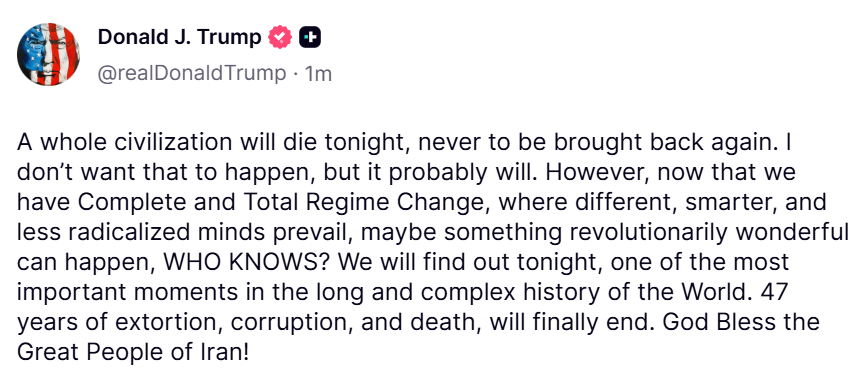
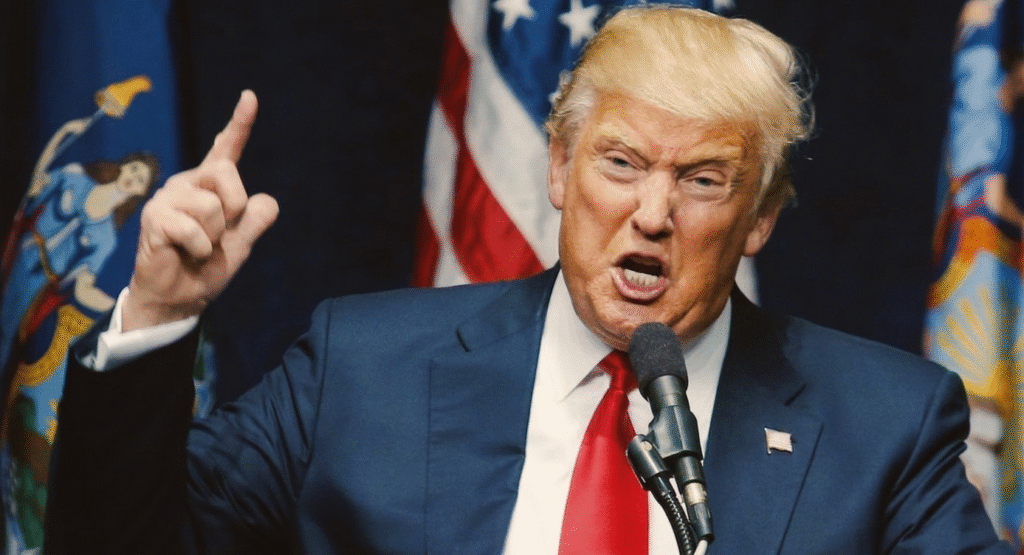
The Iran war, now in its 38th day, has entered its most dangerous hours. Speaking Monday at a White House press conference, U.S. President Donald Trump warned that Iran could be “taken out in one night” and that night “might be tonight.” Then, in a Truth Social post that shook global markets and security councils alike, Trump went further, declaring: “A whole civilisation will die tonight.”
The statement came hours before Trump’s self-imposed 8 p.m. ET Tuesday deadline for Tehran to reopen the Strait of Hormuz, a vital waterway through which roughly 20 percent of the world’s oil supply normally flows. The strait has been closed since U.S. and Israeli strikes triggered the war on February 28, sending oil prices surging past $114 a barrel.
Iran, for its part, has rejected a proposed 45-day ceasefire brokered by Pakistan(reportedly), demanding instead a permanent end to hostilities and guarantees against future attacks. With no deal in sight, Washington appears to be on the edge of its most consequential military decision since the Iraq War.
What Exactly Did Trump Say?
In a Truth Social post minutes ago, Trump wrote: “A whole civilization will die tonight, never to be brought back again. I don’t want that to happen, but it probably will.” He then added something that stopped analysts cold: a reference to “Complete and Total Regime Change, where different, smarter, and less radicalized minds prevail,” before signing off with “God Bless the Great People of Iran.”
This is not just a military threat. It is an announcement of a political endgame. Trump is not merely talking about bombs. He appears to be signalling that the objective of tonight’s action is the total dismantling of the Islamic Republic itself, the system of government that has ruled Iran for 47 years. His framing of “one of the most important moments in the long and complex history of the World” suggests Washington believes it is standing at a civilisational turning point, not just a tactical military deadline.
The post’s closing line, directed warmly at the Iranian people rather than its government, mirrors the language of regime-change operations, distinguishing the population from the leadership before a decisive blow.
Earlier in the week, Trump had threatened power plants, bridges and energy infrastructure in expletive-laden posts, and said at a press conference Iran could be “taken out in one night.” When asked if strikes on civilian infrastructure worried him as a potential war crime, he was blunt: “No. I hope I don’t have to do it.” Defense Secretary Hegseth had already confirmed strikes were scaling up dramatically by the hour.
Iran’s immediate response
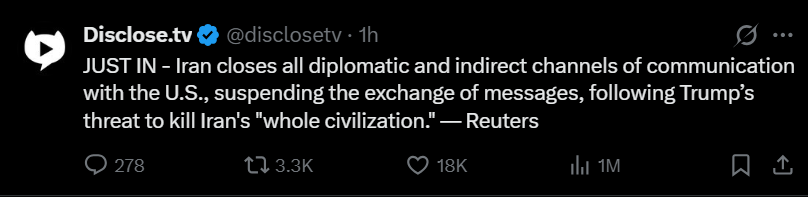
Iran responded immediately and defiantly. As Trump’s 8 p.m. ET deadline expired, Iranian state media announced that all talks and indirect negotiations with the United States have been halted in direct response to the president’s latest threats. Tehran has slammed the door on the last remaining diplomatic channels, pushing the conflict closer to the edge of full-scale catastrophe.
Decoding the Warning: Is Trump Threatening a Nuclear Strike, an Infrastructure Apocalypse, or Both?
This is where the language gets chilling, and where geopolitical analysts need to pay close attention.
The infrastructure blackout scenario is the most explicitly threatened. Trump has repeatedly and specifically named power plants, bridges, ports, and energy facilities as targets. A coordinated strike on Iran’s electricity grid would plunge a nation of 90 million people into darkness overnight, destroying water treatment, hospitals, and communications. Human rights experts have already called this collective punishment, a violation of the Fourth Geneva Convention. Former Human Rights Watch director Kenneth Roth told NBC News plainly: “Attacking civilians is a war crime.”
The energy strangulation scenario is already partially underway. U.S. forces struck Kharg Island, Iran’s primary oil export hub, even before the deadline arrived. Attacks on South Pars, the world’s largest natural gas field, have also been reported. Destroying Iran’s energy export infrastructure would collapse its economy within weeks.
The nuclear dimension cannot be dismissed. The IAEA has confirmed that strikes have already landed within 250 feet of Iran’s Bushehr Nuclear Power Plant. Director-General Rafael Grossi warned this “could cause a severe radiological accident” affecting Iran and beyond. A direct strike on Bushehr or Iran’s nuclear facilities at Natanz or Fordow would cross a threshold no U.S. president has crossed before, with consequences that are genuinely uncontrollable.
When Trump says “a whole civilisation will die,” the range of possible meanings runs from psychological pressure tactic to an operational order with catastrophic reach.
Why This Moment Is Geopolitically Seismic
The Strait of Hormuz is not just Iran’s leverage. It is the throat of the global economy. Every additional day it stays closed is another hammer blow to energy markets, supply chains, and the economies of Asia and Europe alike. U.S. gas prices have climbed 39 percent since the war began.
Iran’s IRGC has warned it will “deprive the U.S. and its allies of oil and gas for many years” if red lines are crossed, and threatened to extend disruption to the Bab al-Mandeb Strait, another critical global shipping chokepoint. A wider regional conflagration, drawing in Iraq, Lebanon, Yemen, and the Gulf states, is no longer a theoretical risk. It is an active danger.
What Happens Next
Three scenarios now dominate the calculus. The first is a massive conventional escalation, a wave of strikes on Iranian infrastructure that transforms the conflict from a targeted war into a civilisational assault. The second is a last-minute diplomatic breakthrough, possibly through Pakistan, Egypt, or Qatar, though Iran’s rejection of the ceasefire proposal makes this look increasingly unlikely before the deadline. The third is that Trump blinks again, as he has done with earlier deadlines in this war, using the threat as a pressure tool without following through.
What is no longer in question is this: the world has not faced language like this from a sitting U.S. president in modern history. Whether it is strategy, psychology, or something far darker, the next few hours will define the trajectory of the Middle East for a generation.
Article updated April 7, 2026. Situation is developing rapidly.