
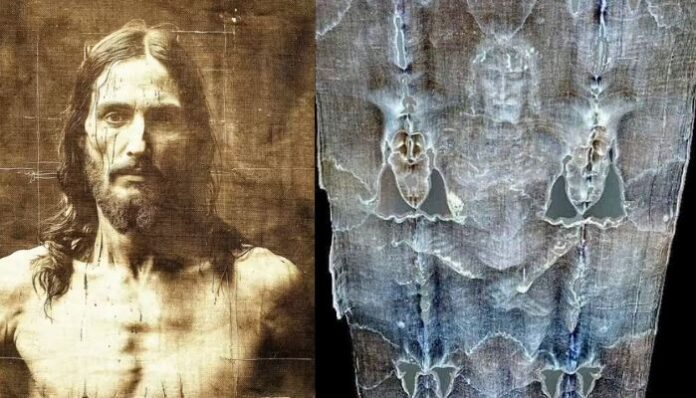
Few objects in human history have been studied as obsessively, argued over as fiercely, or believed in as fervently as a 4.4 meter strip of linen kept in a climate controlled chapel in Turin, Italy. The Shroud of Turin : imprinted with the ghostly image of a bearded man has survived fires, centuries of skepticism, and multiple rounds of scientific testing. It has survived, too, the 1988 carbonating result that placed its origin squarely in the medieval period.
Now comes another challenger to the settled narrative: a DNA analysis claiming genetic material on the shroud points toward Indian ancestry, raising questions about whether the cloth may have originated : or at least travelled : far earlier and farther than medieval Europe. The study has lit up religious forums, alternative history channels, and international media. It deserves careful examination.
1. What the DNA study actually claims
The study in question, conducted by a team of Italian researchers led by Gianni Barcaccia, analysed plant DNA and human mitochondrial DNA collected from dust particles vacuumed from the shroud’s surface. Among the genetic signals detected were lineages associated with populations from the Indian subcontinent, the Middle East, and North Africa : alongside European genetic markers.
Researchers pointed to haplogroups : inherited genetic markers : that are common in populations of South Asian descent. Headlines quickly translated this into: Shroud of Turin may have come from India. The leap, however, is significant, and not one the study itself conclusively makes.
Mitochondrial DNA on a surface artefact can come from anyone who has ever touched it, breathed near it, or been in the same room during handling. The shroud has been exhibited, examined, transported, and venerated by pilgrims, scientists, and clergy from every corner of the world for centuries. Finding South Asian DNA on its surface is, to put it plainly, not surprising : and it proves nothing about where the cloth was woven or who first wore it.
2. The carbon dating evidence and why it hasn’t gone away
In 1988, three independent laboratories : in Oxford, Zurich, and Tucson : each received blind samples of the shroud’s linen and dated them using accelerator mass spectrometry. All three converged on a medieval date range of roughly 1260 to 1390 CE. The result was published in Nature and has since been cited thousands of times.
Proponents of an ancient origin have contested this finding on multiple grounds: that the tested sample came from a later:repaired corner of the cloth; that medieval bacterial contamination skewed the results; that a fire in 1532 altered the carbon content. None of these objections has been independently validated. The labs that performed the original testing have defended their methodology, and requests to re:test using larger, better:sampled portions of the cloth have been denied by the Vatican’s custodians.
The medieval date also aligns neatly with the historical record. The shroud first appears in documented history in 1354, when it was displayed by a French knight. A bishop’s investigation shortly after concluded it was a painted forgery. No credible historical chain of custody exists connecting the cloth to the first century.
3. A timeline of the debate
1354 : First historical record. Geoffrey de Charny exhibits the shroud in Lirey, France. A local bishop’s report calls it a painted forgery.
1532 : The Chambéry fire. The cloth is partially burned, leaving scorch marks still visible today. Critics cite this as a potential contamination event for future carbon dating.
1898 : The negative image discovery. Photographer Secondo Pia notices that the photographic negative of the shroud reveals a far clearer face, reigniting public fascination worldwide.
1978 : The STURP investigation. The Shroud of Turin Research Project conducts 120 hours of direct scientific testing and cannot identify a pigment or painting mechanism : but does not conclude a supernatural origin either.
1988 : Carbon dating. Oxford, Zurich, and Tucson labs independently place the cloth’s linen origin at 1260–1390 CE, published in Nature.
2015 : Barcaccia DNA study. Italian researchers detect diverse DNA from dust samples : including South Asian haplogroups : and suggest the cloth may have travelled a complex route before reaching Europe.
2026 : Fresh wave of coverage. Claims of an “India link” resurface across international media, prompting renewed debate about what the DNA evidence can and cannot show.
4. Claim vs. fact: a breakdown
Claim: DNA from Indian populations proves the shroud originated in India or passed through it before reaching Europe.
Assessment: Contested. Surface DNA indicates contact, not origin. Anyone who handled the cloth across centuries could have deposited genetic material : including modern pilgrims and researchers.
Claim: The 1988 carbon dating was flawed because the sample came from a medieval repair patch. Assessment: Contested. The labs deny this. Independent textile analysis has not confirmed a repair patch in the sampled area. The hypothesis remains unverified.
Claim: The image on the shroud cannot have been created by medieval technology.
Assessment: Contested. While the precise image mechanism is not fully understood, several scientists have demonstrated plausible medieval production methods using acidic substances and UV radiation effects on linen.
Established fact: The earliest credible historical documentation of the shroud dates to 1354 CE in France, with no verified chain of custody linking it to the first century CE.
Established fact: Three independent carbon:dating laboratories placed its linen origin in the medieval period (1260–1390 CE). This finding has not been overturned by peer:reviewed counter:evidence.
5. How a study becomes a viral claim
The DNA study that sparked this wave of coverage was published in 2015 : over a decade ago. Its reappearance in 2026 headlines is less a scientific development than a media cycle. The pattern tends to follow five steps:
First, a peer:reviewed study with a nuanced, heavily qualified conclusion is published. Researchers note significant limitations in their own findings. Second, a secondary article : often in a non:specialist outlet : strips the nuance and leads with the most dramatic possible interpretation of the results. Third, the dramatic framing is shared by communities already invested in an alternative narrative. Social media amplifies the signal, not the caveats. Fourth, mainstream media picks up the buzz and publishes fresh articles, often without revisiting the original study or its limitations : and the story gets a new publication date, making it feel current. Fifth, the rebuttal, when it comes, is quieter, less viral, and arrives after the claim has already embedded itself as something scientists discovered.
This is not a story about dishonest journalism in every case. It is a story about how the structure of modern media : optimised for attention, not accuracy : systematically favours the exciting claim over the careful correction.
6. Why this debate persists : and what it reveals
The Shroud of Turin is not merely a historical artefact. For millions of Christians, it is a potential relic of the crucifixion : a physical connection to the foundational event of their faith. For researchers, it is one of the most examined pieces of cloth in history. For sceptics, it is a case study in how belief can resist disconfirmation. For everyone, it is genuinely mysterious in at least one important respect: the precise mechanism by which the image was formed remains unexplained.
That genuine mystery is, paradoxically, what keeps bad:faith claims alive. When honest science says “we cannot fully explain X,” it creates space that motivated reasoning rushes to fill. The 1988 carbon dating answered one question definitively : when the linen was made : but left others open. Those open questions have been the entry point for every subsequent wave of alternative claims.
Science deals in probabilities and qualifications. Headlines deal in certainties and surprises. The gap between those two modes of communication is where misinformation lives.
7. What responsible engagement looks like
None of this is an argument that the shroud question is permanently closed, or that curiosity about it is misplaced. The image’s formation mechanism remains genuinely uncertain. There are legitimate researchers who believe further testing : with better:controlled sampling : could yield new information. That is how science is supposed to work.
What responsible engagement requires is distinguishing between what a study shows and what its popularisers claim it shows; reading the limitations section, not just the abstract; being alert to the gap between “this is possible” and “this is supported by evidence”; and recognising that old studies repackaged with new headlines are not new discoveries.
The shroud has outlasted every attempt to definitively close the debate : partly because of genuine remaining questions, and partly because its symbolic weight ensures that each new piece of evidence will be read through the lens of what people already believe. That is not a reason to abandon rigour. It is the reason rigour matters more than ever.