LATEST (Day 14–15, March 13–14): Israel struck central Tehran near a major rally. Iran’s new Supreme Leader vows Hormuz stays closed & attacks on US bases continue. Dubai Airport struck by Iranian drones. Qatar airspace closed. 3.2M displaced in Iran. Civilian toll: 1,444+ killed, 18,551+ injured. US gas prices hit 22-month high ($3.63/gallon). Rupee: record low ₹92.40/USD.
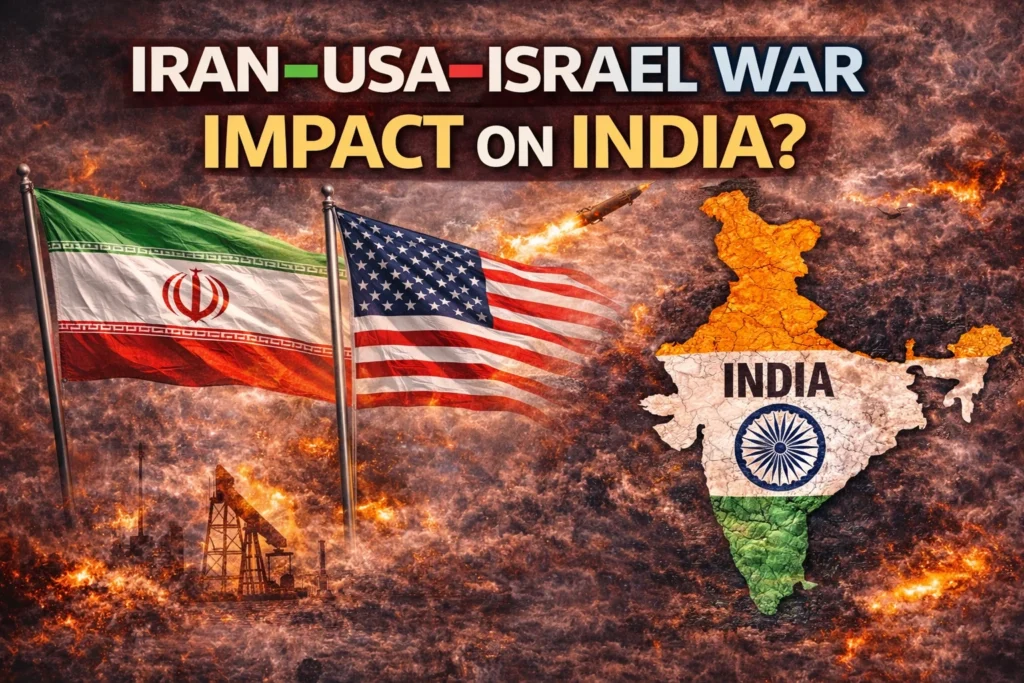
The Conflict : What Happened
Operation Epic Fury began on February 28, 2026, when the US and Israel launched coordinated airstrikes across Iran targeting military infrastructure, nuclear facilities, and leadership. Supreme Leader Ali Khamenei was killed in the opening strikes. Iran retaliated with 500+ ballistic missiles and ~2,000 drones. The new Supreme Leader Mojtaba Khamenei has effectively closed the Strait of Hormuz.
| War Statistic | Status (March 14, 2026) |
| War started | February 28, 2026 (Day 15 today) |
| Operation name | Operation Epic Fury (US-Israel) |
| US targets struck in Iran | 5,000+ |
| Iranian missiles & drones fired | 500+ ballistic missiles; ~2,000 drones |
| Civilian deaths in Iran | 1,444+ confirmed; 18,551+ injured |
| Civilians displaced in Iran | 3.2 million (UNHCR) |
| New Iranian Supreme Leader | Mojtaba Khamenei (son of slain leader) |
| Brent crude price | ~$110/barrel (was $65–67 pre-war) |
| Strait of Hormuz | Effectively closed by IRGC; mines laid |
| IEA emergency reserves released | Record 400 million barrels |
| US military casualties | 8 killed (incl. 6 in tanker crash), 140+ wounded |
Latest Updates : Days 12–15
Military & Attacks
- Israel struck central Tehran near an Al Quds Day rally (March 13); one killed, explosions near senior officials including President Pezeshkian.
- US Air Force refueling tanker crashed in western Iraq (March 13) all 6 crew killed; no hostile fire confirmed.
- Iran & Hezbollah launched a joint 5-hour attack on 50+ Israeli targets including military intelligence HQ and Haifa naval base (March 11).
- Israel expanded strikes into Beirut’s southern suburbs; Lebanon displacement could exceed 1 million within days.
- Dubai International Airport struck by Iranian drones; hotels hit. Australia ordered non-essential officials to evacuate UAE and Israel.
- Iran confirmed laying mines in the Strait of Hormuz; US Navy destroyed 16 Iranian minelayer ships near the strait.
- Ras Tanura refinery in Saudi Arabia struck by drones; Kuwait cutting oil output as storage fills.
Diplomatic Developments
- Iran’s new Supreme Leader Khamenei (first formal statement, March 13): Hormuz stays closed until US bases in the region shut down.
- Iran considering allowing oil through Hormuz only if traded in Chinese yuan a direct challenge to the petrodollar (CNN).
- Trump said US Navy escorts for tankers through Hormuz will happen ‘soon.’
- Russia confirmed giving Iran tactical drone-targeting advice against Gulf and US targets.
- PM Modi called Iranian President Pezeshkian (March 13) first call since the war began — urging de-escalation and safe energy passage.
Energy Markets
- Brent crude ~$110/barrel; worst case $130–300/barrel if full blockade is sustained.
- Qatar LNG production forcibly halted after Iranian drone attack global gas markets tightening further.
- Russian Urals crude is now $4–5/barrel MORE expensive than Brent Russia is exploiting India’s reduced alternatives.
- UAE and Saudi Arabia could face forced production cuts next as Gulf storage fills.
Why India Is Directly Affected
India is not a combatant but its deep structural ties to the Gulf make this an immediate economic emergency.
- Imports 80–90% of crude oil; over 50% transits the Strait of Hormuz (Citi estimate)
- ~9.1 million Indians live and work in Gulf states 3 million in UAE alone
- ~40,000 Indians in Israel; ~10,000 in Iran
- Gulf remittances to India: ~$50 billion annually now at serious risk
- 75% of basmati rice exports (~6 million tons) go to Middle Eastern markets
- LPG (cooking gas) supply for 300M+ Indian households largely transits through Hormuz
Economic Impacts on India
Oil Price Shock
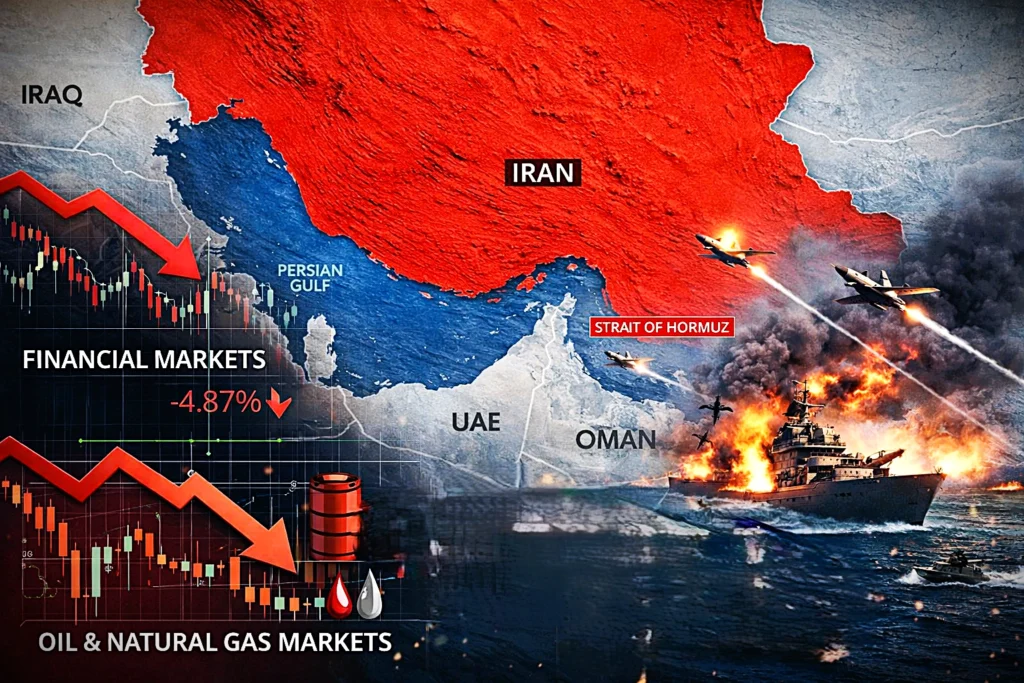
Brent crude surged from $65–67 to ~$110/barrel a 60%+ rise in two weeks. Every $10/barrel rise adds $13–14 billion to India’s annual import bill and widens the current account deficit by 40–50 basis points. India’s oil stocks cover only 20–25 days.
| Scenario | Projected Crude Price |
| Short conflict (swift resolution) | $80–90/barrel, declining |
| Prolonged conflict (months) | ~$130/barrel sustained |
| Full Hormuz blockade (worst case) | $130–300/barrel |
| Current level (March 14, 2026) | ~$110/barrel |
LPG Cooking Gas Crisis
LPG is India’s most direct household vulnerability in this war. Over 320 million Indian households use LPG cylinders for cooking, and a large share of India’s LPG supply including propane and butane shipments transits through the Strait of Hormuz or is sourced from Gulf producers (Saudi Aramco’s Aramco Trading is India’s largest LPG supplier).
- LPG cylinder prices (14.2 kg domestic) have already been raised by ₹60 (~6.5%) as supply tightens
- Commercial LPG cylinder prices have risen ₹100–120, feeding into restaurant and hotel costs fuelling urban food inflation
- Qatar — a key LPG exporter to India has had its LNG production disrupted by drone attacks
- Saudi Aramco, India’s largest LPG supplier, is managing the Ras Tanura refinery crisis after drone strikes
- India has invoked emergency powers to prioritise domestic LPG distribution to households over commercial use
- If prices rise a further 15–20%, the government will face pressure to reinstate the full LPG subsidy adding ₹200–400 billion to the subsidy bill
- States like UP, Bihar, and West Bengal with high rural LPG dependence under the Ujjwala scheme are the most vulnerable to supply shocks
The RBI and Finance Ministry have flagged LPG as a specific transmission channel for core inflation, as cooking gas costs affect the CPI food basket both directly (household use) and indirectly (restaurants, street food, catering).
Inflation
CPI was 2.75% in January 2026. Nomura raised its India CPI forecast to 4.5% for FY2026-27 (from 3.8%), with LPG shortages and transport cost increases as primary drivers. A 10% crude rise adds ~30 basis points. Capital Economics estimates most Asian economies see inflation rise ~0.5 percentage points at current crude levels India’s exposure is above average given its higher import dependency.
Rupee at Record Lows
The rupee hit an all-time low of ₹92.40/USD (March 13). In four days it fell from ₹90.80 to ₹92.40. The RBI is defending the currency by selling dollars from reserves. MUFG projects ₹95.50/USD if oil holds near $100; ₹97.50+ if crude hits $120. A weaker rupee makes every import oil, electronics, machinery, chemicals more expensive, creating a self-reinforcing inflationary spiral.
Current Account Deficit (CAD)
CAD was projected at 0.7–0.8% of GDP for FY2026-27. At $100/barrel average oil, ICRA estimates it widens to 1.9–2.2% of GDP. DBS Bank: CAD widens ~70 basis points if oil averages $100+. India’s forex reserves (~$716 billion) offer a buffer, but they are being drawn down by RBI’s rupee defence.
Stock Markets
Nifty 50 and Sensex had their worst week since the pandemic. FIIs are accelerating outflows. Oil marketing companies (IOC, BPCL, HPCL) fell sharply as under-recoveries mount. Elara Capital notes the current turbulence could become a buying opportunity if a ceasefire emerges but sustained $100+ oil for multiple quarters would be a different, structurally bearish scenario.
Aviation
Air India cancelled all flights to UAE, Saudi Arabia, Israel, and Qatar. Dubai International Airport was struck by drones. Longer rerouted flights add up to 4 hours and heavy fuel burn. IndiGo’s earnings could fall ~13% for every $5 rise in Brent (JM Financial). Weekly aviation losses: ~₹875 crore ($96M) for Indian and international carriers.
Russian Oil The Discount That Disappeared
India’s post-2022 strategy of buying cheap Russian crude to offset Gulf risks has collapsed. Russian Urals is now $4–5/barrel more expensive than Brent. Russia is exploiting India’s reduced alternatives and the global demand spike. Indian refiners (IOC, BPCL) are paying a premium where they once paid a discount worsening the import bill at the worst possible time.
Agriculture & Remittances
400,000+ metric tons of basmati rice is stuck at ports or in transit. Fertilizer imports (urea, DAP, potash) from Gulf states face disruption, raising input costs. Gulf remittances (~$50 billion/year) are under threat as 9.1 million Indians face insecurity and potential evacuation. States like Kerala, UP, and Bihar are most exposed.
Fiscal Pressure
LPG and fuel subsidy bills could rise by ₹200–500 billion if oil holds above $80/barrel. The government is absorbing costs to contain inflation ahead of state elections but this widens the fiscal deficit. SBI Research: if oil averages $100 through FY2026-27, GDP growth falls to 6.6% and inflation rises to 4.1%.
India’s Response
- PM Modi chaired emergency CCS meeting (March 2) on crude supplies, shipping, and citizen safety
- PM Modi called Iranian President Pezeshkian (March 13) first direct call urging de-escalation and safe energy corridors
- Finance Ministry March 6 review explicitly flagged risks to energy, inflation, CAD, and remittances
- India invoked emergency powers to prioritise domestic LPG supply (March 13)
- LPG cylinder price raised ₹60 for consumers; commercial prices up ₹100–120
- RBI selling dollars from reserves to defend the rupee; monitoring capital flows
- Strategic petroleum reserves (~5.33M metric tonnes; ~20–25 days cover) under active evaluation
- Accelerating crude supply talks with US, Brazil, and West Africa to reduce Gulf dependence
- Diplomatic neutrality maintained calling for de-escalation without taking sides
Key Economic Indicators
| Indicator | Status (March 14, 2026) |
| Brent crude (pre-war, Feb 2026) | $65–67/barrel |
| Brent crude (current) | ~$110/barrel |
| Indian rupee | ₹92.40/USD — all-time low |
| India CPI inflation (Jan 2026) | 2.75% |
| Nomura CPI forecast (FY2026-27) | 4.5% (raised from 3.8%) |
| CAD at $100/barrel oil (ICRA) | 1.9–2.2% of GDP |
| India oil stock cover | ~20–25 days only |
| LPG domestic cylinder price rise | +₹60 per cylinder (6.5%) |
| LPG commercial price rise | +₹100–120 per cylinder |
| Aviation weekly loss | ~₹875 crore ($96M) |
| Basmati rice stuck at ports | 400,000+ metric tons |
| Gulf remittances at risk | ~$50 billion/year |
| Forex reserves buffer | ~$716 billion |
| GDP growth risk (SBI) | Falls to 6.6% if oil averages $100 |
| Russian Urals crude vs Brent | +$4–5/barrel PREMIUM (not discount) |
Frequently Asked Questions
Q1: Why does this war directly affect India even though India is not involved?
India imports 80–90% of its crude oil, with over 50% transiting the Strait of Hormuz a waterway Iran has now effectively closed. India’s 9.1 million Gulf workers send ~$50 billion home annually. India exports 75% of its basmati rice to Middle Eastern markets. LPG for 320 million Indian households transits through or is sourced from the Gulf. These are not indirect links they are structural economic dependencies that make every escalation felt immediately in Indian kitchens, fuel stations, and financial markets.
Q2: How bad is the LPG situation, and will cooking gas become unaffordable?
LPG prices have already risen ₹60 per domestic cylinder (6.5%) and ₹100–120 for commercial cylinders. India’s largest LPG supplier Saudi Aramco is managing a crisis after the Ras Tanura refinery was struck by drones. Qatar LNG exports have been disrupted. If the Strait of Hormuz remains closed and Gulf supply dips further, a second price hike of ₹80–120 per cylinder is likely within 3–4 weeks. The government has invoked emergency powers to prioritise household supply over commercial use, but a sustained shortage would force either steep price hikes or a reinstatement of full LPG subsidies costing the exchequer ₹200–400 billion. Rural households under the Ujjwala scheme and urban lower-income families face the greatest hardship.
Q3: How high could oil prices go, and what does that mean for petrol?
Three scenarios: (1) Short conflict $80–90/barrel, manageable. (2) Prolonged conflict ~$130/barrel, severe strain. (3) Full Hormuz blockade $130–300/barrel, catastrophic. At current $110 levels, petrol and diesel could rise ₹5–10 per litre once the government stops absorbing costs through subsidies. State elections are the primary brake on passing these costs to consumers. Iran has itself threatened $200/barrel as a pressure tactic. India’s oil stocks cover only 20–25 days, making delay increasingly untenable.
Q4: Why is the rupee falling, and how bad could it get?
Oil is priced in dollars. More expensive oil means India needs more dollars increasing USD demand and weakening the rupee. FIIs are simultaneously pulling capital from Indian markets to safe havens. The rupee hit ₹92.40/USD an all-time low. MUFG projects ₹95.50 if oil averages $100; ₹97.50+ if oil hits $120 with energy shortages. A weaker rupee makes all imports more expensive electronics, machinery, pharmaceuticals, chemicals amplifying inflation in a compounding spiral that is difficult to break without oil price relief.
Q5: Are Indians in the Gulf safe, and what is the evacuation situation?
The situation is fluid and deteriorating. Iranian drones and missiles have struck UAE (Dubai airport), Kuwait, Bahrain, Qatar, and Saudi Arabia all countries with large Indian communities. Australia has ordered non-essential officials to evacuate UAE and Israel. The Indian government has activated emergency monitoring and MEA hotlines. Evacuation contingencies exist, but evacuating 9.1 million people would be unprecedented in scale. The ~40,000 Indians in Israel and ~10,000 in Iran face the most acute risks. Gulf remittances $50 billion/year are at risk if workers are evacuated or employment contracts are disrupted. PM Modi’s direct call to Tehran signals the government recognises both the human and economic stakes.
Conclusion
The 2026 Iran–Israel–US War has delivered the most severe energy shock to India in a generation. In just 15 days, it has dismantled the three pillars of India’s post-2022 energy strategy: cheap Russian oil (now a $4–5 premium over Brent), stable Gulf supply (Hormuz closed and mined), and a manageable current account deficit (now projected to widen to nearly 2% of GDP).
The damage is already tangible and spreading across every layer of the Indian economy. The rupee has hit an all-time low. LPG prices have risen for the first time in months. Basmati exports are frozen at ports. Indian aviation is rerouting around shuttered Gulf airspace at enormous cost. The Nifty and Sensex had their worst week since the pandemic. And the government faces an impossible choice: absorb spiralling oil and LPG costs through subsidies (blowing the fiscal deficit), or pass them to consumers (stoking inflation ahead of state elections).
India’s structural strengths provide meaningful short-term buffers. Forex reserves of $716 billion give the RBI room to defend the rupee. Diplomatic flexibility Modi’s direct call to Tehran, India’s UN neutrality, its relationships with both warring sides preserves India’s ability to advocate for de-escalation in ways few other nations can. The diversification of crude sourcing toward the US, Brazil, and West Africa that began after 2022 is now being accelerated under emergency conditions.
But these buffers are finite. India’s oil stocks cover only 20–25 days. The strategic petroleum reserves add limited extra runway. Russian crude once the insurance policy is now more expensive than Brent. LPG supply chains from Saudi Arabia and Qatar are under active threat. And the $50 billion in annual Gulf remittances that underpin household incomes in Kerala, UP, Bihar, and dozens of other states faces its most serious disruption in decades.
The scale of long-term damage will be determined by two variables: how long the conflict lasts, and whether the Strait of Hormuz reopens. A ceasefire in the coming weeks would limit the damage to a painful but manageable economic shock elevated inflation, a weaker rupee, a temporarily wider deficit from which India’s fundamentally strong economy would recover. A prolonged conflict with a sustained Hormuz closure would be a different order of crisis altogether: an energy emergency comparable in macroeconomic impact to 1991, with lasting consequences for India’s inflation, currency, fiscal health, and development trajectory.