Understanding the Gulf Cooperation Council (GCC)
Formation and Mandate
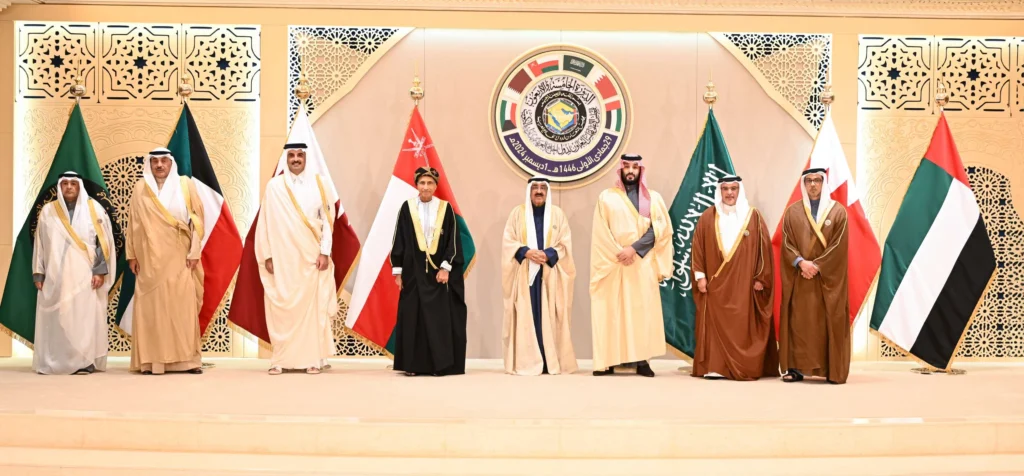
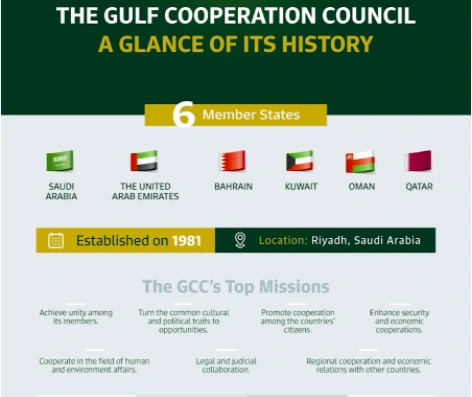
The Gulf Cooperation Council was formally established on May 25, 1981 in Abu Dhabi, United Arab Emirates. It was created in the context of rising regional instability, including the 1979 Iranian Revolution and the outbreak of the Iran : Iraq War, which underscored the need for unified security and economic coordination among the Arab Gulf states. The founding charter outlined three overarching goals: to coordinate, integrate, and inter-connect among member states in all fields in order to achieve unity.
Over the decades, the GCC ( Gulf Cooperation Council) has evolved from a primarily security-focused bloc into a comprehensive economic, political, and cultural union. It operates through a Supreme Council (the highest decision-making body), a Ministerial Council, a Secretariat General headquartered in Riyadh, and various specialized technical committees.
Member States
The six member states of the GCC are:
- Saudi Arabia : The largest economy in the Arab world and the world’s leading oil exporter. Home to Vision 2030, one of the most ambitious economic diversification plans globally.
- United Arab Emirates : A global trade and financial hub. Dubai and Abu Dhabi are among the world’s premier logistics, tourism, and investment centers.
- Qatar :The world’s largest LNG exporter and a major financier of global infrastructure projects through its sovereign wealth fund.
- Kuwait : Holds approximately 6–8% of global proven oil reserves and maintains one of the region’s largest sovereign wealth funds.
- Oman : A strategically located nation at the entrance of the Persian Gulf, increasingly focused on diversifying its economy through tourism, logistics, and manufacturing.
- Bahrain : A financial services hub and the first Gulf state to have discovered oil. Bahrain has pursued aggressive economic liberalization and hosts the U.S. Fifth Fleet.
Economic Scale and Global Relevance
The GCC Gulf Cooperation Council collectively accounts for approximately 40% of global proven crude oil reserves and over 20% of global natural gas reserves. Combined GDP exceeds $2 trillion, making it one of the world’s most economically powerful regional blocs. The region commands some of the most critical maritime chokepoints in global trade, including the Strait of Hormuz through which roughly 20% of global oil trade passes and is central to global energy security.
Historical Background of India–GCC Trade Relations
Ancient and Colonial Era Ties
The commercial and cultural ties between the Indian subcontinent and the Arab Gulf trace back thousands of years. The ancient spice and textile trade routes connected Indian ports such as Calicut and Surat with Arabian trading centers. Indian merchants, particularly from Gujarat and Kerala, established sustained diaspora communities along the Arabian coast long before the modern nation-state era. The British colonial period further institutionalized these ties, as India and the Gulf were both under British imperial oversight.
Post-Independence Developments
Following Indian independence in 1947 and the subsequent discovery and commercialization of Gulf oil, the relationship evolved rapidly. The oil boom of the 1970s, particularly following the 1973 OPEC embargo that quadrupled global oil prices, spurred an unprecedented demand for labor in the Gulf states. Millions of Indians particularly from Kerala, Tamil Nadu, Andhra Pradesh, Punjab, and Uttar Pradesh migrated to the Gulf in search of employment, creating what became the largest and most enduring labor migration in modern South Asian history.
The FTA Negotiations: A Decade of Starts and Stops
Formal negotiations for an India GCC FTA were first launched in August 2004 in Riyadh. The talks went through seven rounds of negotiations over several years but became stalled by 2008 due to fundamental disagreements over tariffs on petrochemicals, gold, and other sensitive products, as well as over the scope of services liberalization. India was concerned about Gulf Cooperation Council petrochemicals displacing domestic production, while GCC Gulf Cooperation Council countries sought deeper access to India’s vast consumer market without adequate protections for Indian industry.
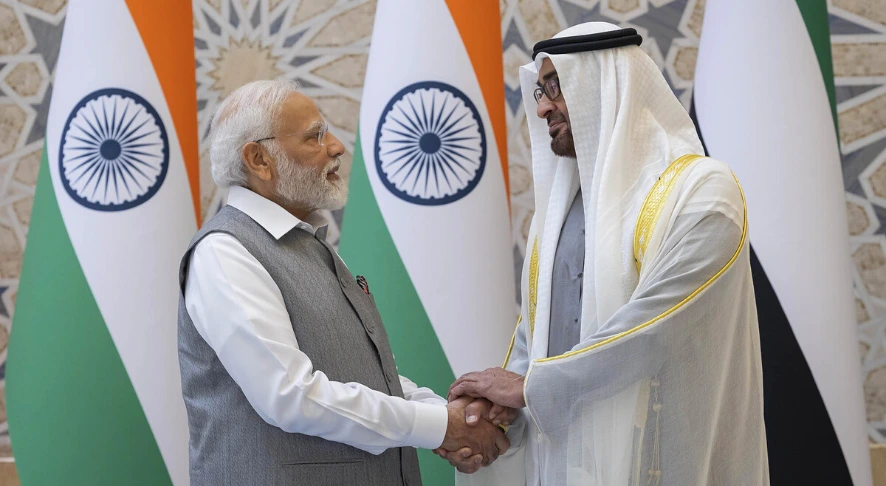
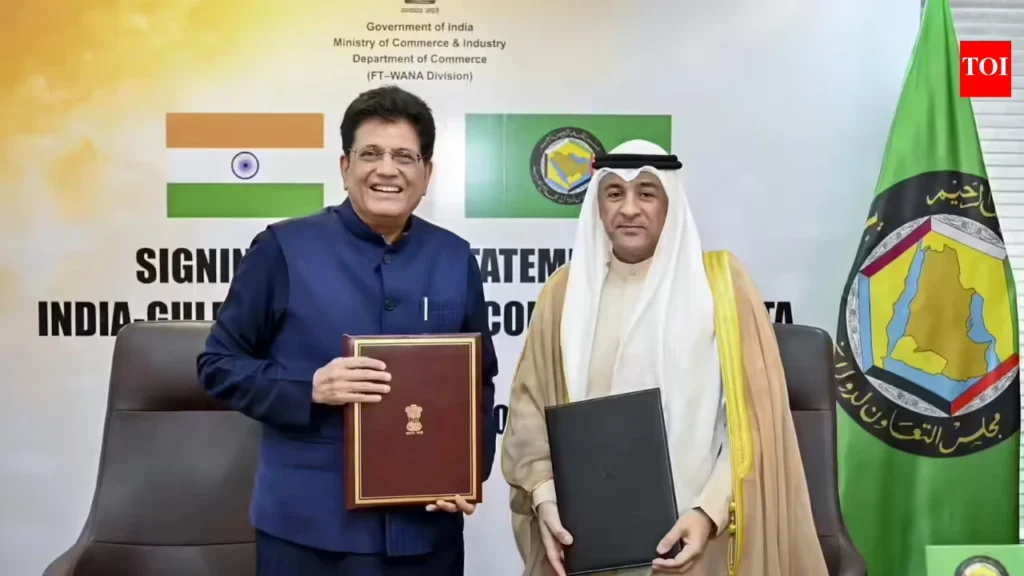
The latest joint statement marks a critical inflection point a mutual recognition that the strategic and economic benefits of an FTA outweigh the difficulties of negotiation, and that both sides must bring renewed seriousness and political commitment to finalizing the framework.
Core Objectives of the India: GCC Free Trade Agreement
Tariff Liberalization
At its core, the FTA seeks to reduce and eventually eliminate customs duties on a wide range of goods traded between India and GCC Gulf Cooperation Council countries. Priority sectors include petrochemicals, textiles, food and agricultural products, metals and steel, engineering goods, gems and jewelry, and pharmaceuticals. A phased tariff reduction schedule is expected to allow sensitive industries on both sides sufficient time to adjust. The FTA would move both sides away from the current framework of Most Favoured Nation (MFN) tariffs under WTO rules toward preferential bilateral rates.
Services Liberalization
Services trade is increasingly central to the India GCC (Gulf Cooperation Council) economic relationship. Indian IT firms, healthcare service providers, educational institutions, financial services companies, and engineering consultancies are all positioned to benefit significantly from improved market access in GCC countries. The FTA aims to create a transparent, rules-based services trade framework, including commitments on Mode 3 (commercial presence) and Mode 4 (movement of natural persons) service delivery.
Investment Promotion and Protection
GCC Gulf Cooperation Council sovereign wealth funds including the Abu Dhabi Investment Authority (ADIA), the Public Investment Fund (PIF) of Saudi Arabia, and the Qatar Investment Authority (QIA)collectively manage trillions of dollars in assets. The FTA includes provisions to encourage and protect bilateral investments through transparent regulatory frameworks, non-discriminatory treatment, and efficient international dispute resolution mechanisms. This is expected to unlock large-scale GCC Gulf Cooperation Council investment in Indian infrastructure, real estate, manufacturing, and technology.
Digital Economy and Technology Cooperation
Both India and the GCC Gulf Cooperation Council are making massive investments in digital infrastructure and smart economies. The FTA’s digital cooperation chapter aims to facilitate collaboration in fintech and digital payments (leveraging India’s UPI infrastructure), artificial intelligence and data analytics, cybersecurity, smart city development, and cloud computing. India’s deep technology talent pool and the GCC’s capital and infrastructural ambition make this a natural area for partnership.
Supply Chain Integration and Logistics
Strengthening logistics and connectivity is a cornerstone of the FTA. India and GCC countries are seeking to reduce supply chain friction by developing dedicated shipping corridors, upgrading port infrastructure, streamlining customs procedures through digital platforms, and expanding aviation linkages. Initiatives like the India-Middle East-Europe Economic Corridor (IMEC), announced at the G20 in New Delhi in 2023, provide a broader geopolitical framework within which FTA-driven supply chain integration can be accelerated.
Energy Partnership
While India already imports large quantities of crude oil and LNG from GCC countries, the FTA aims to elevate this relationship into a long-term structured energy partnership. This includes the establishment of long-term supply contracts at preferential pricing, joint refinery and petrochemical ventures, collaboration on strategic petroleum reserves, and cooperation in renewable energy — including solar, green hydrogen, and ammonia.
Key Highlights of the Joint Statement
The joint statement issued by India and the GCC reflects several strategic priorities and mutual acknowledgments:
- Renewed Commitment to Accelerate Negotiations: Both sides agreed to fast-track discussions following a prolonged pause, demonstrating that political leadership on both sides is now fully invested in completing the agreement.
- Economic Diversification Alignment: The FTA supports GCC Vision programs — particularly Saudi Vision 2030, UAE Vision 2031, and Qatar National Vision 2030 — which seek to reduce dependence on hydrocarbons. For India, the FTA supports its ambitions to become a $5 trillion economy and a global manufacturing hub.
- Workforce Mobility and Worker Protections: The statement gave particular emphasis to improving protections for Indian workers in GCC countries, ensuring fair contracts, skills recognition frameworks, and accessible legal redress mechanisms. This responds to long-standing concerns about the treatment of migrant workers under the kafala (sponsorship) system.
- Renewable Energy and Green Transition: The FTA signals an intent to build a forward-looking energy partnership aligned with global decarbonization goals, including green hydrogen, solar energy trade, and sustainable aviation fuels.
- Food and Agricultural Security: GCC countries depend heavily on food imports, and India is positioned as a natural partner and supplier. The statement underscored cooperation in ensuring stable food supply chains.
Strategic Importance of the FTA for India
Energy Security
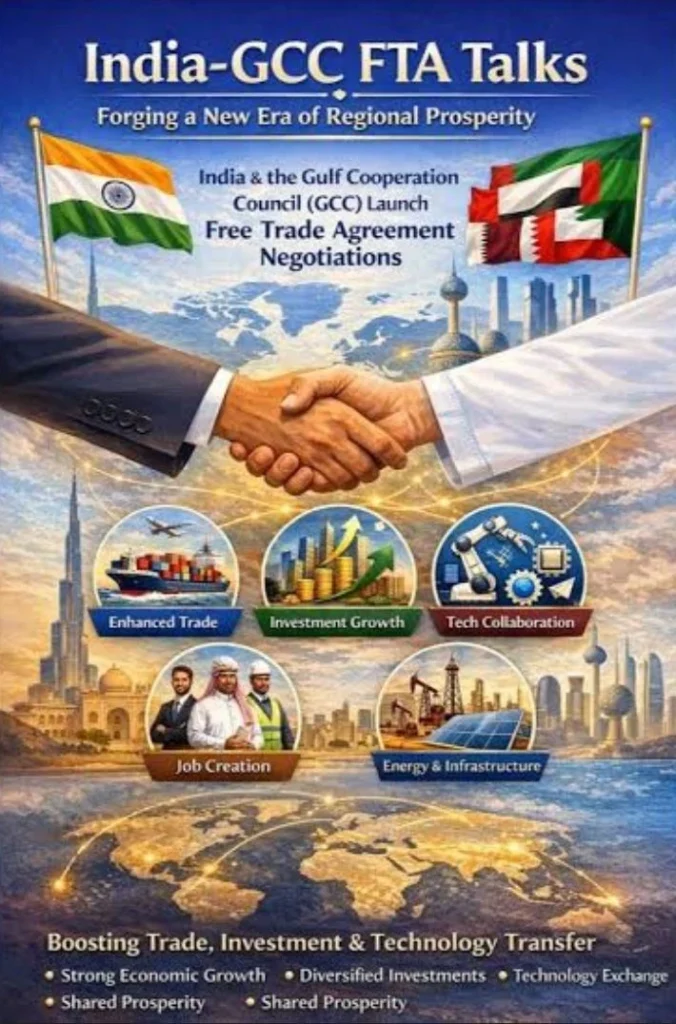
India is the world’s third-largest oil importer, consuming over 5 million barrels per day. The GCC supplies more than 50% of India’s crude oil imports and is a major supplier of LNG. The FTA would institutionalize these energy flows through long-term supply agreements and joint ventures, reducing India’s vulnerability to global price volatility and supply disruptions. It also opens doors for India to participate in GCC upstream energy assets.
Export Expansion
India’s export potential to GCC markets is vast and underexploited. Key sectors poised for growth include pharmaceuticals (India supplies over 25% of GCC drug demand and could increase this significantly), food and agri-products (rice, wheat, meat, dairy, processed foods), engineering goods (machinery, electrical equipment, auto parts), textiles and garments, gems and jewelry (India accounts for a huge share of global diamond processing and gold jewelry manufacturing), and IT and digital services (software development, BPO, cloud, cybersecurity).
Geopolitical and Strategic Leverage
The FTA is not merely economic — it is a strategic instrument. Deepening economic interdependence with the GCC strengthens India’s hand in the broader geopolitical competition for influence in the Middle East, where China, the United States, and European powers are all jostling for position. It reinforces India’s Act West policy and complements the IMEC corridor, which aims to link India to Europe via the Gulf and Israel.
Remittance and Financial Flows
India is the world’s largest recipient of remittances, receiving over $125 billion in 2023. The GCC accounts for roughly 35–40% of these inflows. The FTA, by improving labor market conditions and mobility pathways for Indian professionals, is expected to sustain and potentially increase remittance volumes, which directly contribute to household incomes, consumption, and economic stability across Indian states.
Attracting Investment
India is seeking to attract $100 billion+ in annual FDI as it builds its manufacturing base under schemes like Production Linked Incentives (PLI). GCC sovereign wealth funds and private investors represent a massive untapped source of capital. The FTA’s investment protection and facilitation provisions would give GCC investors greater legal certainty and confidence in deploying capital in Indian markets.
Benefits for GCC Countries
The FTA is not a one-sided arrangement. GCC countries stand to benefit substantially across multiple dimensions:
- Market Access: Access to India’s 1.4 billion-strong consumer market, which is projected to become the world’s third largest by purchasing power by 2030.
- Food and Agricultural Security: Reliable, large-volume supplies of rice, wheat, fruits, vegetables, meat, dairy, and processed foods from India help the GCC reduce its food import risk.
- Manufacturing and Startup Investment: Participation in India’s booming manufacturing ecosystem (electronics, semiconductors, pharmaceuticals, chemicals) and its thriving startup ecosystem (valued at over $400 billion collectively).
- Technology and Innovation Partnerships: Collaboration with Indian IT companies and engineering talent to advance smart city programs, digital governance, and AI-driven public services.
- Healthcare: Access to high-quality, cost-effective Indian healthcare services and pharmaceuticals, reducing healthcare costs for GCC governments and citizens.
- Human Capital: Continued and better-regulated access to India’s large, skilled, and semi-skilled labor pool to support construction, services, hospitality, and technology sectors.
Sector-Wise Impact Analysis
Energy and Petrochemicals
The energy sector is the bedrock of the India GCC relationship. The FTA would create a more structured framework for crude oil and LNG supply contracts, including long-term pricing mechanisms that provide budgetary predictability for both governments. Joint refinery projects such as the proposed West Coast refinery involving Aramco and ADNOC could emerge as flagship FTA-enabled investments. The agreement also creates a pathway for India to become a major importer and processor of GCC petrochemical feedstocks.
Agriculture and Food Security
India is one of the world’s largest producers and exporters of rice, wheat, sugar, onions, and spices. GCC countries import the vast majority of their food requirements. The FTA would reduce tariffs on Indian agricultural exports, making Indian food products more competitive and ensuring stable supply chains. Reciprocally, India could benefit from Gulf investment in Indian agri-processing, cold chain infrastructure, and food technology.
Pharmaceuticals and Healthcare
India is the pharmacy of the world, supplying generic medicines at competitive prices to over 200 countries. GCC countries have increasingly recognized Indian pharmaceutical quality, and the FTA would formalize and deepen this relationship. Beyond medicines, the agreement could facilitate greater presence of Indian hospitals, medical education institutions, and telemedicine providers in the Gulf, helping to address healthcare capacity constraints.
Information Technology and Digital Services
Indian IT companies including TCS, Infosys, Wipro, HCL, and hundreds of smaller firms already have a strong presence in the GCC. The FTA’s services chapter would reduce barriers to commercial establishment and the movement of IT professionals. Collaboration in AI, machine learning, cybersecurity, digital identity, and government technology (GovTech) represents enormous growth potential for Indian firms as GCC governments digitize at scale.
Logistics and Connectivity
Indian ports (Mundra, JNPT, Visakhapatnam) and GCC ports (Jebel Ali in Dubai, King Abdulaziz Port in Dammam) are natural partners in a future regional supply chain architecture. The FTA would catalyze investment in dedicated shipping corridors, customs digitization, and air cargo expansion. The IMEC corridor, linking India’s west coast to the UAE and onwards to Saudi Arabia, Jordan, Israel, and Europe, will dramatically increase the economic logic of India GCC logistics integration.
Gems, Jewelry, and Textiles
India is the world’s largest diamond polishing center and a major exporter of gold jewelry. The GCC, particularly the UAE, is a massive hub for gold and diamond trade. Reduced tariffs under the FTA would boost Indian gems and jewelry exports significantly. Similarly, Indian textiles and garments, which already enjoy a reputation for quality and variety, would gain enhanced access to Gulf markets.
Challenges and Contentious Issues
1. Petrochemical and Metal Tariff Sensitivity
India has long maintained protective tariffs on petrochemicals and downstream metal products to shield domestic industries. GCC countries, particularly Saudi Arabia and the UAE, are expanding their petrochemical manufacturing capacities significantly and seek preferential access to India’s large market. Resolving this tension without causing significant harm to Indian industry will require carefully designed tariff phase-down schedules, safeguard clauses, and rules of origin provisions.
2. Regulatory and Standards Harmonization
Differences in product standards, certification requirements, halal regulations, and pharmaceutical regulatory frameworks can create non-tariff barriers even when tariffs are eliminated. Aligning or mutually recognizing standards across six GCC countries and India each with its own regulatory bodies will be a complex and time-consuming technical exercise.
3. Labour and Immigration Policy
The kafala system, under which migrant workers’ legal status is tied to their employer, remains a contentious issue in India–GCC relations. While GCC countries have introduced some reforms, India seeks stronger contractual and legal protections for its workers. The FTA’s labor mobility provisions must balance GCC sovereignty over immigration policy with India’s legitimate interest in protecting its diaspora.
4. Trade Deficit Management
India runs a significant trade deficit with GCC countries, primarily because of energy imports. While the FTA aims to boost Indian exports, there is domestic concern that a poorly designed agreement could further widen this deficit. Careful sector-by-sector balancing and export promotion measures will be necessary to ensure that the FTA produces tangible gains for Indian exporters.
5. GCC Internal Coordination
While the GCC presents itself as a unified bloc in trade negotiations, member states have distinct economic interests and regulatory frameworks. Achieving a unified GCC negotiating position across tariff schedules, services commitments, and investment rules requires complex intra-GCC coordination, which can slow down the pace of talks with India.
Geopolitical Context and Strategic Implications
The India GCC FTA is not being negotiated in a vacuum. It is taking shape against the backdrop of a rapidly evolving global geopolitical order. The United States’ relative disengagement from the Middle East, China’s growing economic footprint in the Gulf through the Belt and Road Initiative (BRI), and the Abraham Accords’ normalization of Gulf-Israel relations are all reshaping the strategic calculus for every major power in the region.
For India, the FTA is a key pillar of its Act West strategy and its broader ambition to be recognized as an indispensable partner in the Gulf’s economic transformation. The IMEC corridor announced at the G20 in New Delhi in September 2023 and backed by the United States as a counterweight to China’s BRI would be dramatically enhanced by the FTA, creating a connected infrastructure and trade governance framework from Mumbai to Hamburg.
For GCC countries, especially Saudi Arabia and the UAE, deepening ties with India hedges against over-dependence on any single major power. As they diversify their economies and their diplomatic portfolios, India’s combination of democratic governance, technological capacity, large consumer market, and strategic location makes it an ideal long-term partner.
Future Outlook and Roadmap
The trajectory of the India–GCC FTA, while promising, will depend on sustained political will, technical diligence, and pragmatic flexibility. Based on current signals, the following roadmap is anticipated:
- Near-Term (2024–25): Resumption of formal negotiating rounds, exchange of goods and services tariff offer lists, and establishment of joint technical working groups on digital trade, investment, and energy.
- Medium-Term (2025–27): Resolution of key tariff disagreements, conclusion of services liberalization schedules, and agreement on investment protection provisions. Possibly an interim or early harvest agreement covering areas of convergence.
- Long-Term (2027 onwards): Entry into force of a comprehensive FTA, implementation of tariff phase-down schedules, and launch of joint investment and infrastructure projects enabled by the agreement.
A successfully concluded India–GCC FTA could serve as a template for India’s broader regional trade strategy, demonstrating that India is a serious and capable FTA negotiating partner. It would also deepen India’s integration into the global value chains that flow through the Gulf, from energy to logistics to digital services.
Frequently Asked Questions (FAQs)
Q1. What is the India GCC Free Trade Agreement?
The India GCC FTA is a proposed comprehensive trade and economic partnership agreement between India and the six Gulf Cooperation Council member state Saudi Arabia, UAE, Qatar, Kuwait, Oman, and Bahrain. It aims to boost trade in goods and services, promote cross-border investment, facilitate labor mobility, and deepen cooperation across sectors including energy, digital economy, agriculture, and logistics.
Q2. Why is the GCC so strategically important for India?
The GCC is critically important for India for multiple reasons: it supplies over 50% of India’s crude oil imports; it hosts more than 8.5 million Indian expatriates who remit approximately $40–50 billion annually to India; it represents a major potential market for Indian exports; and it controls sovereign wealth funds with trillions of dollars in capital that could be invested in India’s infrastructure and manufacturing.
Q3. Which Indian sectors will benefit the most?
The sectors expected to benefit most include pharmaceuticals and healthcare, IT and digital services, agriculture and food processing, textiles and garments, gems and jewelry, engineering goods, and renewable energy. Indian logistics and financial services companies are also expected to gain from the agreement.
Q4. What challenges could delay or derail the agreement?
Key challenges include disagreements over petrochemical and metal tariffs, differences in regulatory standards, labor and immigration policy concerns particularly around the kafala system, managing India’s trade deficit with GCC countries, and achieving unified GCC positions across all member states. These issues will require patient, technically rigorous negotiations.
Q5. When is the agreement expected to be finalized?
No official timeline has been confirmed. However, the joint statement signals political intent to fast-track negotiations. Analysts suggest that an early harvest agreement covering areas of mutual convergence could be possible within 2–3 years, with a comprehensive FTA potentially concluded by 2027–28 if momentum is maintained.
Q6. How does this FTA relate to the India-Middle East-Europe Economic Corridor (IMEC)?
The IMEC, announced at the G20 New Delhi Summit in September 2023, envisions a trans-regional infrastructure corridor connecting India’s west coast to the UAE, Saudi Arabia, Jordan, Israel, and ultimately to Europe. The India GCC FTA would provide the trade governance framework that gives the IMEC its commercial logic, enabling seamless cross-border movement of goods, services, and investment along the corridor.
Conclusion
The joint statement on the India GCC Free Trade Agreement represents far more than a diplomatic formality. It is an acknowledgment by two of the world’s most economically consequential regions that their futures are deeply intertwined and that the time has come to build a formal, comprehensive, and enduring economic architecture to reflect that reality.
For India, the FTA promises to unlock new export markets, attract transformative investment, secure energy supplies, and strengthen geopolitical influence in a region of immense strategic importance. For the GCC, it provides access to one of the world’s largest and fastest-growing economies, a reliable food and technology partner, and a democratic anchor in a turbulent global order.
The road to finalization will not be without obstacles. Tariff disputes, regulatory differences, labor rights concerns, and the complexities of negotiating with a six-nation bloc will test the resolve of negotiators on both sides. But the foundational conditions for success political will, economic complementarity, and historical ties are firmly in place.
If successfully concluded, the India GCC Free Trade Agreement has the potential to be among the most consequential trade agreements of the 21st century, reshaping economic corridors, deepening energy cooperation, empowering millions of workers, and binding together two of the world’s most dynamic economic regions in a partnership built for the long term.