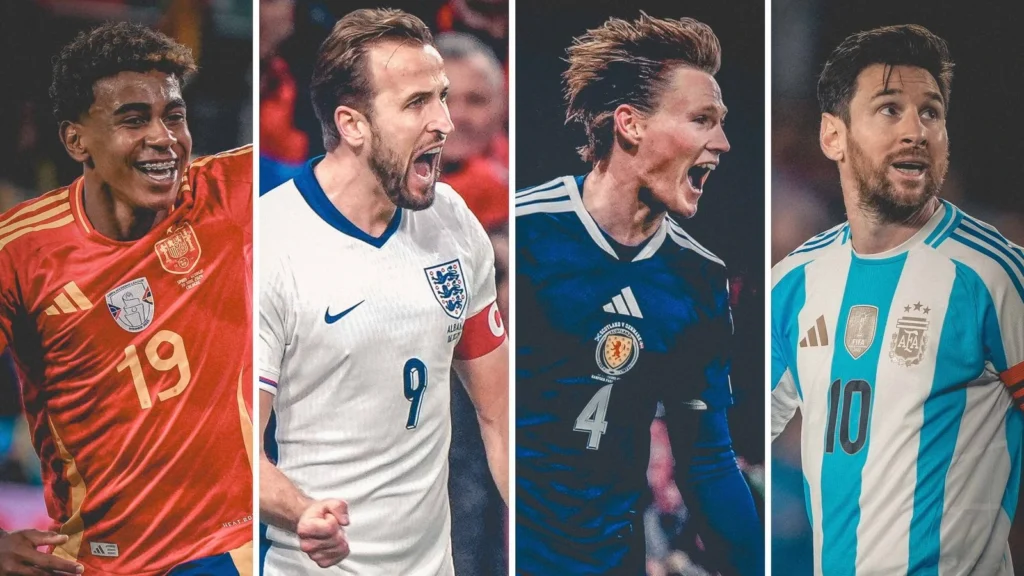
Top Players to Watch in FIFA World Cup 2026
Every World Cup produces its defining stars players whose performances transcend the tournament and enter football’s eternal conversation. Based on current form and trajectory, these are the players whose 2026 performances will be most eagerly anticipated by the global football community.
The Established Superstars
- Kylian Mbappe (France): At 27, he will be at the absolute peak of his physical powers in 2026. Already with a World Cup winners medal (2018) and a runners-up medal (2022), Mbappe in 2026 will be one of the most-watched individuals in global sport. His combination of pace, technique, and goalscoring instinct is genuinely unparalleled.
- Vinicius Jr. (Brazil): The Real Madrid forward has developed into one of the most explosive and effective attackers in world football. At 25 in 2026, Vinicius will be motivated by Brazil’s desire to end their long wait for a sixth World Cup title and by his own status as the figurehead of a new generation of Brazilian football.
- Jude Bellingham (England): At just 22 years old during the 2026 tournament, Bellingham already carries the weight of England’s expectations on his shoulders. His box-to-box excellence, leadership, and goalscoring threat from midfield make him a truly unique player.
Young Superstars Entering Their Prime
- Lamine Yamal (Spain): Born in 2007, Yamal will be 18 during the 2026 World Cup yet will already be one of the most experienced players in Spain’s squad. His natural talent has drawn comparisons to the great Lionel Messi, which at his age is extraordinary praise.
- Florian Wirtz (Germany): Germany’s creative talisman combines exceptional technical ability with goalscoring instinct. At 22 in 2026, Wirtz will be a primary reason Germany are considered serious contenders.
- Endrick (Brazil): The teenager who joined Real Madrid from Palmeiras will be 19 during the tournament. His blend of pace, physicality, and finishing has already drawn admiring attention from across world football.
Legendary Players’Potential Final World Cup
For some players, 2026 may represent their final opportunity to achieve the ultimate prize. Lionel Messi, who turns 39 shortly before the tournament, has hinted that his competitive career may extend to 2026, motivated by the chance to defend Argentina’s title. Whether or not Messi participates, his legacy as the greatest player of his generation (and arguably of all time) will be felt throughout the 2026 tournament. Similarly, Cristiano Ronaldo, Luka Modric, Robert Lewandowski, and others will face questions about whether 2026 represents their final World
FIFA World Cup 2026 Host Country Details
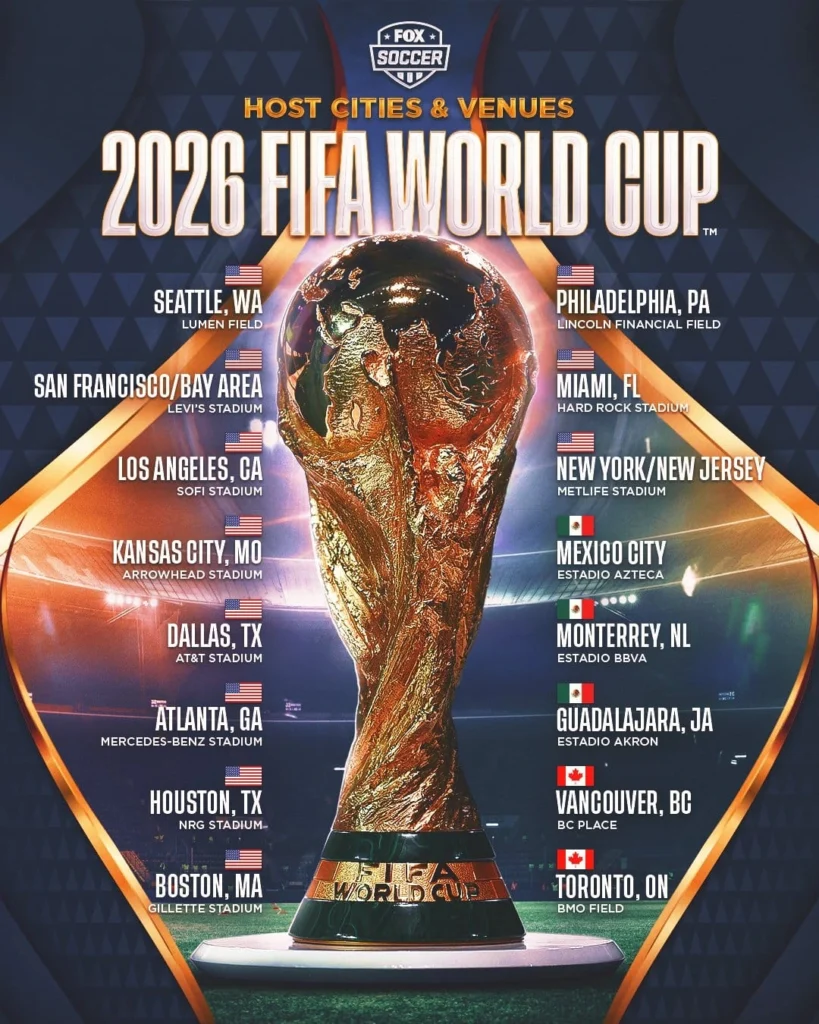
For the first time in the history of the FIFA World Cup, three nations will jointly host the tournament. The United States, Canada, and Mexico successfully bid for the 2026 edition under the combined ‘United 2026’ bid, which was awarded by FIFA in June 2018, defeating a rival bid from Morocco. This tri-nation hosting arrangement is unprecedented and reflects both the logistical capacity of North America and FIFA’s ambition to grow the sport in the region.
The United States
The United States will serve as the primary host, staging the largest number of matches including the grand final. The USA last hosted the World Cup in 1994, when the tournament attracted then-record average attendances and left a lasting legacy for football in the country. That event is widely credited with launching Major League Soccer (MLS), which has grown into one of the top football leagues in the world. Key American host cities include New York/New Jersey (home of MetLife Stadium, expected to host the final), Los Angeles, Dallas, San Francisco/Bay Area, Miami, Atlanta, Seattle, Boston, Kansas City, and Philadelphia. These cities collectively represent the diversity of American geography, culture, and football fandom.
Mexico
Mexico is, in many respects, the heartbeat of Latin American football. The country’s passion for the game is legendary, and its stadiums particularly the iconic Estadio Azteca in Mexico City are among the most atmospheric in the world. The Azteca is set to host matches in 2026, completing a remarkable hat-trick: it previously hosted World Cup finals in 1970 (Brazil vs. Italy) and 1986 (Argentina vs. West Germany). No other stadium in history has hosted three World Cup finals. Mexico will also stage matches in Guadalajara and Monterrey.
Canada
Canada is the newest of the three co-hosts in terms of World Cup hosting experience this will be its first ever FIFA World Cup. The country has invested significantly in football infrastructure in recent years, buoyed by the growth of the Canadian Premier League and the historic qualification of the Canadian men’s national team for the 2022 World Cup (their first since 1986). Host cities in Canada include Toronto and Vancouver, offering world-class facilities and a diverse, passionate fan base.
Stadium Venues: A Closer Look
| Stadium | City | Country | Capacity |
| MetLife Stadium | New York/New Jersey | USA | ~82,500 |
| SoFi Stadium | Los Angeles | USA | ~70,000 |
| AT&T Stadium | Dallas | USA | ~80,000 |
| Levi’s Stadium | San Francisco | USA | ~68,500 |
| Hard Rock Stadium | Miami | USA | ~65,000 |
| Estadio Azteca | Mexico City | Mexico | ~87,500 |
| Estadio Akron | Guadalajara | Mexico | ~49,850 |
| Estadio BBVA | Monterrey | Mexico | ~53,500 |
| BMO Field | Toronto | Canada | ~30,000+ |
| BC Place | Vancouver | Canada | ~54,500 |
Fan Zones and Tourism Impact
Beyond the stadiums themselves, the tri-nation hosting format will create an enormous tourism economy. Fan zones in each host city will accommodate tens of thousands of supporters who cannot secure match tickets but wish to experience the atmosphere. Hotels, airlines, and hospitality businesses across North America are expected to see unprecedented demand. Economists project the combined economic impact of the 2026 World Cup across the three host nations to exceed $5 billion USD.
FIFA World Cup 2026 Dates & Tournament Schedule
The FIFA World Cup 2026 is scheduled to take place from June to July 2026, spanning approximately 39 days from the opening match to the grand final. The expanded 48-team format means the tournament is longer than previous editions, with 104 total matches compared to 64 in Qatar 2022.
Tournament Timeline Overview
| Stage | Approximate Dates | Matches |
| Group Stage | Mid-June 2026 | 72 matches (12 groups x 6 games) |
| Round of 32 | Late June 2026 | 16 matches |
| Round of 16 | Early July 2026 | 8 matches |
| Quarterfinals | Mid-July 2026 | 4 matches |
| Semifinals | Mid-July 2026 | 2 matches |
| Third Place Play-Off | Late July 2026 | 1 match |
| Grand Final | Late July 2026 | 1 match |
Opening Ceremony and First Match
The opening ceremony for FIFA World Cup 2026 is expected to be a spectacular, globally-broadcast event showcasing North American culture, music, and football heritage. Based on FIFA’s tradition, a host nation’s team will play in the opening match, likely held at a major US stadium such as MetLife Stadium or AT&T Stadium. The ceremony is anticipated to feature world-renowned artists and draw an in-stadium crowd of over 80,000, with hundreds of millions more watching worldwide.
Match Timing Guide for Indian Viewers (IST)
For fans watching from India, the time difference with North America presents a challenge. Matches played in the afternoon local time in North America will be in the late evening or early morning hours in India (IST = UTC+5:30).
| Local Kick-Off Time (USA/Mexico) | Indian Standard Time (IST) | Viewer Experience |
| 12:00 PM (Noon) ET | 9:30 PM IST | Evening viewing — comfortable |
| 3:00 PM ET | 12:30 AM IST | Late night |
| 6:00 PM ET | 3:30 AM IST | Very early morning |
| 9:00 PM ET | 6:30 AM IST | Early morning — manageable |
FIFA World Cup 2026 Format & Groups Explained
The new 48-team format is the most significant structural change to the World Cup since the expansion from 24 to 32 teams in 1998. Understanding how it works is essential for any serious fan.
The 48-Team Format Explained
The 48 qualified nations will be divided into 12 groups of four teams each. In each group, all four teams play each other once (three matches each), earning 3 points for a win, 1 for a draw, and 0 for a loss. The top two teams from each group qualify automatically for the Round of 32. Additionally, the eight best third-placed teams from across all 12 groups also advance, creating 32 teams for the knockout stage.
The Round of 32 A New Stage
One of the most talked-about additions to the 2026 format is the Round of 32 — an extra knockout round that did not exist in the 32-team format. This stage adds 16 more high-stakes matches and means that qualification from the group stage no longer guarantees reaching the Round of 16. Teams must now win a knockout match immediately after the group stage, adding a new layer of drama and unpredictability to the tournament structure.
Group Stage Draw and Seeding
The draw for the group stage is conducted by FIFA using a pot system based on FIFA World Rankings. The highest-ranked teams are placed in Pot 1 as seeds to ensure they are distributed across different groups. Geographic restrictions also apply teams from the same confederation are generally not drawn into the same group (with some exceptions for UEFA, which has the most teams). The concept of a ‘Group of Death’ a group containing multiple strong teams remains a beloved fixture of World Cup culture and becomes more statistically likely with 12 groups in play.
FIFA World Cup 2026 Qualified Teams
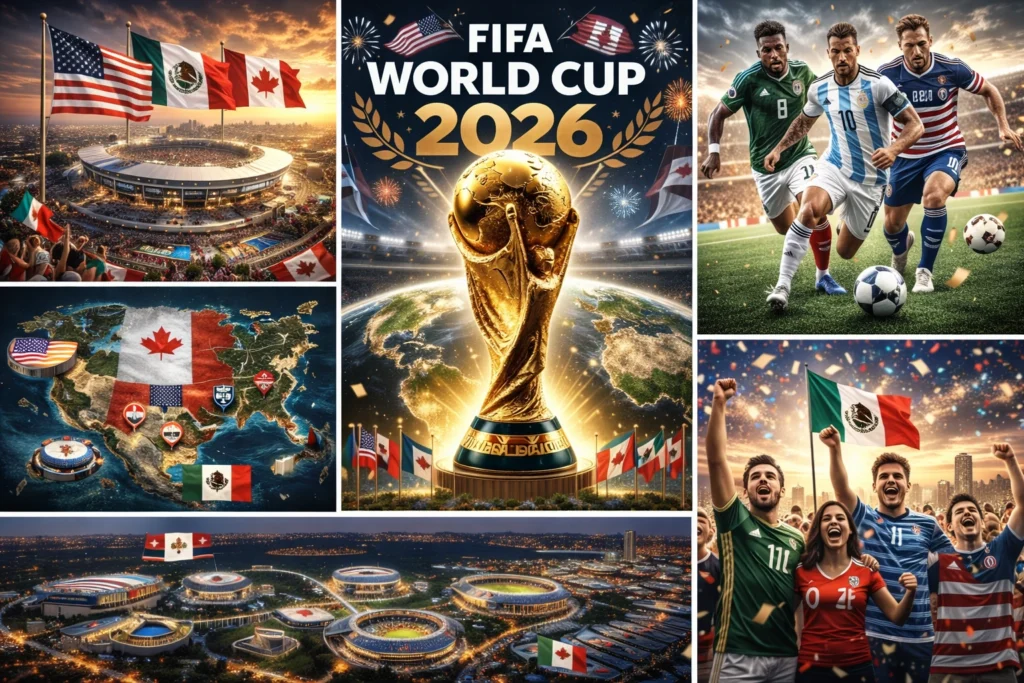
With 48 spots available, the qualification landscape for FIFA World Cup 2026 is broader than ever before. Qualification spots are distributed across FIFA’s six confederations: UEFA (Europe), CONMEBOL (South America), AFC (Asia), CAF (Africa), CONCACAF (North/Central America & Caribbean), and OFC (Oceania).
Allocation of Spots by Confederation
| Confederation | Region | Direct Spots | Total |
| UEFA | Europe | 16 | 16+ |
| CONMEBOL | South America | 6 | 6+ |
| AFC | Asia | 8 | 8+ |
| CAF | Africa | 9 | 9+ |
| CONCACAF | N./C. America & Caribbean | 6 (incl. 3 hosts) | 6+ |
| OFC | Oceania | 1 | 1 |
Automatic Qualification: Host Nations
As is customary in FIFA World Cup rules, the three co-host nations the United States, Canada, and Mexico receive automatic qualification and do not need to participate in the standard qualifying process. All three nations are counted against CONCACAF’s allocation.
Strong Contenders and Perennial Powers
Argentina
The reigning World Cup champions, Argentina enter 2026 as the team to beat. Led by Lionel Messi — who will be 38 at tournament time — and a generation of exceptional talent including Julian Alvarez, Enzo Fernandez, and Rodrigo De Paul, Argentina’s squad blends experience and explosive youth. Their CONMEBOL qualification campaign will be watched intensely as a barometer of their form going into 2026.
Brazil
The five-time World Cup champions possess extraordinary depth in attack, with players like Vinicius Jr., Rodrygo, Raphinha, and Endrick capable of dismantling any defense. Brazil will be determined to reclaim the trophy they last won in 2002, and their passion for the game makes them always one of the most dangerous teams in any tournament.
France
Runners-up in 2022 and champions in 2018, France possess perhaps the most talented individual squad in world football. With Kylian Mbappe in his prime, plus Aurelien Tchouameni, Antoine Griezmann, and a deep talent pool, Les Bleus are consistent favorites for the title in any World Cup they enter.
England
England arrive in 2026 with genuine ambition after a series of strong tournament performances. With Jude Bellingham, Phil Foden, Bukayo Saka, Harry Kane, and a new wave of emerging talents, England fans dare to believe their long major trophy drought could end in North America. The depth and quality of this England squad is arguably the best in a generation.
Germany
Four-time World Cup winners, Germany are in a period of renewal following disappointing early exits in 2018 and 2022. A new generation of exciting players led by Florian Wirtz, Jamal Musiala, and Kai Havertz gives Germany genuine momentum. Playing in front of massive German-American communities across the USA, they could receive extraordinary support.
Emerging Teams and Dark Horses
One of the most exciting aspects of expanding to 48 teams is the opportunity for emerging football nations to compete on the world’s biggest stage. From Asia, Japan (who defeated Germany and Spain in 2022), South Korea, and Australia are strong contenders. From Africa, Morocco who reached the 2022 semifinals, the best ever performance by an African nation Senegal, Nigeria, and Egypt will be forces to reckon with. The expanded format gives smaller nations a genuine chance to make their mark on world football.
FIFA World Cup 2026 Qualifiers: Complete Overview
The qualification process for FIFA World Cup 2026 is the most expansive in the tournament’s history. With 48 spots available (minus three for the host nations, leaving 45 spots to be filled through qualification), more nations than ever before have a realistic path to the finals. Qualification is managed by each of FIFA’s six confederations, each using its own format and structure tailored to the size and nature of its membership.
The increased allocation of spots across each confederation particularly for Asia (from 4.5 to 8 spots) and Africa (from 5 to 9 spots) — has made the qualification process more competitive and more meaningful than ever before. Nations that previously had almost no realistic chance of qualifying now find themselves within reach of the world’s greatest stage.
Qualifiers: Europe (UEFA)
Europe’s UEFA confederation is the largest contributor of teams to the World Cup. With 16 direct qualification spots available an increase from 13 in the 32-team format the European qualifying competition involves 54 UEFA member nations and is highly competitive.
Format of UEFA Qualification
The UEFA qualifying campaign is structured in a group stage format. The 54 nations are divided into groups of varying sizes (typically 4-6 teams each). Each team plays home and away matches against every other team in their group. Group winners qualify directly. Second-placed teams and some Nations League performers enter playoffs for additional spots.
Key Talking Points from UEFA Qualification
- Traditional powerhouses: Germany, Spain, Portugal, France, Italy, the Netherlands, and England are all expected to qualify from their groups, though upsets are never impossible in international football.
- Nations League integration: UEFA’s Nations League competition is integrated with the World Cup qualification playoff pathway, providing additional routes for talented teams who underperform in their qualifying groups.
- Potential surprise qualifiers: Nations such as Austria, Turkey, Romania, and Serbia have shown significant improvement and may qualify ahead of historically stronger nations.
- Smaller nations with prospects: Iceland, Scotland, Wales, and the Czech Republic will compete fiercely in their groups and could spring surprises.
Qualifiers: Asia (AFC)
The Asian Football Confederation has been allocated 8 direct qualifying spots a significant increase from the 4.5 spots available for the 2022 World Cup. This reflects both the expansion of the tournament and FIFA’s recognition of football’s growing strength across the Asian continent.
AFC Qualification Structure
The AFC qualifying process operates through multiple rounds. Nations first play in preliminary rounds to whittle down the field before entering the main qualifying round-robin groups. The top two teams from each of the main qualifying groups qualify directly, while third and fourth-placed teams may enter a playoff round for additional spots.
Asian Teams to Watch
- Japan: Consistently one of Asia’s strongest sides, Japan stunned the world in 2022 by defeating Germany and Spain in the group stage before falling to Croatia on penalties.
- South Korea: The co-hosts of the 2002 World Cup, South Korea boast world-class talent in Europe’s top leagues and remain a consistent qualifier and knockout contender.
- Iran: Asia’s most prolific qualifiers in recent decades, Iran are organized, disciplined, and capable of defeating top competition.
- Saudi Arabia: Their stunning defeat of Argentina in 2022 announced them as a force to be taken seriously, and Saudi football has attracted enormous investment since.
- Australia: The Socceroos play in the AFC and reached the 2022 Round of 16, with a growing football culture and strong infrastructure.
- India: India’s qualification journey remains challenging. Currently ranked outside the top 100 globally by FIFA, India would need a remarkable transformation to qualify. However, growing domestic interest in the ISL (Indian Super League) represents the foundation for long-term improvement.
Qualifiers: South America (CONMEBOL)
CONMEBOL’s qualification format is unique: all ten South American nations play each other in a full home-and-away round-robin, effectively a mini-league spanning two years of international football. The top six teams qualify directly — a significant improvement from the four direct spots plus one playoff spot available for 2022.
How the CONMEBOL Table Works
Every nation plays 18 matches in total (home and away against each of the other nine nations). Points, goal difference, goals scored, head-to-head results, and FIFA ranking are the tiebreakers in order. The marathon format means every match is crucial a bad run of results early in the campaign can leave a nation chasing points for months.
Key Rivalries and Fixtures
- Argentina vs. Brazil: The ‘Superclasico de las Americas’ is one of the most iconic rivalries in world football. Whenever these two giants meet in the CONMEBOL table, it is the most-anticipated fixture on the calendar.
- Uruguay: Consistently punching above their weight for a nation of just 3.5 million people, Uruguay are World Cup royalty (two-time winners) and always competitive qualifiers.
- Colombia: Talented, technical, and capable of challenging for the direct qualification spots, Colombia are perennial CONMEBOL contenders.
- Ecuador and Peru: Both nations are capable of challenging for the coveted direct qualification spots, with Ecuador particularly showing impressive form in recent campaigns.
Current Standings Explanation
The CONMEBOL table is dynamic and can shift dramatically based on a single round of fixtures. Teams separated by a single point face entirely different realities direct qualification versus the uncertainty of a playoff. Goal difference becomes crucially important as the campaign nears its conclusion, adding extraordinary tension to even apparently low-stakes late fixtures.
Qualifiers: Confederation Wide Team List
As qualification campaigns are ongoing, the definitive list of qualified teams will not be finalized until the final qualifying windows in late 2025. The following table provides an educated overview of the expected participants by confederation based on current form and historical patterns.
| Confederation | Expected Qualifiers (Examples) | Spots |
| UEFA (Europe) | France, Germany, England, Spain, Portugal, Italy, Netherlands, Belgium, and others | 16 |
| CONMEBOL (S. America) | Argentina, Brazil, Uruguay, Colombia, Ecuador, and one more | 6 |
| AFC (Asia) | Japan, South Korea, Iran, Saudi Arabia, Australia, and others | 8 |
| CAF (Africa) | Morocco, Senegal, Nigeria, Egypt, and others | 9 |
| CONCACAF | USA (host), Mexico (host), Canada (host), and 3 qualifiers | 6 |
| OFC (Oceania) | New Zealand or another OFC winner | 1 |
Qualifiers: Match Schedule and Key Windows
Qualifying matches for the 2026 World Cup take place during FIFA’s designated international break windows throughout the calendar year. These windows allow clubs to release their players for national team duty while maintaining the balance with club football schedules.
Key International Break Windows
- March window: An early indicator of form and momentum. Teams use this window to set the tone for their campaign and establish early positions in qualifying tables.
- June window: A critical mid-campaign window where standings begin to take shape and pressure mounts on lower-placed teams needing to recover ground.
- September window: Qualification begins to crystallize. Teams with comfortable leads can manage resources while those in danger must push aggressively.
- October window: One of the most exciting windows as direct qualification begins to be confirmed for leading nations and playoff races intensify.
- November window (Final): The conclusion of most qualifying campaigns. Nations win, lose, or draw their way to the finals the culmination of two years of competition.
High Voltage Qualifier Fixtures
Some matches in the qualifying campaign carry extraordinary weight and attract global audiences even before the tournament begins. Fixtures such as England vs. Germany in UEFA qualifying, Argentina vs. Brazil in CONMEBOL, Japan vs. South Korea in AFC, and Morocco vs. Nigeria in CAF represent the kind of marquee international football that rivals any club game for drama and significance.
FIFA World Cup 2026 Tickets Guide
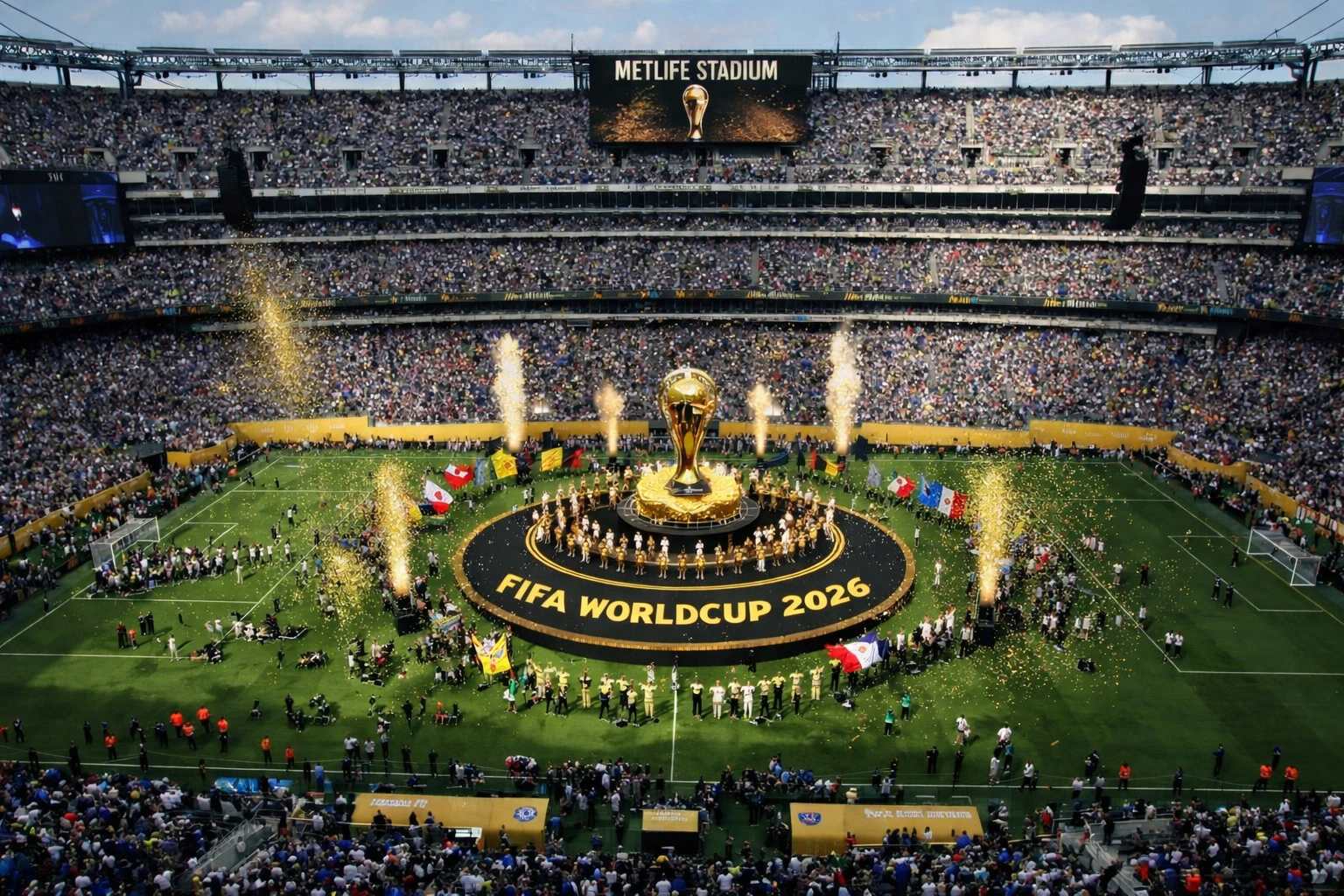
Tickets for the FIFA World Cup 2026 are among the most coveted in global sport. With the expansion to 48 teams and 104 matches, there will be more tickets available than ever before but demand will also be at an all-time high. Planning ahead is absolutely essential for any fan wishing to attend.
Ticket Release Timeline
- Phase 1 (Early Access / Draw Lottery): Ticket applications open before the group stage draw, allowing fans to apply for tickets without knowing which specific matches will be played at each venue. These are allocated via a lottery system to manage overwhelming demand.
- Phase 2 (Post-Draw Sales): After the group draw, fans can apply for specific match tickets knowing which teams will be playing. This phase is more popular as fans can target their preferred nations or venues.
- Phase 3 (Remaining Inventory and Resales): Any remaining tickets are sold on a first-come, first-served basis. FIFA also operates an official resale platform to combat the secondary market.
- Phase 4 (Last-Minute Sales): Shortly before the tournament, FIFA releases any final remaining inventory. These tickets are snapped up almost instantly.
Ticket Price Categories
| Category | Match Type | Approximate Price Range (USD) |
| Category 1 (Best seats) | Group Stage | $200 – $500 |
| Category 2 (Standard) | Group Stage | $100 – $250 |
| Category 3 (Basic) | Group Stage | $50 – $150 |
| Category 1 | Quarterfinal/Semifinal | $500 – $1,200 |
| Category 1 | Grand Final | $1,000 – $3,000+ |
| VIP Hospitality Packages | Any match | $2,000 – $10,000+ |
How to Buy Tickets from India
- Official FIFA ticket portal: All official tickets must be purchased through FIFA’s official website (fifa.com/tickets). There is no other official channel. Purchasing from any other source risks receiving fraudulent tickets.
- Create a FIFA account: Register on the FIFA website well in advance. You will need a FIFA account to apply for or purchase tickets during any sales phase.
- Apply during the lottery: For high-demand phases, submit your application during the official application windows. Payment is only charged if you are successful in the draw.
- Travel and visa planning: Indian fans will need a US, Canadian, or Mexican visa depending on which matches they plan to attend. Apply for visas well in advance demand will be extraordinarily high. Consider using FIFA’s official travel partners for package deals that include accommodation and match tickets.
- Avoiding scams: Never purchase tickets from third-party resellers, social media listings, or unofficial websites. FIFA’s official resale platform is the only safe secondary market. Scams targeting international football fans are extremely common during World Cup cycles and can be highly sophisticated.
Predictions & Tournament Favorites
Predicting a World Cup winner is an exercise in informed speculation the tournament has a well-documented history of surprises, upsets, and dark horses. Nevertheless, based on current squad strength, tactical cohesion, and tournament experience, the following analysis provides a framework for understanding the 2026 contenders.
Top Title Contenders
- Argentina: As reigning champions with a tactically astute coach and a squad blending world-class individuals with genuine team chemistry, Argentina are the favorites based on pedigree. Their CONMEBOL qualification form will signal their intent going into the tournament.
- France: The richest individual talent pool in the world, marshalled by world-class management. France’s ability to absorb pressure and win knockout football makes them particularly dangerous in the later stages.
- Brazil: The emotional weight of 24 years without a World Cup title and an explosive attacking generation makes Brazil the sentimental pick of many analysts and pundits worldwide.
- England: The stars are aligning for England. Bellingham, Saka, Foden, Kane — this is arguably England’s most talented squad in 60 years. The talent to end their long major trophy drought is undeniably present.
Potential Surprise Semifinalists
- Portugal: With or without Ronaldo, Portugal possess exceptional squad depth. Felix, Bernardo Silva, Ruben Neves, and others make them quietly dangerous in any tournament.
- Spain: A new generation built around Barcelona’s La Masia production line, including Lamine Yamal and Pedri. Spain always find a way to compete at the highest level of international football.
- Morocco: Their 2022 semifinal run was no fluke. With continued development and the passionate support of large North African communities across major US cities, Morocco could genuinely challenge for the final four again.
- Netherlands: Talented, occasionally inconsistent, and capable of brilliant football. The Netherlands have the individual quality to reach the final four if their team cohesion matches their individual ability.
Tactical Trends Expected in 2026
Modern international football has evolved significantly in recent cycles. Expect a prevalence of high-pressing, compact defensive structures, and the increasing importance of midfield control. The growing influence of data analytics in squad selection and tactical preparation will be more visible than ever before. Set pieces corners, free kicks, and throi ns have become increasingly sophisticated and decisive in international football, and teams that master these situations gain a significant competitive advantage over those that do not.
How to Watch FIFA World Cup 2026 Live
With 104 matches spread across 39 days, fans will have more live football to watch than ever before. The broadcasting landscape for 2026 is expected to include a mix of traditional television, OTT streaming, and digital platforms across every major market in the world.
Expected Broadcasters in India
The broadcasting rights for FIFA World Cup 2026 in India have not been officially announced at the time of writing, but based on historical patterns, the rights are expected to be distributed between a major sports broadcaster and a streaming platform. JioCinema broadcast the 2022 World Cup in India for free, setting a new standard for digital sports broadcasting access. Fans should monitor official announcements from FIFA and from the eventual winning bidder during 2024-2025.
OTT and Streaming Platforms
Digital streaming has become increasingly central to how sports are consumed globally. FIFA itself has been developing its own digital platforms. In India, platforms with major sports rights will compete aggressively for the 2026 broadcast deal. The trend toward mobile-first viewing particularly among younger fans will be a key consideration for broadcasters as they structure their coverage packages.
Tips for Indian Viewers
- Download broadcaster apps in advance and ensure your internet connection is stable for HD or 4K streaming.
- Set alerts for match timings in IS the time difference means some important matches may fall at unusual hours requiring either a late night or early morning commitment.
- FIFA’s official website and social media channels will carry free highlights and key moments regardless of regional broadcaster arrangements.
- Fan zones and public screenings in major Indian cities will likely be organized by official broadcaster partners for the most significant matches of the tournament.
Frequently Asked Questions (FAQs)
When will FIFA World Cup 2026 start?
FIFA World Cup 2026 is expected to begin in mid-June 2026, with the grand final scheduled for late July 2026. The precise opening date will be confirmed by FIFA in their official match schedule announcement, expected well in advance of the tournament.
Who is hosting FIFA World Cup 2026?
The tournament is co-hosted by three nations: the United States, Canada, and Mexico. This is the first time in World Cup history that three nations have jointly hosted the tournament. The USA will stage the majority of matches including the grand final.
How many teams will play in the 2026 World Cup?
For the first time, 48 national teams will compete in the FIFA World Cup. This represents a 50% increase from the 32-team format used since 1998 and will result in 104 total matches across approximately 39 days.
When will FIFA World Cup 2026 groups be announced?
The group stage draw will be conducted by FIFA once all qualification campaigns have been completed, likely in late 2025 or early 2026. The draw ceremony is a major media event in its own right and will be broadcast globally to hundreds of millions of viewers.
How to buy FIFA World Cup 2026 tickets?
All official tickets must be purchased through FIFA’s official ticket portal at fifa.com. FIFA will announce ticket application windows in phases. It is critical that fans only use the official FIFA platform — third-party sellers are unregulated and purchasing from them risks receiving fraudulent tickets or paying far above face value.
Will Lionel Messi play in the 2026 World Cup?
As of writing, Lionel Messi has not confirmed whether he will play in the 2026 World Cup. He would be 38 years old during the tournament. Many observers believe his fierce competitive desire and Argentina’s status as reigning champions may motivate him to attempt a title defense, but this remains speculative.
How does the new 48-team format work?
The 48 teams are divided into 12 groups of 4. The top 2 from each group plus the best 8 third-placed teams advance to the Round of 32 (a new knockout stage). From there, standard knockout football — Round of 16, Quarterfinals, Semifinals, Third Place Play-Off, and the Grand Final — determines the champion.
Conclusion
The FIFA World Cup 2026 represents a watershed moment in the history of the beautiful game. Bigger, bolder, and more globally representative than any tournament that has come before it, the 2026 edition will write new chapters in football’s eternal story chapters of triumph and heartbreak, of debut nations and established giants, of defining moments that will be replayed and celebrated for generations to come.