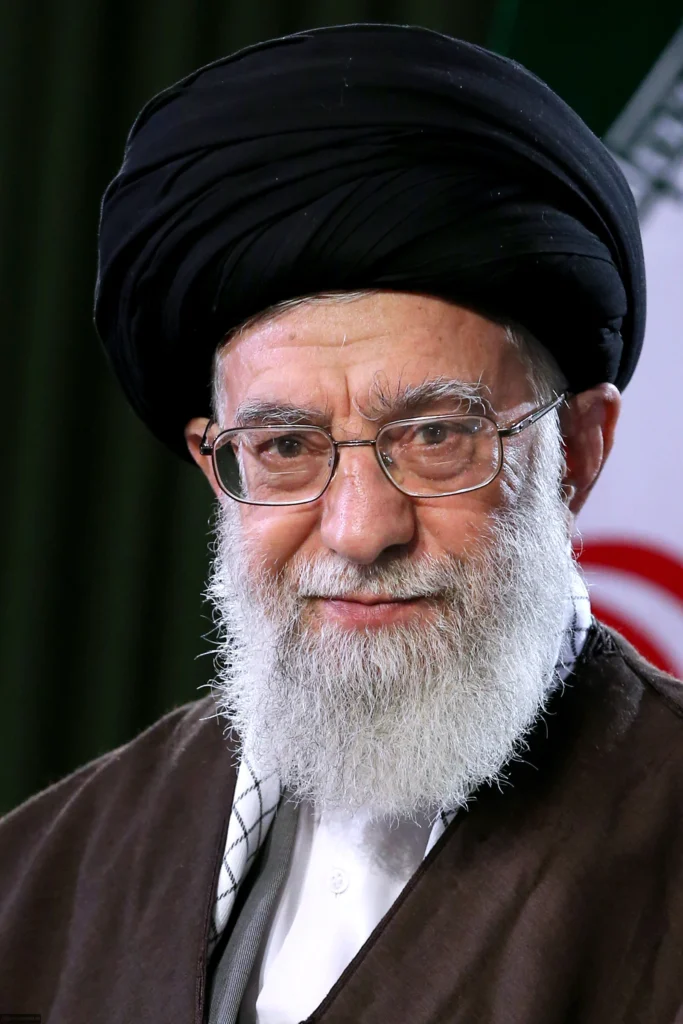
Who Was Ayatollah Ali Khamenei?
Ayatollah Ali Khamenei was not simply Iran’s president he was the Supreme Leader of Iran, the single most powerful position in the country. He held this role for nearly 37 years, from 1989 until his death on February 28, 2026, making him one of the longest-ruling leaders in the world. As Supreme Leader under Iran’s constitution, he had absolute authority over Iran’s military, nuclear program, judiciary, foreign policy, secret services, and state media. Even Iran’s elected president answered to him on all serious matters.
Khamenei was born on April 19, 1939, in Mashhad one of the holiest cities in the Shia Muslim world. He was a mid-level cleric when Ayatollah Khomeini, the founder of the Islamic Republic, died in 1989. He was not the obvious choice for Supreme Leader he lacked the senior religious credentials the constitution originally required but he was politically cunning and had built strong ties with the powerful Islamic Revolutionary Guard Corps (IRGC). Just before Khomeini died, Iran’s constitution was quietly revised to lower the religious requirements for the Supreme Leader role, which allowed Khamenei to be elevated.
Over the following decades, Khamenei systematically consolidated power. He sidelined rivals, built up the IRGC into a massive military-economic empire, and made himself the final authority on every issue of consequence. He championed Iran’s nuclear program as a symbol of national pride and independence. He built and funded Iran’s network of armed proxy groups Hezbollah in Lebanon, Hamas in Gaza, Houthi rebels in Yemen, and militias across Iraq and Syria to project Iranian power across the region without risking direct Iranian military engagement. He oversaw brutal crackdowns on multiple protest movements the 2009 Green Movement, the 2019 fuel protests, the 2022 Mahsa Amini uprising, and the January 2026 mass protests, the last of which resulted in more than 7,000 civilians being killed by Iranian security forces, shocking the world.
When Khamenei was killed, it marked only the second leadership transition since Iran’s 1979 revolution an event of extraordinary historical significance.
The Assassination What Happened on February 28, 2026?
The Operation
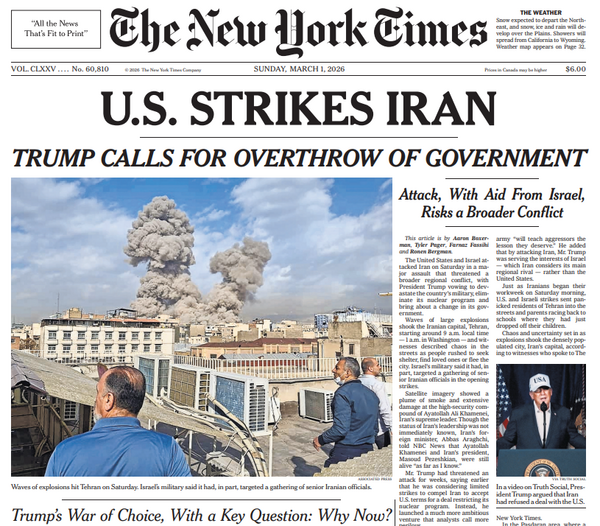
On Saturday, February 28, 2026, the United States and Israel launched a massive coordinated military assault on Iran. The operation was codenamed “Operation Roaring Lion” by Israel and “Operation Epic Fury” by the US Department of Defense. It was described by US Defense Secretary Pete Hegseth as “the most lethal, most complex, and most-precision aerial operation in history.”
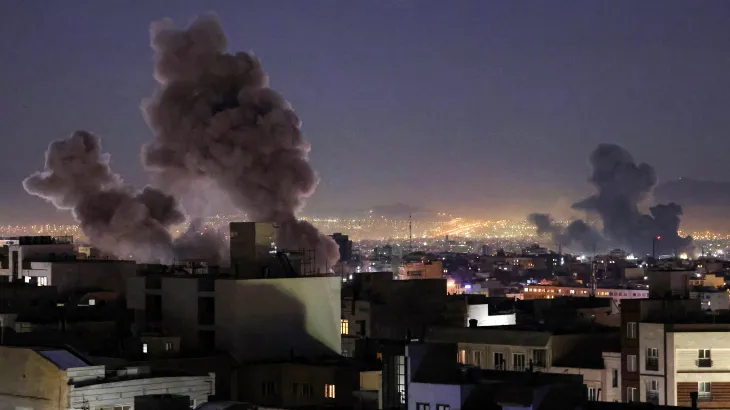
The strikes began in the early morning hours in Iran during the holy month of Ramadan, as Iranian civilians were observing the pre-dawn Suhoor meal. Huge explosions rang out across Tehran and multiple other cities. About 200 Israeli fighter jets hit approximately 500 targets across western and central Iran, including aerial defense systems, missile launchers, military bases, and leadership compounds. US missiles and drones struck simultaneously.
Khamenei’s Death
At the time of the strike, Khamenei aged 86 was at his office within his residence compound in Tehran, reportedly conducting meetings. CIA intelligence had tracked his movements for months and identified this moment as a rare window when he was accessible and above ground. An unnamed Israeli official later stated that Khamenei’s body was located following the strikes, and a photograph was reportedly shown to Israeli Prime Minister Benjamin Netanyahu.
Iran’s Foreign Ministry initially denied Khamenei had been harmed, with spokesman Esmail Baghaei stating he was “safe and sound.” Iranian news agencies Tasnim and Mehr also initially claimed he was “steadfast and firm.” However, both US President Donald Trump and Israeli Prime Minister Netanyahu publicly declared Khamenei was dead. Trump wrote on Truth Social: “Khamenei, one of the most evil people in History, is dead.”
Iranian state media confirmed his death on Sunday, March 1, 2026, with an Iranian TV broadcaster breaking down in tears as he announced that the Supreme Leader had reached “martyrdom.” The government declared 40 days of national mourning and seven days of public holiday.
Who Else Was Killed
The strikes were devastating for Iran’s entire leadership structure. Among those killed alongside Khamenei were:
- Iran’s Defence Minister Amir Nasirzadeh
- Chief of Staff of Iran’s Armed Forces Mohammad Bagheri (also named as Abdolrahim Mousavi in some reports)
- IRGC Commander Mohammad Pakpour
- Ali Shamkhani Senior adviser to Khamenei and Secretary of the Supreme Defence Council
- Several senior IRGC intelligence commanders
- Khamenei’s daughter, son-in-law, grandchild, and daughter-in-law
- His wife, Mansoureh Khojasteh Bagherzadeh, died from her injuries on March 2, 2026
More than 40 senior Iranian security and government figures were killed in total. Former US Secretary of State Mike Pompeo noted that “multiple layers of leadership have vanished.”
The Strikes Also Killed Civilians
The February 28 strikes were not without devastating civilian cost. At least 133 civilians were killed in Iran according to the US-based Human Rights Activists News Agency. In one of the most tragic incidents, a girls’ elementary school the Shajareh Tayyebeh school in the southern city of Minab was struck, killing at least 108 children and staff. Two others were killed at a school east of Tehran. The targeting of civilian infrastructure drew sharp international criticism even from those who supported the operation’s military objectives.
Why Did the US and Israel Strike Now?
Reason 1 The Nuclear Program Had Reached a Breaking Point
Iran had enriched uranium to near weapons-grade levels the highest in its history. Nuclear negotiations between the US and Iran had resumed in early 2025 and appeared to be making progress, but collapsed completely in February 2026 when Iran refused to commit to abandoning its pursuit of weapons-grade uranium. Trump declared diplomacy exhausted. Khamenei was specifically identified as the personal obstacle to any deal described as “extraordinarily stubborn” by US intelligence, someone who simply would not change course. The conclusion was that as long as Khamenei lived, a nuclear deal was impossible.
Reason 2 The January 2026 Massacre
In late December 2025 and January 2026, massive protests erupted across all 31 provinces of Iran over economic collapse and decades of repression. The Iranian government’s response was unprecedented in its brutality; more than 7,000 civilians were killed, with protesters being shot in the streets. The massacre triggered global outrage and gave the US political and moral justification to act.
Reason 3 The June 2025 Twelve-Day War
Israel had already fought a major war against Iran in June 2025, striking nuclear facilities and killing scientists and military commanders. Iran retaliated with massive missile attacks on Israel. The US joined Israel in striking Iran’s nuclear enrichment sites. While these strikes set back Iran’s nuclear program significantly, they did not destroy it and Iran immediately began rebuilding. The February 2026 operation was in many ways the continuation and completion of what began in June 2025.
Reason 4 Ongoing Proxy Attacks on Americans
Iran-backed militias had continued attacking US military bases across the region throughout 2025 and into 2026. Three US troops were killed in the days surrounding the February 28 operation, and Trump vowed to avenge their deaths. The IRGC had launched what it described as waves of retaliatory strikes even before Khamenei’s death was confirmed.
Regime Change as a Stated Goal
Trump was explicit: one aim of the operation was regime change. He called on the Iranian people to “rise up against the government” and “secure their future.” Netanyahu said the goal was to “remove the existential threat posed by the terrorist regime in Iran” and create “conditions for the brave Iranian people to take their destiny into their own hands.”
Part 4: Reactions Inside Iran
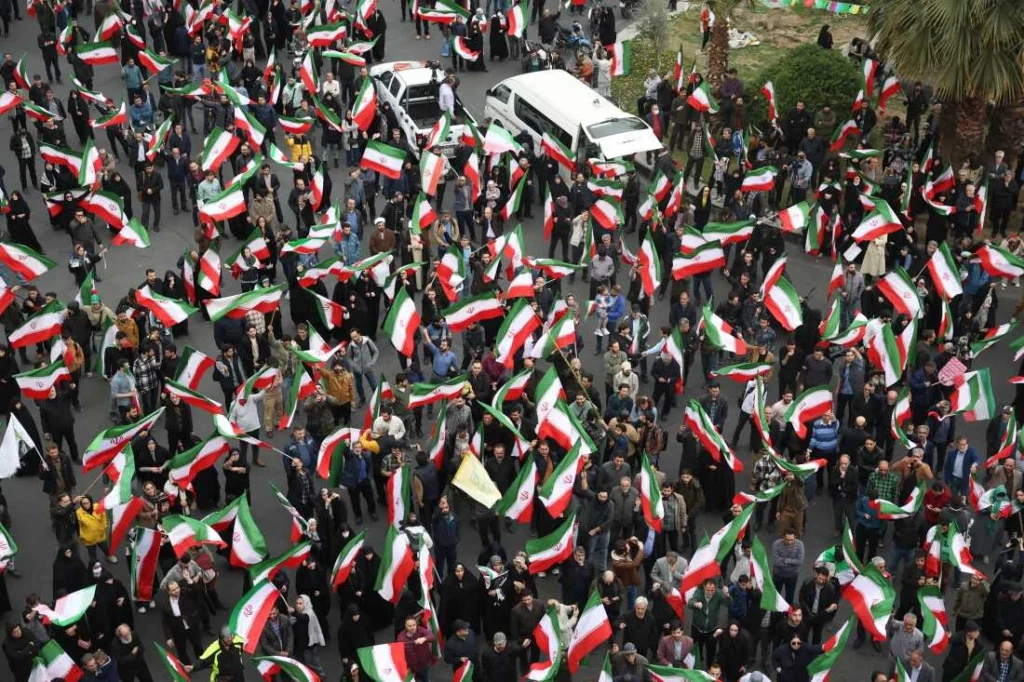
The reaction of ordinary Iranians to Khamenei’s death was dramatically divided a reflection of just how polarized the country had become under his rule.
In cities across Iran Tehran, Isfahan, Karaj, Kermanshah, Qazvin, Sanandaj, Shiraz, and Izeh thousands of citizens went into the streets to celebrate. Music played, people cheered, and there were scenes of public joy from Iranians who had suffered decades of repression, economic hardship, and violence at the hands of the regime. For the protesters who had risked their lives in January 2026 and watched their fellow citizens be massacred, this was the moment they had hoped for.
At the same time, tens of thousands of pro-regime mourners gathered at Enghelab (Revolution) Square in Tehran, waving flags and chanting “Death to America.” Thousands wept and beat their chests in grief, clutching portraits of the man who had led their religious republic for nearly four decades.
Iran’s internet connectivity was almost entirely blocked for a second day following the strikes. The government urged pro-establishment supporters to gather at mosques and city centers despite the ongoing war.
Part 5: Iran’s Massive Retaliation
Iran struck back immediately and broadly. The IRGC launched what it described as multiple successive “waves” of retaliatory attacks by its own count, six large-scale waves within the first 48 hours.
Iran launched missiles and drones at:
- Israel Air raid sirens sounded across Tel Aviv. Six people were killed in BeitShemesh, with 23 others taken to hospital. Missiles also struck other areas.
- Qatar Multiple explosions rocked Doha. Thick smoke was seen billowing near Barwa after Iranian missiles targeted locations hosting US military assets.
- UAE Strikes targeted Dubai and Abu Dhabi. The UAE military intercepted over 100 ballistic missiles and nearly 200 drones. Two people were injured by debris in Abu Dhabi. Smoke rose from the port of Jebel Ali in Dubai.
- Bahrain An Iranian strike targeted the Mina Salman port, causing a fire. A worker on a foreign ship died from falling debris.
- Saudi Arabia A refining facility at Aramco’s Ras Tanura was damaged.
- Kuwait Smoke rose near the US Embassy. Several US jets were reportedly crashed.
- Iraq Two drones targeted the US Victory Base near Baghdad International Airport, with one reportedly striking the base. Explosions were also reported in Erbil.
- Jordan Jordan intercepted Iranian missiles and drones threatening its territory.
The IRGC also claimed to have struck the USS Abraham Lincoln aircraft carrier a claim the US military’s Central Command flatly and publicly denied, calling it a “LIE” and stating the carrier was not even close to being hit.
Iran’s Foreign Minister Abbas Araghchi insisted Iran was targeting American military assets, not Arab neighbors. “We are not attacking our brothers in the Persian Gulf,” he said. “We are attacking American targets.” However, civilian infrastructure across the Gulf was clearly affected.
Hezbollah joined the war on March 2, 2026, launching strikes on Israel from Lebanon for the first time in over a year, claiming it was in response to Khamenei’s assassination. Israel immediately responded with strikes on Beirut and southern Lebanon, killing at least 31 people and wounding 149 according to Lebanon’s Health Ministry. Israel warned civilians in nearly 50 Lebanese villages to evacuate.
The Houthi movement in Yemen also threatened to escalate Red Sea attacks and resume missile and drone strikes on US and Israeli-flagged ships.
Part 6: Iran’s New Leadership What Comes Next?
The Interim Leadership Council
Khamenei had no officially appointed successor. Iran’s constitution (Article 111) requires the Assembly of Experts, a body of senior clerics to appoint a new Supreme Leader. Until that happens, an interim three-member Leadership Council was formed consisting of:
- President Masoud Pezeshkian
- Judiciary Chief Gholam-Hossein Mohseni-Ejei
- Ayatollah Alireza Arafi a clerical member of the Guardian Council, appointed as the jurisprudence expert
Iran’s top security official Ali Larijani announced the council’s formation and warned that any “secessionist groups” attempting to take advantage of the situation would face a harsh response. He accused the US and Israel of trying to “plunder and disintegrate” Iran.
Who Could Be the Next Supreme Leader?
With many of the most prominent candidates killed in the February 28 strikes, the succession question is deeply uncertain. Names being discussed include:
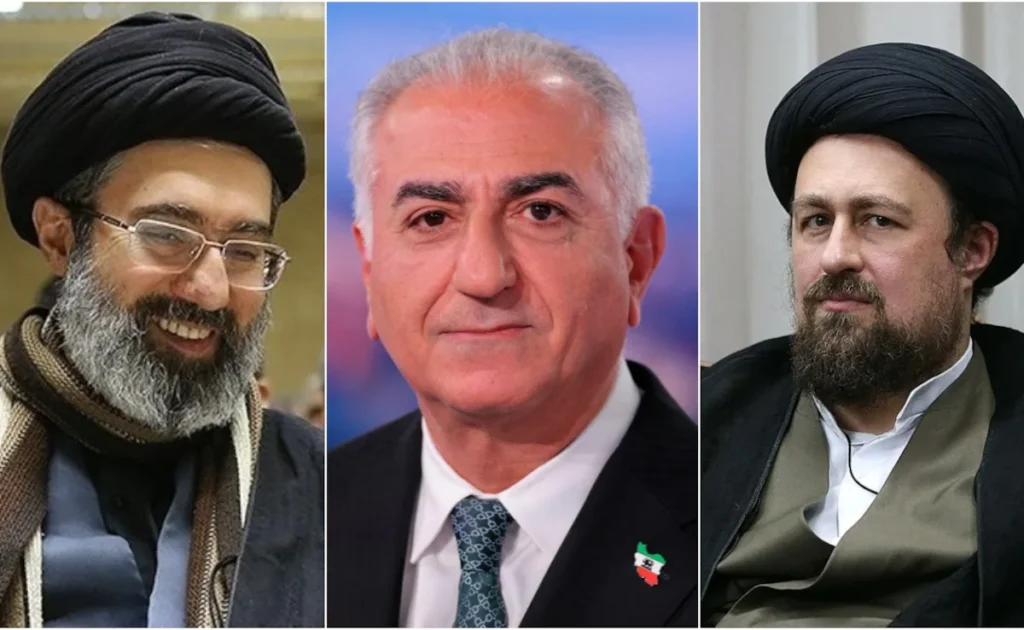
Mojtaba Khamenei Khamenei’s 56-year-old son, said to have significant backing from the IRGC, though he has never held government office and a father-to-son transfer would be widely seen as creating a religious dynasty
Hassan Khomeini Grandson of the Islamic Republic’s founder Ayatollah Khomeini, considered relatively moderate
The IRGC is pushing for a swift appointment to prevent power vacuums
Analysts at the Council on Foreign Relations identified three possible trajectories: regime continuity (essentially “Khamenei-ism without Khamenei”), military takeover by the IRGC, or regime collapse. None of these scenarios, the CFR warned, would lead to immediate positive change for ordinary Iranians in the near term.
Trump’s Diplomatic Opening
In a remarkable turn, Trump indicated just one day after the strikes that Iran had reached out wanting to talk. “They want to talk, and I have agreed to talk,” he told The Atlantic. He said things were “moving in a very positive way” and projected the operation would take “four weeks or less” to achieve its objectives though many analysts disputed whether regime change could be achieved on such a timeline. He also lamented that Iran had not reached a deal earlier. “They should have done it sooner. They waited too long.”
Iran’s Foreign Minister Araghchi also said Iran had “always been open to diplomacy” though he blamed the US for attacking during active negotiations.
Part 7: Economic Impact
Inside Iran
Iran’s economy was already in severe crisis before the February 28 strikes. Decades of Western sanctions had caused the Iranian rial to collapse to historic lows, with annual inflation running at devastating rates. Millions of Iranians could not afford basic necessities. The January 2026 massacre of protesters had deepened economic paralysis. The February 28 strikes compounded everything Iran’s airspace was closed, internet was cut, military infrastructure was destroyed, and the country entered a state of acute wartime crisis. Foreign nationals including hundreds of Chinese citizens were evacuated.
Regional Economic Disruption
Iran’s retaliatory strikes on Gulf Arab states caused immediate economic damage across one of the world’s most important economic zones. The UAE, which hosts a massive global trading hub saw explosions in Dubai and Abu Dhabi, prompting schools and universities nationwide to switch to remote learning. The UAE’s military intercepted over 300 Iranian projectiles. Saudi Arabia’s Ras Tanura refinery, a critical oil processing facility, was damaged. Qatar, which hosts major US military bases and is one of the world’s largest natural gas exporters, was struck multiple times.
Global Oil and Energy Markets
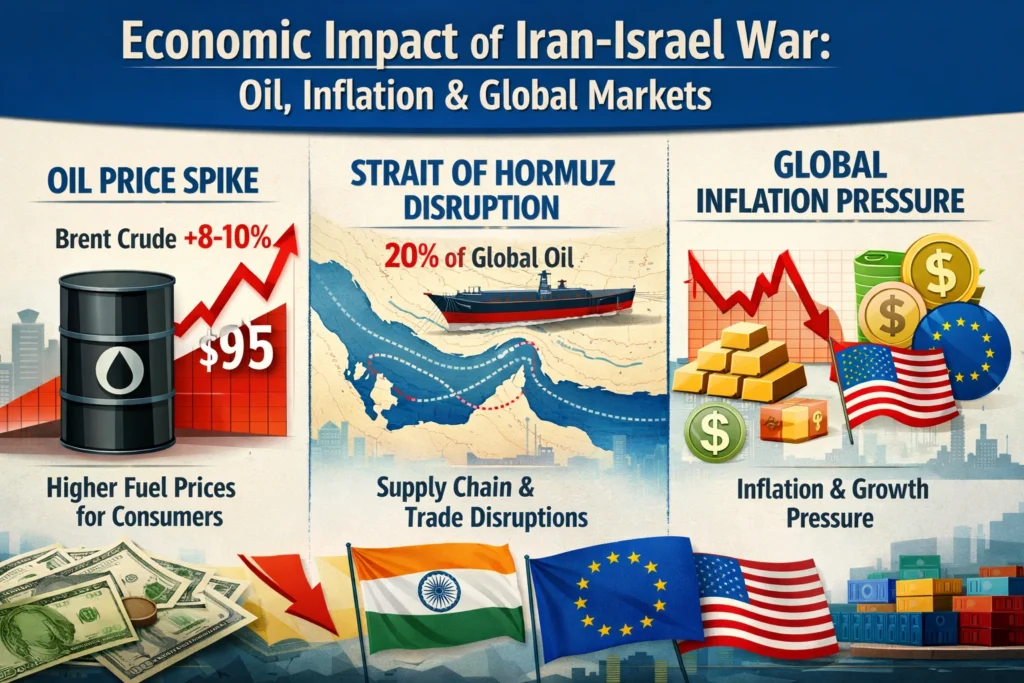
The Strait of Hormuz, the narrow waterway between Iran and Oman through which approximately 20% of all global oil trade passes daily was directly threatened. The IRGC Navy issued formal warnings against maritime transit through the strait, effectively weaponizing one of the world’s most critical energy chokepoints. Oil prices surged sharply as markets priced in the risk of prolonged disruption. Energy analysts published scenarios ranging from moderate price increases to severe global supply shocks depending on how long the conflict lasted.
Global Markets and Trade
Stock markets across Asia, Europe, and the Americas fell sharply as the scale of the conflict became clear. Defense stocks surged. Shipping companies began rerouting away from the Persian Gulf region. The Red Sea, already disrupted by Houthi attacks since 2023 faced fresh waves of drone and missile threats. The cascading effect on global supply chains threatened to reverse progress made after earlier periods of disruption.
Part 8: Iran’s Relations With Key Countries
Iran and the United States
The US-Iran relationship has been defined by hostility since Iran’s 1979 Islamic Revolution, when Iranian students stormed the US Embassy in Tehran and held 52 American diplomats hostage for 444 days. The US has imposed crippling sanctions on Iran ever since, and the two countries have clashed repeatedly through proxy wars in Iraq, Syria, and Lebanon, through covert operations, and through confrontations in the Persian Gulf.
The killing of Iran’s top general Qasem Soleimani by a US drone strike in January 2020 brought the countries to the brink of open war. The June 2025 US-Israeli strikes on Iran’s nuclear facilities, and the February 2026 assassination of Khamenei himself, represent the most direct US military action against Iran in history.
Iran and Israel
Iran and Israel were allies before the 1979 revolution. After it, Iran declared Israel an illegitimate state and vowed its destruction. Israel has conducted hundreds of covert operations against Iran the Stuxnet cyberattack, assassinations of nuclear scientists, and hundreds of airstrikes in Syria on Iranian assets. Iran funded Hezbollah and Hamas to maintain military pressure on Israel from multiple directions. The October 7, 2023 Hamas attack which killed around 1,200 Israelis accelerated the escalation that ultimately led to Khamenei’s killing.
Iran and Russia
Russia and Iran have developed a close strategic partnership built on shared opposition to Western dominance. Iran supplied Russia with Shahed drones used extensively in the Ukraine war. Russia provided Iran with diplomatic protection at the UN Security Council and military technology. When Khamenei was killed, Russian President Putin called it a “cynical murder” that violated “all standards of human morality and international law” and described Khamenei as “an outstanding statesman” who had brought Russian-Iranian relations to “the level of a comprehensive strategic partnership.”
Iran and China
China is Iran’s most important economic partner. The two countries signed a 25-year, $400 billion comprehensive cooperation agreement in 2021, covering trade, energy, infrastructure, and military cooperation. China purchases Iranian oil in defiance of US sanctions, providing Iran’s government with its most critical revenue stream. When Khamenei was killed, China’s Foreign Ministry called it “a serious violation of Iran’s sovereignty” and “strongly condemned” the strikes, calling for the “immediate halting of military operations.”
Iran and Saudi Arabia
The Iran-Saudi rivalry is one of the most consequential in the Middle East rooted in religious differences (Iran is Shia, Saudi Arabia is Sunni), geopolitical competition, and opposing alignments (Saudi Arabia is closely allied with the US, Iran is anti-Western). The two countries fought proxy wars across Yemen, Syria, Lebanon, and Iraq for decades. After a 2016 rupture, China brokered a surprising diplomatic normalization in 2023. Iran’s strikes on Saudi Arabia’s Ras Tanura refinery on February 28, 2026, severely undermined this fragile peace. Gulf Cooperation Council foreign ministers held an emergency video conference to respond to the crisis.
Iran and the Gulf States (UAE, Qatar, Bahrain, Kuwait)
Iran’s retaliatory strikes directly hit Qatar, UAE, Bahrain, and Kuwait all of which host US military installations. This put these countries in a deeply difficult position: caught between their formal relations with Iran and the fact that their territory was being used as a target of Iranian retaliation for hosting American forces. The UAE ordered nationwide school closures. Qatar condemned Iran’s strikes as a “violation of sovereignty.” All Gulf states scrambled to intercept Iranian projectiles.
Iran and Pakistan
In January 2024, Iran launched missile and drone strikes on Pakistani territory targeting militant bases, in a dramatic act that temporarily saw Pakistan recall its ambassador. Pakistan responded with its own strikes on Iranian soil. The episode showed that Iran was willing to violate the sovereignty of a neighboring Muslim country when it believed its security demanded it. Following Khamenei’s death, violent protests erupted in Pakistan’s Karachi, where at least nine demonstrators were killed after storming the US Consulate.
Iran and Lebanon/Hezbollah
Hezbollah, Iran’s most powerful proxy, entered the war on March 2, 2026, launching strikes on Israel from Lebanon and declaring it was acting in response to Khamenei’s assassination. Hezbollah Secretary-General Naim Qassem vowed to “undertake our duty of confronting the aggression.” Israel immediately responded with devastating strikes on Beirut and southern Lebanon.
Iran and Yemen/Houthis
The Houthi movement in Yemen which Iran arms and funds threatened to escalate Red Sea attacks and declared it was “in a state of high readiness” following Khamenei’s killing.
Part 9: World Reactions
United States: Trump called Khamenei “one of the most evil people in history” and warned Iran not to retaliate further, threatening to “hit them with a force that has never been seen before.” He simultaneously expressed openness to talks, saying Iran “wants to talk” and he was willing to engage.
Israel: Prime Minister Netanyahu declared that Khamenei had been killed and said Israel would “continue to act with full force.” Defense Minister Israel Katz said: “He who acted to destroy Israel has been destroyed. Justice has been served.”
Russia: President Putin called it a “cynical murder” and a “deliberate, premeditated, and unprovoked act of armed aggression,” warning of a “humanitarian, economic, and potentially even radiological disaster.”
China: Beijing “strongly condemned” the killing as a “serious violation of Iran’s sovereignty,” a trampling of the UN Charter, and called for the “immediate halting of military operations.”
European Union: EU foreign policy chief Kaja Kallas described Khamenei’s death as “a defining moment in Iran’s history” and noted there was “now an open path to a different Iran, one that its people may have greater freedom to shape.”
United Nations: Secretary-General António Guterres condemned both the US-Israeli strikes and Iran’s retaliatory attacks, calling it “a grave threat to international peace and security” and warning that “military action carries the risk of igniting a chain of events that no one can control.”
Pope Leo XIV: The Catholic Church’s first American pope called for an end to “the spiral of violence,” appealing to all parties to “assume the moral responsibility to stop the spiral of violence before it becomes an irreparable chasm.”
North Korea: Condemned the strikes as “illegal aggression” and a violation of national sovereignty.
Hezbollah: Condemned the US-Israeli strikes and joined the war on March 2.
Palestinian Authority: Condemned Iran’s retaliatory strikes on Gulf Arab states, expressing solidarity with those nations.
Frequently Asked Questions (FAQs)
Q1: Who was Ayatollah Ali Khamenei?
He was Iran’s Supreme Leader the highest authority in the country, holding absolute power over the military, nuclear program, judiciary, and foreign policy. He ruled for nearly 37 years, from 1989 until his assassination on February 28, 2026.
Q2: How was Khamenei killed?
He was killed in a joint US-Israeli military operation codenamed “Operation Epic Fury” / “Operation Roaring Lion.” About 200 Israeli fighter jets struck approximately 500 targets across Iran. Khamenei was killed at his compound in Tehran. His death was confirmed by Iranian state media on March 1, 2026.
Q3: Why did the US and Israel kill Khamenei?
The stated reasons were Iran’s advancing nuclear program (close to weapons-grade), the collapse of nuclear talks in February 2026, Iran’s massacre of over 7,000 protesters in January 2026, and ongoing Iranian-backed attacks on US military personnel. Trump also declared regime change as a goal.
Q4: Who else was killed in the strikes?
Iran’s Defence Minister, the Chief of Staff of Armed Forces, IRGC commander, senior intelligence chiefs, Khamenei’s daughter, son-in-law, grandchild, and his wife who died from injuries on March 2. More than 40 senior Iranian figures were killed. At least 133 civilians also died.
Q5: How did Iranians react to Khamenei’ death?
Reactions were deeply divided. Thousands celebrated in streets across multiple cities, playing music and cheering. Simultaneously, tens of thousands of pro-regime mourners gathered in Tehran in grief, waving flags and chanting “Death to America.”
Q6: How did Iran retaliate?
Iran launched six waves of retaliatory strikes on Israel and US military assets in Qatar, UAE, Bahrain, Saudi Arabia, Kuwait, Iraq, Jordan, and Oman. Hezbollah also entered the war from Lebanon on March 2.
Q7: Who is now leading Iran?
An interim three-member Leadership Council was formed: President Masoud Pezeshkian, Judiciary Chief Gholam-Hossein Mohseni-Ejei, and Ayatollah Alireza Arafi. The Assembly of Experts is working to appoint a permanent new Supreme Leader.
Q8: Is Iran open to negotiations?
Iran’s Foreign Minister said Iran has “always been open to diplomacy.” Trump also said Iran “wants to talk” and he agreed to speak with Iranian representatives. However, active military exchanges were still ongoing as of March 2, 2026.
Q9: What is the economic impact?
Oil prices surged, the Strait of Hormuz was threatened, Gulf Arab economies were directly struck, global markets fell, and Iran’s own economy entered acute crisis. The UAE intercepted over 300 Iranian projectiles as Iranian missiles and drones hit Gulf infrastructure.
Conclusion
The assassination of Ayatollah Ali Khamenei on February 28, 2026, is without question one of the most seismic events in modern geopolitical history. For nearly four decades, Khamenei was the immovable pillar of the Islamic Republic, the man who held together Iran’s nuclear ambitions, its vast network of regional proxy forces, its defiance of the Western-led international order, and its founding ideological mission to confront Israel and push America out of the Middle East. His death at the hands of a joint US-Israeli operation while he sat at his office during Ramadan marks the most dramatic and direct confrontation between these powers in history.
The immediate consequences are already catastrophic in scale. Tehran and other Iranian cities continue to be struck. Iran has retaliated across twelve countries, hitting Gulf states that host US forces, striking Israel with repeated missile barrages, and activating Hezbollah in Lebanon. The Strait of Hormuz, the throat of the global oil supply, is under threat. Civilians have died in Iran, Israel, Lebanon, and across the Gulf. Schools are closed in the UAE. Markets are falling worldwide.
And yet amid the chaos, there are unexpected signals. Trump says Iran wants to talk. Iran’s foreign minister says diplomacy has always been possible. The new Leadership Council has emphasized constitutional continuity. The Iranian people themselves are divided some celebrating liberation, others mourning, all uncertain about what comes next.
Whether this extraordinary moment ends in the collapse of the Islamic Republic, the rise of a hardline IRGC-led successor state, a negotiated settlement, or a broader regional war that draws in Russia, China, and the wider world no one yet knows. What is certain is that the Middle East has entered a new era. The decisions made in the coming days and weeks, in Tehran, Washington, Tel Aviv, Moscow, and Beijing, will shape the region and the world for generations to come. The world watches, with hope, fear, and the understanding that the stakes could not be higher.