
Introduction
The best investment strategies 2026 is evolving rapidly. With advancements in artificial intelligence, global economic shifts, renewable energy expansion, and changing interest rate cycles, investors must adopt well planned strategies instead of relying on guesswork.
In this guide, you will learn the best investment strategies for 2026, how to apply them based on your risk profile, and how to build a diversified portfolio for long-term success.
1. Investment Outlook for 2026
1.1 Global Economic Trends
The global economy in 2026 is shaped by several key forces. Inflation is stabilizing in major economies after the turbulent post pandemic years, providing more predictable conditions for investors. Central banks worldwide are adjusting interest rates carefully, balancing growth concerns with inflation control. Technological disruption continues to transform industries at an accelerating pace, while sustainability and green energy have moved from niche concerns to mainstream Investment Strategies priorities.
1.2 Market Opportunities in 2026
Several sectors stand out as particularly promising for investors this year. The AI and automation sector continues its explosive growth trajectory, revolutionizing everything from healthcare to manufacturing. Renewable energy Investment Strategies are benefiting from both policy support and improving economics. Emerging markets are expanding as developing nations modernize their economies and build consumer bases. Digital finance and fintech innovation are reshaping how people save, invest, and transact globally.
Understanding these trends helps investors position their portfolios strategically for the opportunities ahead.
2. Top Investment Strategies for 2026

2.1 Diversification Strategy (Risk Management Foundation)
Diversification remains one of the safest and most effective strategies available to investors. By spreading investments across different asset classes, you reduce the impact of any single investment’s poor performance on your overall portfolio.
Why It Works:
Diversification reduces overall portfolio risk by ensuring that losses in one area can be offset by gains in another. It protects against sector specific downturns that might devastate a concentrated portfolio, while providing stable long-term growth through balanced exposure to various markets and asset types.
Suggested Asset Allocation Example:
A well diversified moderate portfolio might include 50%, 60% in stocks spanning both domestic and international markets, 15%, 20% in bonds for stability and income, 10% in gold or other commodities as inflation hedges, 5% ,10% in real estate or REITs for tangible asset exposure, and 5% in cryptocurrency for growth potential.
2.2 Growth Investing Strategy
Growth investing focuses on companies with high future expansion potential, even if they currently trade at premium valuations. This strategy prioritizes capital appreciation over current income.
Best Growth Sectors in 2026:
The artificial intelligence sector continues to offer tremendous growth potential as AI integration deepens across industries. The semiconductor industry benefits from insatiable demand for chips powering everything from smartphones to data centers. Electric vehicles are transitioning from innovation to mainstream adoption. Clean energy companies are scaling rapidly with policy tailwinds. Cloud computing platforms continue expanding as digital transformation accelerates globally.
Key Tips:
Look for companies demonstrating strong revenue growth that exceeds industry averages. Evaluate their competitive advantages, whether through technology, brand strength, or network effects. Monitor valuation levels carefully to avoid overpaying, even for excellent companies.
2.3 Dividend Investing Strategy
Dividend investing provides steady passive income along with potential capital appreciation, making it particularly attractive for investors seeking cash flow.
Benefits:
This strategy creates a regular income stream that can supplement other earnings or be reinvested for compounding growth. Dividend-paying stocks typically exhibit lower volatility compared to pure growth stocks, as their yields provide downside support. The compounding effect through dividend reinvestment accelerates wealth building over time.
Ideal For:
Dividend investing suits conservative investors who prioritize stability and income over aggressive growth. It’s excellent for long-term wealth builders who appreciate the discipline of regular dividends. Retirement-focused individuals find dividend stocks particularly valuable for generating living expenses without selling principal.
2.4 Index Fund & ETF Strategy (Passive Investing)
Passive investing through index funds and ETFs remains highly effective in 2026, offering broad market exposure with minimal costs.
Why Choose Index Funds?
Index funds feature low expense ratios that preserve more of your returns compared to actively managed funds. They provide broad market exposure, eliminating the risk of picking the wrong individual stocks. Historical data consistently shows that index funds deliver solid long-term returns that match or exceed most active managers.
Popular Options:
S&P 500 ETFs offer exposure to America’s largest companies and have historically returned around 10% annually. Nifty 50 Index Funds provide similar diversified exposure to India’s top corporations. Global Market ETFs enable investors to capture opportunities across developed and emerging markets worldwide.
2.5 Dollar Cost Averaging (DCA) Strategy
Dollar-cost averaging involves investing a fixed amount regularly regardless of market conditions, removing emotion from investment Strategies timing decisions.
Advantages:
This approach reduces market timing risk by ensuring you buy at various price points over time. It minimizes emotional investing by creating a mechanical, disciplined process. DCA proves particularly suitable for volatile markets where trying to time entries and exits often leads to costly mistakes.
The strategy is best applied through monthly SIPs (Systematic Investment Strategies Plans), which automate the process and enforce discipline.
2.6 Defensive Investment Strategies
Defensive investing prioritizes capital preservation during uncertain or volatile periods, accepting lower returns in exchange for greater stability.
Defensive Assets:
Gold has historically served as a safe haven during market turbulence and economic uncertainty. Government bonds provide predictable income with minimal default risk. FMCG (fast-moving consumer goods) stocks remain stable because people continue buying essentials regardless of economic conditions. Healthcare stocks prove resilient since medical needs persist through all economic cycles.
This strategy works best when you sense elevated market risk or when approaching major financial goals where you cannot afford significant losses.
2.7 Real Estate & REIT Strategy
Real estate remains a proven wealth-building tool, offering both income potential and inflation protection through tangible assets.
Options:
Direct property investment offers the highest potential returns but requires substantial capital, active management, and local market expertise. Real Estate Investment Trusts (REITs) provide exposure to property portfolios while maintaining liquidity and requiring much lower minimum investments. Commercial property funds enable participation in office buildings, retail centers, and industrial facilities that might be inaccessible to individual investors.
REITs are ideal for investors seeking real estate exposure with lower capital requirements and greater liquidity than direct ownership.
2.8 Cryptocurrency Strategy (High Risk Allocation)
Cryptocurrency remains volatile but promising, offering exposure to blockchain technology and digital asset innovation.
Smart Approach:
Allocate only 5,10% of your portfolio to crypto to limit downside risk while maintaining upside potential. Focus on established assets like Bitcoin and Ethereum rather than chasing speculative altcoins. Avoid overexposure that could jeopardize your financial security during crypto’s inevitable volatility.
Remember this is a high risk, high reward allocation invest cautiously and only with money you can afford to lose entirely.
3. Choosing the Right Strategy Based on Your Profile

3.1 Based on Age
In Your 20s:
Youth provides the luxury of time to recover from market downturns, justifying higher equity exposure in your portfolio. Growth-focused investments make sense because you can ride out volatility and compound returns over decades. This is the time to take calculated risks that could significantly accelerate wealth building.
In Your 30s:
The 30s call for balanced growth and stability as financial responsibilities often increase Investment Strategies with families and mortgages. A diversified portfolio becomes essential to manage growing obligations while still pursuing meaningful appreciation. You’re balancing wealth accumulation with increasing need for reliability.
40 and Above:
As retirement approaches, increased defensive allocation protects the wealth you’ve built from late-career market shocks. Focus shifts toward capital protection rather than aggressive growth, as you have less time to recover from major losses. Preserve what you’ve earned while generating income for retirement needs.
3.2 Based on Risk Tolerance
Aggressive Investor:
If you have high risk tolerance and long time horizons, emphasize growth stocks that offer maximum appreciation potential. Include crypto exposure to capture emerging technology trends. Accept higher volatility in pursuit of superior returns.
Moderate Investor:
Balance growth and stability through a diversified portfolio spanning stocks, bonds, and alternative assets. Seek reasonable returns without excessive anxiety about short-term market movements. This middle path suits most investors’ psychological comfort and financial goals.
Conservative Investor:
Prioritize bonds for predictable income and capital preservation. Include dividend stocks from stable companies with long track records. Add gold as portfolio insurance against market turmoil. Accept lower returns in exchange for sleeping well at night.
4. Long Term vs Short Term Investment Strategies in 2026
Long Term Strategy
Long-term Investment Strategies focuses on compounding, allowing your money to grow exponentially over years and decades. Ignore short-term volatility because temporary market swings are irrelevant to decade-long goals. Rebalance your portfolio periodically to maintain target allocations as different assets grow at varying rates. This approach requires patience and discipline but historically delivers the most reliable wealth building results.
Short Term Strategy
Short term investing involves tactical sector rotation, moving between industries based on economic cycles and market momentum. This requires higher monitoring to catch opportunities and avoid deteriorating positions. Accept higher risk involved in making frequent decisions based on near-term forecasts. Short term strategies can enhance returns for skilled investors but often underperform buy-and-hold approaches after accounting for taxes, fees, and inevitable mistimed trades.
5. Common Investment Strategies Mistakes to Avoid in 2026
Many investors sabotage their returns through preventable errors. Following social media hype leads to buying overpriced assets at emotional peaks. Panic selling during corrections locks in losses before markets recover. Lack of diversification concentrates risk dangerously in narrow bets. Ignoring asset allocation allows portfolios to drift into inappropriate risk levels. Not reviewing your portfolio annually means missing rebalancing opportunities and failing to adjust for changing circumstances.
Avoiding these mistakes is as important as choosing the right strategy. Discipline and process matter more than cleverness.
6. Sample Moderate Risk Portfolio for 2026
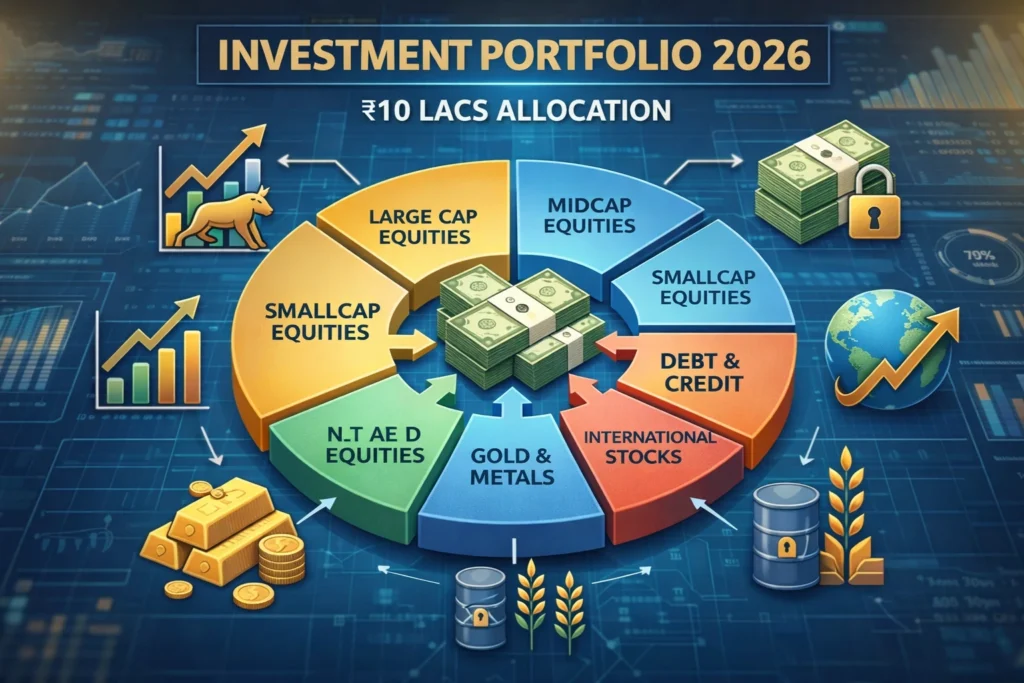
A balanced approach for 2026 might allocate 55% to equity through index funds and carefully selected growth stocks. Include 20% international exposure to capture global opportunities and reduce home-country bias. Maintain 15% in bonds for stability and income. Hold 5% in gold as portfolio insurance. Reserve 5% for crypto to participate in digital asset innovation.
Adjust these percentages according to your personal goals, income stability, and risk comfort. This framework provides a starting point, not a rigid prescription.
7. Expert Tips for Successful Investment Strategies in 2026
Invest consistently regardless of market conditions to benefit from dollar cost averaging and compounding. Maintain an emergency fund covering six months of expenses before aggressively investing, ensuring you never need to liquidate investments at inopportune times. Review your portfolio every six months to rebalance and adjust for changing goals or circumstances. Stay updated with global trends affecting markets, from geopolitical developments to technological breakthroughs. Always focus on long-term wealth creation rather than short-term speculation. These principles separate successful investors from those who chase returns and suffer disappointing results.
Conclusion
The best Investment Strategies in 2026 is not about chasing trends it’s about balancing growth, stability, and risk management. By diversifying wisely, investing consistently, and aligning investments with your financial goals, you can build sustainable wealth over time.
Start planning today, stay disciplined, and let compounding work in your favor. The wealth you build this year and beyond depends not on perfect market timing, but on sound strategy executed with patience and persistence.