Justice Yashwant Varma has resigned from the Allahabad High Court after a year-long controversy involving the alleged discovery of unaccounted cash at his official residence. The resignation comes with impeachment proceedings actively underway in Parliament, raising as many questions as it closes.
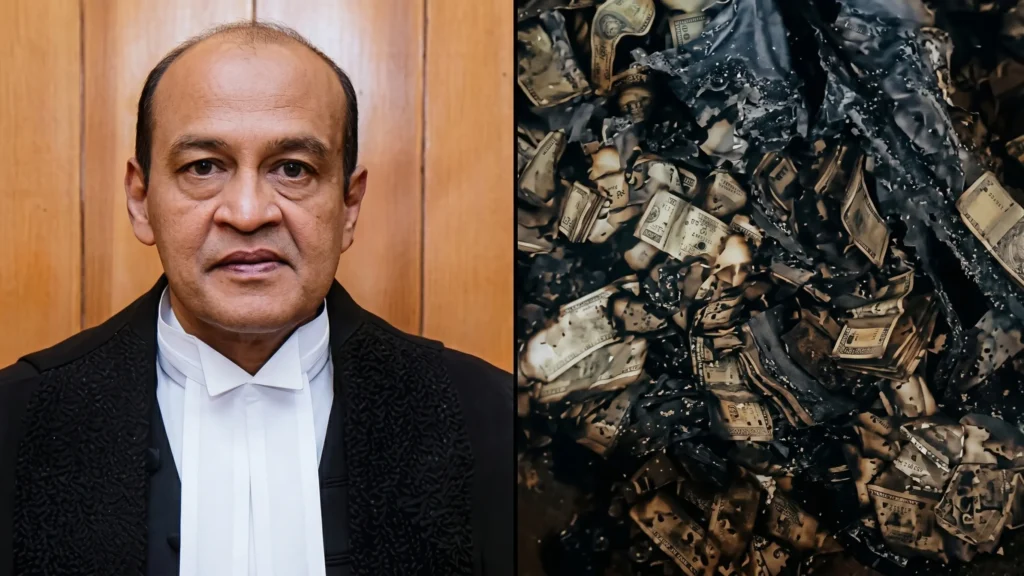
Justice Yashwant Varma Submits Resignation to President
Justice Yashwant Varma of the Allahabad High Court submitted his resignation to President Droupadi Murmu on April 9, 2026, with effect from the same date. A copy of the resignation was marked to Chief Justice of India Surya Kant.
In his resignation letter, Justice Yashwant Varma stated he did not wish to “burden the august office with the reasons” behind his decision but said the resignation was submitted with “deep anguish.” He added that it had been “an honour to serve” as a judge of the Allahabad High Court.
The resignation of Justice Yashwant Varma came while a Lok Sabha-appointed three-member inquiry committee under the Judges (Inquiry) Act, 1968, was actively conducting hearings into the burnt cash case. Impeachment notices against him had been backed by 145 Lok Sabha members and 63 Rajya Sabha members. The process, by all indications, was accelerating in the Yashwant Varma case. His exit has now halted it in its tracks.
The Fire, the Cash and the Controversy That Started It All
The case traces its origins to March 14, 2025, when a fire broke out at Justice Varma’s official government bungalow in Delhi, while he was serving as a judge of the Delhi High Court. During firefighting operations, stacks of partially burnt currency notes, reportedly in bundles of Rs 500, were discovered in an outhouse on the premises. Early reports placed the amount at around Rs 15 crore, though that figure was never officially confirmed.
The discovery triggered immediate and widespread outrage. The Supreme Court uploaded photographs and a video from the incident to ensure public transparency. The visuals showed currency notes in various stages of burning, which made denial of the cash’s existence difficult to sustain publicly.
Justice Varma denied the allegations entirely. He told the inquiry committee that no cash was recovered from his residence and that he was not present at the time of the fire.
Collegium Action, Transfer and In-House Inquiry
Within days of the incident, then Chief Justice of India Sanjiv Khanna convened the Supreme Court Collegium and initiated an in-house inquiry. A three-judge panel comprising Justice Sheel Nagu, Justice G.S. Sandhawalia, and Justice Anu Sivaraman was constituted to examine the facts.
Justice Varma was transferred from the Delhi High Court back to the Allahabad High Court, his parent court, and judicial work was withdrawn from him pending the inquiry’s outcome. He took oath in Allahabad on April 5, 2025.
The inquiry committee submitted its report in May 2025, concluding that Justice Varma had exercised “secret or active control” over the area where the cash was found, establishing prima facie culpability. CJI Khanna forwarded the report to the President and the Prime Minister and reportedly advised Justice Varma to resign. He refused. The matter then moved to Parliament.
Impeachment Proceedings and the Resignation That Forestalled Them
Impeachment notices were moved in both Houses of Parliament in July 2025. The Lok Sabha Speaker constituted a fresh inquiry committee under the Judges (Inquiry) Act. That committee had been holding day-to-day hearings from March 13 to March 21, 2026. With more than 200 MPs collectively backing removal motions across both Houses, Justice Varma’s position was untenable.
His resignation on April 9 effectively ended the parliamentary process before any final finding could be recorded.
The Questions a Resignation Cannot Answer
Justice Varma’s exit closes the institutional procedure. It does not close the questions. The inquiry panel was close to its findings. No formal verdict on culpability was ever officially published through the parliamentary route. No criminal proceedings have been initiated. The Rs 15 crore figure, the source of the cash, and the complete chain of events remain without official legal determination.
It is worth asking whether a similar discovery of unaccounted, partially burnt cash at the home of an ordinary citizen would have moved on the same slow institutional timeline. In most circumstances, it would have meant immediate FIRs, police custody, and expedited legal proceedings. The process in this case, from discovery in March 2025 to resignation in April 2026, took over 13 months and ended without a judicial verdict.
Judicial Accountability and What This Case Reveals
India’s constitutional framework for judicial accountability relies primarily on the in-house inquiry mechanism and parliamentary impeachment. Both are deliberately high-threshold processes, designed to protect judicial independence. But protection of independence and absence of accountability are not the same thing.
Justice Varma’s case exposed the gap between those two ideas. The Supreme Court’s transparency in publishing inquiry materials was commendable. The parliamentary process, once initiated, moved with relative seriousness. But the outcome, a quiet resignation without a formal finding, leaves an unresolved record.
Public trust in institutions is not built only on outcomes. It is built on the visible consistency with which the law applies to everyone. That consistency, in this case, remains an open question.
Justice Varma’s resignation marks the end of a chapter that began with a fire and ends without a verdict. The controversy may fade from the headlines, but the structural questions it raised about the pace, transparency, and completeness of judicial accountability in India are unlikely to be settled by a single resignation letter.