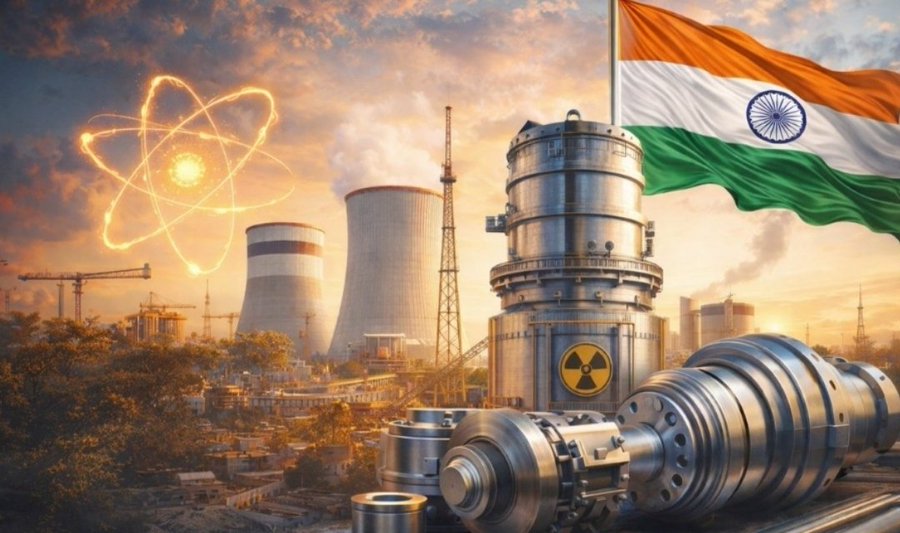
New Delhi – India’s nuclear energy sector is poised for a significant transformation as the Modi government prepares to introduce a Production Linked Incentive (PLI) scheme worth ₹18,000–20,000 crore for nuclear manufacturing in the upcoming Union Budget for FY27.
A Strategic Investment in Energy Independence
This ambitious initiative marks a major policy shift toward strengthening India’s domestic nuclear manufacturing capabilities and reducing dependence on foreign technology and equipment. The proposed PLI scheme is expected to catalyze private sector participation in an industry that has traditionally been dominated by public sector undertakings.
What the PLI Scheme Entails
The Production Linked Incentive model, which has already proven successful in sectors like semiconductors, electronics, and pharmaceuticals, incentivizes companies to increase domestic production by offering financial rewards based on incremental sales and investments in manufacturing facilities.
For the nuclear sector, this could mean:
- Enhanced domestic manufacturing of critical nuclear components and equipment
- Technology development in advanced reactor designs and fuel cycle technologies
- Supply chain strengthening for nuclear power plants and research facilities
- Job creation in high-skill technical and engineering domains
India’s Nuclear Energy Ambitions
This move aligns with India’s commitment to achieve net-zero emissions by 2070 and triple its nuclear power capacity over the next decade. Currently, nuclear energy contributes approximately 3% of India’s total electricity generation, with 23 operational reactors producing around 7,480 MW.
The government has set ambitious targets to increase nuclear capacity to 22,480 MW by 2031-32, which would require substantial investments in both reactor construction and the supporting manufacturing ecosystem.
Strategic Significance
The timing of this PLI scheme is particularly significant as global attention shifts toward clean energy alternatives. Nuclear power is increasingly recognized as a reliable, low-carbon baseload energy source that can complement renewable energy installations.
Key strategic benefits include:
- Energy security through reduced import dependence
- Technology sovereignty in critical nuclear technologies
- Export potential for Indian nuclear equipment and expertise
- Climate goals advancement through clean energy generation
Industry Response Expected
While official details await the Budget announcement, industry experts anticipate strong interest from both established engineering companies and new entrants in specialized manufacturing domains. The scheme could particularly benefit heavy engineering firms, precision component manufacturers, and advanced materials producers.
Looking Ahead
As India positions itself as a global manufacturing hub under the ‘Make in India’ initiative, extending PLI benefits to the nuclear sector represents a strategic investment in both energy security and technological advancement. The official announcement in the FY27 Budget will provide clarity on eligibility criteria, timelines, and specific manufacturing segments covered under the scheme.
The success of this initiative could establish India as a significant player in the global nuclear supply chain while simultaneously addressing domestic energy needs through clean, reliable power generation.
Note: Final details of the PLI scheme will be confirmed upon the official Budget announcement for FY27.