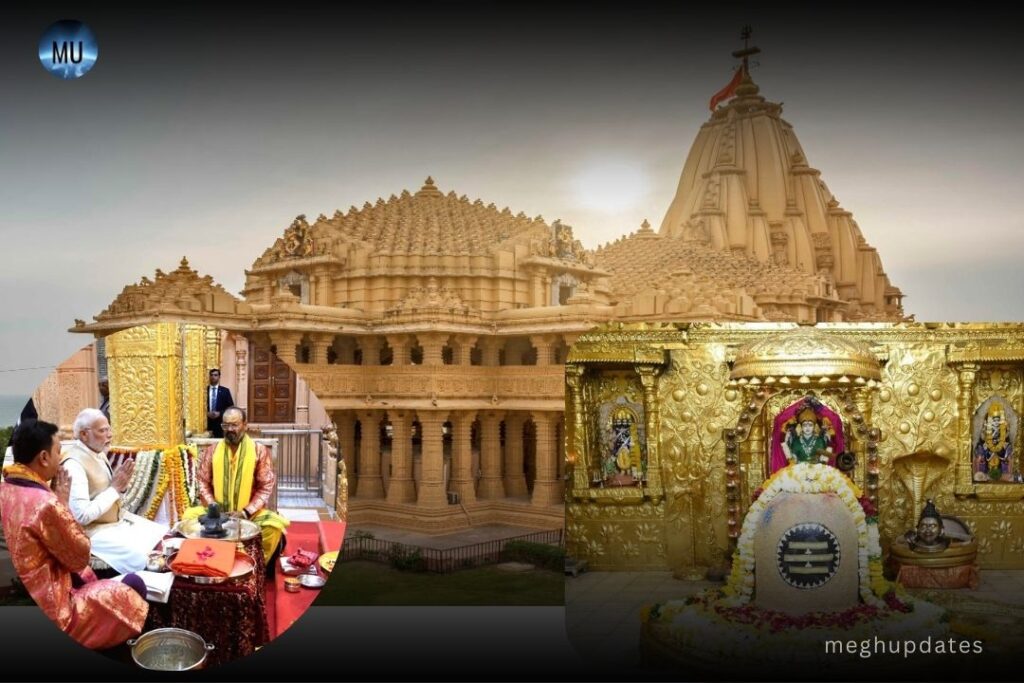
Prabhas Patan, Gujarat, January 11, 2026 — Standing majestically on the Arabian Sea coast in Gujarat’s Veraval, the Somnath Temple remains one of India’s most revered Hindu shrines and a powerful symbol of resilience, faith, and cultural renaissance.
A Temple of Legends
The Somnath Temple, dedicated to Lord Shiva in his form as the “Lord of the Moon” (Som means moon, Nath means lord), holds the distinction of being the first among the twelve sacred Jyotirlinga shrines of Shiva. According to Hindu mythology, the temple’s origins trace back to antiquity, with legends suggesting it was first built in gold by the Moon God Somraj himself, then rebuilt in silver by Ravana, in wood by Lord Krishna, and finally in stone by the Solanji king Bhimdev.
The temple’s location at the confluence of mythology, history, and geography has made it a spiritual beacon for millennia. Ancient texts describe it as a place of immense wealth and architectural grandeur, attracting pilgrims from across the Indian subcontinent and beyond.
A History Written in Destruction and Renewal
What makes Somnath truly extraordinary is not just its spiritual significance, but its remarkable story of survival through repeated destruction and reconstruction—a cycle that spans over a thousand years.
The Medieval Invasions: The temple faced its most famous destruction in 1026 CE when Mahmud of Ghazni raided and plundered the shrine, carrying away its legendary wealth. This was followed by subsequent destructions by Allauddin Khilji’s armies in the 13th century, and later by Mughal emperor Aurangzeb in 1706, who ordered the temple demolished and a mosque built on its ruins.
Each time, the temple was rebuilt by devoted kings and communities, only to face destruction again. This cycle of destruction and resurrection transformed Somnath from merely a place of worship into a symbol of Hindu resilience and cultural continuity.
The Modern Resurrection
The current structure, the seventh reconstruction, represents one of independent India’s most significant cultural projects. After centuries of lying in ruins, the temple’s restoration became a matter of national importance following India’s independence in 1947.
Sardar Vallabhbhai Patel’s Vision: India’s first Home Minister and Deputy Prime Minister, Sardar Patel, championed the temple’s reconstruction as a symbol of India’s cultural revival and national unity. He laid the foundation stone on November 13, 1947, declaring that the temple’s reconstruction would signify the end of foreign domination and the beginning of cultural renaissance.
The reconstruction was completed and the temple consecrated on May 11, 1951, by India’s first President, Dr. Rajendra Prasad, though this happened after Patel’s death in 1950. The project was executed without government funds, relying entirely on public donations—a testament to its emotional significance for millions of Indians.
Architectural Splendor
The present temple showcases the Chalukya style of architecture, standing 155 feet tall with intricate carvings and a shikhara (spire) that rises prominently against the coastal skyline. Built using pink sandstone, the temple complex features:
- A Sabha Mandap (assembly hall) capable of accommodating thousands
- Elaborate sculptural panels depicting scenes from Hindu scriptures
- A kalash (pinnacle) weighing approximately 10 tons
- An 8.2-meter tall flag pole, or Dhwaja, bearing the temple’s banner
The temple’s strategic location means that between the temple and Antarctica, there is no land mass—making it a unique geographical and spiritual point on the western coast of India.
Breaking News: PM Modi Leads Historic Somnath Swabhiman Parv Celebrations
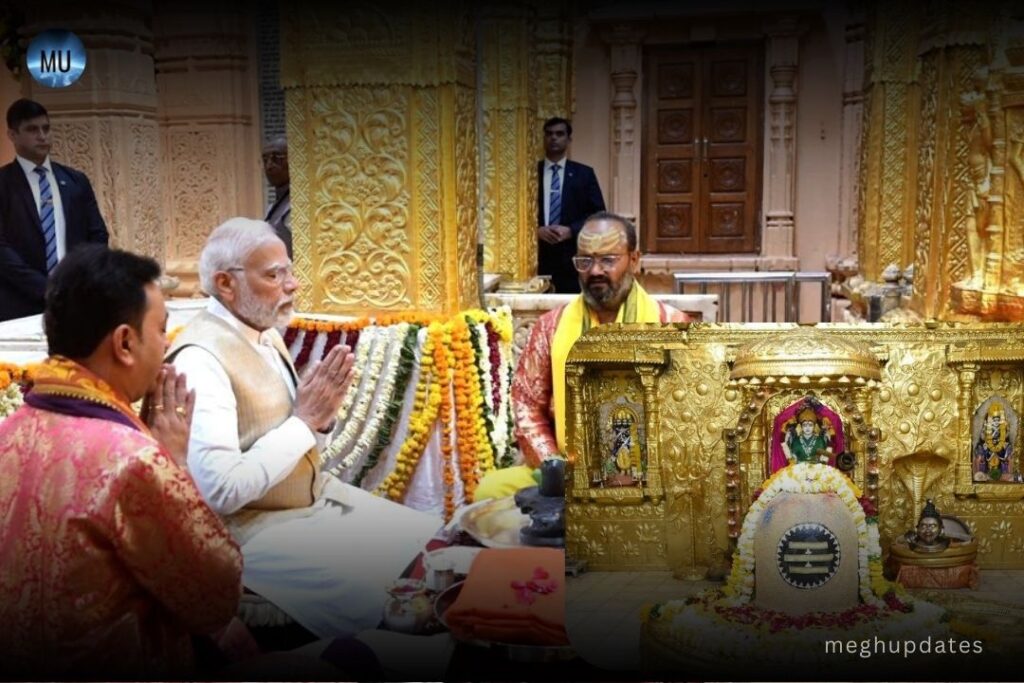
In a momentous development, Prime Minister Narendra Modi participated in the Somnath Swabhiman Parv from January 8-11, 2026, commemorating 1,000 years since Mahmud of Ghazni’s first attack on the temple in 1026 . The four-day celebration also marked 75 years since the temple reopened to devotees on May 11, 1951
The Grand Celebration
The festivities began with 72 continuous hours of Omkar mantra chanting by students from Vedic Gurukuls. On Saturday evening, January 10, PM Modi arrived at the temple and participated in various spiritual rituals, describing the experience as profoundly moving.
Key Events:
Friday Evening (January 10): PM Modi participated in Omkar Mantra chanting at around 8 PM and witnessed a spectacular drone show featuring 1,000 drones at Somnath temple . The show depicted the thousand-year legacy of the shrine.
Saturday Morning (January 11): At around 9:45 AM, the Prime Minister led the Shaurya Yatra, a ceremonial procession featuring 108 horses The yatra honored countless warriors who sacrificed their lives defending the temple through the centuries. During the procession, the Prime Minister played the conch shell and acknowledged the gathered crowds.
Temple Darshan: At around 10:15 AM, PM Modi performed Darshan and Pooja at the Somnath Temple , paying floral tributes to statues of Veer Hamirji Gohil, a historical defender of the temple, and Sardar Vallabhbhai Patel.
Public Address: At around 11 AM, the Prime Minister participated in and addressed a public function in Somnath, where he reflected on the temple’s extraordinary journey.
PM Modi’s Powerful Message
In his address, PM Modi emphasized the temple’s enduring significance. He stated that the flag atop Somnath proclaims India’s strength and resilience to the entire world. The Prime Minister noted that despite invaders believing they had triumphed a thousand years ago, the temple stands strong today as proof of unbroken faith.
The Prime Minister also highlighted how the continuous Omkar chanting, the drone display, and the procession of horses created an extraordinary spiritual atmosphere that combined ancient tradition with modern presentation.
Somnath’s Golden Age Under PM Modi’s Leadership
PM Modi also serves as Chairman of the Shri Somnath Trust, and under his leadership, the temple has entered what is being described as a “Suvarna Yug” (Golden Age) The temple has witnessed unprecedented spiritual, infrastructural, and cultural revival over the past two decades.
Recent Developments:
- Nearly 97 lakh devotees visit the Somnath Jyotirling annually, with footfall remaining steady between 92 and 97 lakh from 2020 to 2024
- Maha Shivratri 2025 alone witnessed 3.56 lakh devotees, while rituals such as Bilva Pooja have attracted over 13.77 lakh worshippers
- The shrine ranks among India’s top 10 most-searched destinations, with digital impressions exceeding 1.37 billion in 2025
Infrastructure and Environmental Initiatives:
Somnath was declared a Swachh Iconic Place in 2018, with initiatives including waste-to-vermicompost systems, plastic recycling under Mission LIFE, rainwater harvesting, sewage treatment plants and afforestation projects. The temple’s Miyawaki forest is estimated to absorb 93,000 kg of carbon dioxide annually.
The temple complex has also been enhanced with improved connectivity through new highways, airports, and rail services. A Light and Sound show, narrated by Amitabh Bachchan, brings the temple’s history alive for millions of visitors.
Cultural and National Significance
The Somnath Swabhiman Parv was organized to remember the countless citizens of India whose sacrifice to defend the Temple continues to inspire the cultural consciousness of future generations. The event featured soulful devotional performances by renowned artists including Kirti Sagathia, Hardik Dave, and folk singer Rajbha Gadhvi, who presented folk literature and narrated historical episodes of Somnath.
The celebrations were attended by Gujarat Chief Minister Bhupendra Patel, Deputy Chief Minister Harsh Sanghavi, Cabinet Ministers, Members of Parliament, and thousands of devotees from across the nation. meghupdates
A Living Symbol for Modern India
Today’s Somnath Temple stands as more than a religious structure. The recent celebrations demonstrated how the temple continues to unite the nation in remembrance of its civilizational journey. With PM Modi’s active involvement and the temple trust’s modernization efforts, Somnath has successfully blended ancient spirituality with contemporary infrastructure and technology.
The temple exemplifies India’s ability to preserve its heritage while embracing progress. The use of drones to depict historical narratives, digital platforms for devotee engagement, and environmental sustainability initiatives show how tradition and modernity can coexist harmoniously.
For the millions who visit its shores annually, Somnath offers not just darshan of the divine, but a tangible connection to an unbroken thread of faith that has survived everything history could throw at it. The recent Swabhiman Parv celebrations reinforced this message—that what is built on faith and protected by sacrifice can never truly be destroyed.
As the temple marks 75 years since its modern reconstruction and 1,000 years since its first major assault, it stands taller than ever—a monument to the proposition that resilience, faith, and cultural pride are more powerful than any force of destruction. The flag flying atop Somnath continues to proclaim to the world: India endures, and so does its eternal spirit.