Dateline: Islamabad | December 28, 2025
Pakistan’s Government has Officially Acknowledged
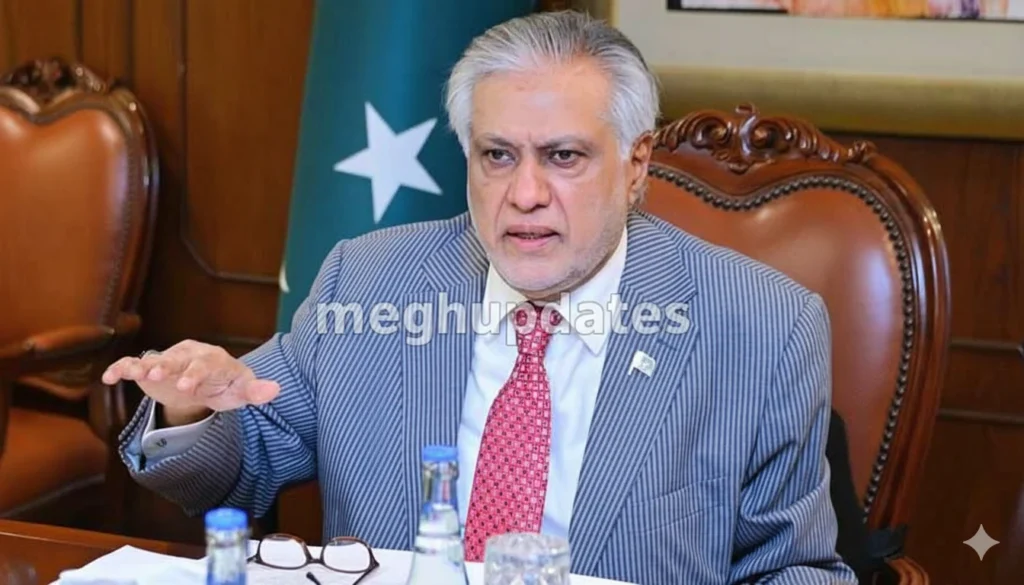
Pakistan’s government has officially acknowledged the success of India’s military operation against its Nur Khan Air Base for the first time, marking a dramatic reversal from months of denial. During a year-end press briefing, Pakistan’s Foreign Minister and Deputy Prime Minister Ishaq Dar confirmed that Indian forces targeted the strategic military installation in Rawalpindi’s Chaklala area in early May, causing damage to critical facilities and injuring personnel.
Dar’s admission came nearly eight months after Operation Sindoor, when India launched precision strikes on terror infrastructure in Pakistan and Pakistan-occupied Kashmir following the April 22 Pahalgam terror attack that killed 26 civilians. The operational scale was significant, with Dar revealing that India deployed approximately 80 drones across Pakistani airspace within 36 hours. He claimed Pakistan’s air defence systems intercepted 79 of these drones, though one drone successfully struck the Nur Khan facility.
“They (India) send drones towards Pakistan. In 36 hours, at least 80 drones were sent. We were able to intercept 79 drones out of 80, and only one drone damaged a military installation and personnel were also injured in the attack,” Dar stated during the briefing.
The Foreign Minister further described India’s strike on Nur Khan in the early morning hours of May 10 as a move that “made the mistake” of targeting the installation—an oblique acknowledgement that contradicted Pakistan’s previous official stance minimizing the impact of the operation.
The admission is significant given Pakistan’s historical pattern of denying or downplaying the effects of Indian military operations. It also corroborates earlier admissions by Pakistan’s civilian and military leadership. Prime Minister Shehbaz Sharif had previously disclosed that Army Chief General Asim Munir personally contacted him at approximately 2:30 am on May 10 to report the missile strikes on Nur Khan and other locations.
How Pakistan Nur Khan Air Base Holds Exceptional Strategic ?
Nur Khan Air Base holds exceptional strategic value for Pakistan’s military. Located near Rawalpindi and close to key military command centers and the capital, the base serves as a critical logistical and operational hub for the Pakistan Air Force. The facility’s prominence makes the targeting decision reflective of Operation Sindoor’s precision-strike methodology.
Satellite imagery from Maxar Technologies, captured on May 13, provided visual confirmation of the strikes’ impact. The images showed significant damage across multiple Pakistani air bases, including Nur Khan, PAF Base Mushaf in Sargodha, Bholari Air Base, and PAF Base Shahbaz in Jacobabad. The photographic evidence vindicated India’s claims regarding Operation Sindoor’s effectiveness.
During his briefing, Dar detailed Pakistan’s crisis response timeline. He noted that Pakistan’s civil and military leadership, led by Prime Minister Sharif, convened an emergency meeting on the night of May 9 to assess the situation and authorize response measures. This high-level coordination underscored the seriousness with which Pakistan’s leadership viewed the unfolding military escalation.
The four-day conflict that followed Operation Sindoor saw intense cross-border military engagement between the two nuclear-armed neighbors. Pakistan initiated increased cross-border shelling, while India responded with retaliatory strikes. The situation eventually de-escalated when Pakistan’s Director General of Military Operations contacted his Indian counterpart to propose a ceasefire, which India accepted.
India’s Foreign Secretary Vikram Misri later confirmed the ceasefire agreement, noting that both countries had committed to halting all military operations on land, sea, and air effective May 10, 2025.
Military analysts and Indian defense experts have questioned the accuracy of Pakistan’s casualty figures. Lieutenant General (Retired) K.J.S. Dhillon rejected the claim that only personnel were injured, pointing to Pakistan’s own records as evidence of greater losses. He referenced a post by Pakistan’s Samaa TV that listed 138 posthumously awarded gallantry awardees from Operation Sindoor, suggesting substantially higher casualties.
“If 138 were awarded posthumously, that means at least 400 to 500 people had died during the operation. For him to say that there were only minor injuries does not add up,” Dhillon stated. He further cited videos recorded by Pakistani civilians showing the Nur Khan base engulfed in flames, contradicting official claims of limited damage.
Pakistan’s admission carries broader diplomatic implications. Dar also addressed international mediation claims, stating that Pakistan had not requested U.S. or Saudi intervention during the conflict, though he acknowledged that U.S. Secretary of State Marco Rubio and Saudi Foreign Minister Prince Faisal bin Farhan had expressed a desire to engage with both nations. This statement indirectly counters previous claims by U.S. President Donald Trump that he had brokered the ceasefire.
The operation’s political repercussions extended beyond military circles. Pakistan’s President Asif Ali Zardari revealed in recent public remarks that his military advisors had urged him to relocate to a secure bunker during the strikes, reflecting the level of alarm within Pakistan’s political establishment. Zardari claimed he refused to seek shelter, asserting that leaders do not hide during times of conflict.
Operation Sindoor itself represented a carefully calibrated response to terror activity. India’s Defense Ministry characterized the operation as targeting nine terror camps across Pakistan and Pakistan-occupied Kashmir while avoiding civilian targets. The operation was launched in the early hours of May 7, mere weeks following the Pahalgam attack that claimed 26 civilian lives.
Pakistan has consistently maintained unsubstantiated claims regarding its military performance during the conflict, alleging that it shot down seven Indian fighter jets without presenting credible evidence. These claims stand in sharp contrast to verified satellite imagery documenting the physical damage sustained by Pakistani military installations.
Dar’s formal admission marks an unusual public acknowledgment from Pakistan’s diplomatic establishment. The nation’s traditional approach involves categorical denial or significant minimization of military setbacks, making this candid recognition noteworthy in Pakistan’s diplomatic communications.
The incident underscores the volatile nature of India-Pakistan relations and the capacity for rapid military escalation in the South Asian region. It also demonstrates the effectiveness of precision military operations and the difficulty of concealing modern military strikes in an era of sophisticated satellite surveillance technology.
The broader ramifications of Operation Sindoor continue to shape regional security calculations and strategic planning within both nations’ defense establishments.