Controversial Foundation Stone Ceremony Proceeds Despite Opposition
Murshidabad, West Bengal – In a highly controversial move that has ignited fierce political tensions across West Bengal, suspended Trinamool Congress MLA Humayun Kabir on Saturday laid the foundation stone of a mosque styled after the demolished Babri Masjid in Beldanga, Murshidabad district. The event took place on December 6, marking the 33rd anniversary of the original Babri Masjid demolition in Ayodhya.
High Court Declines to Intervene, Security Forces Deployed
The Calcutta High Court on Friday declined to intervene in the foundation-laying ceremony following a public interest litigation challenging the event. The division bench of Acting Chief Justice Sujoy Paul and Justice Partha Sarathi Sen directed the West Bengal government to maintain strict law and order while permitting Kabir to proceed with the program.
Speaking to reporters before departing from his residence, Kabir confirmed police support following the court’s decision. “I will lay the foundation stone of Babri Masjid today. I will not say anything. Police are supporting me. I have already spoken with them. Following the Calcutta High Court order yesterday, the Police are supporting me. They have provided me security,” the suspended MLA stated.
The state government deployed approximately 3,000 police personnel alongside staff from two local police stations to ensure public safety. The Centre confirmed that 19 companies of central armed forces were positioned in the sensitive Murshidabad district to prevent any untoward incidents.
TMC Suspends Kabir for “Communal Politics”
The Trinamool Congress suspended Humayun Kabir from the party on Thursday, just days before the scheduled event. Kolkata Mayor and senior TMC leader Firhad Hakim announced the disciplinary action, stating that Kabir had been involved in “communal politics” contrary to party principles.
Chief Minister Mamata Banerjee, without directly naming Kabir, delivered a sharp rebuke at a rally in Baharampur, calling him a “Mirzafar-gaddar (traitor)” who allegedly took money from the BJP to stoke communal tensions. “The people of Murshidabad will not accept the politics of riots,” Banerjee emphasized, invoking the district’s pluralistic heritage and the legacy of Nawab Siraj-ud-Daulah.
However, TMC state general secretary Kunal Ghosh later clarified that Kabir’s suspension was not specifically for wanting to build a mosque, but for repeatedly issuing anti-party statements and engaging in organizational indiscipline. “In West Bengal, any person can build a temple, mosque, church, or any place of worship. But when political events are held in the name of religion, it becomes a matter of organizational discipline,” Ghosh explained.
Foundation Ceremony Proceeds with Community Support
Despite the controversy, the foundation-laying ceremony proceeded as planned at noon on Saturday. Kabir had earlier stated that the program would begin with Quran recitation at 12 noon, followed by the foundation stone laying. He claimed to have organized arrangements for approximately 400 invited guests and prepared 30,000 packets of biryani for attendees.
Local residents were seen participating in the preparations. Md Safiqul Islam of Uttar Barasat was observed carrying bricks on his head, stating, “I will go where Humayun Kabir will lay the foundation stone for Babri Masjid. I am carrying bricks for Babri Masjid.”
Kabir expressed gratitude to the administration for their cooperation: “All is well. Wait until it is 12 noon; the reading of the Quran will begin then. After that, the foundation stone will be laid. I am receiving all cooperation from the administration. Murshidabad Police and State Police are all supporting me. I thank them.”
Historical Context: The 1992 Babri Masjid Demolition
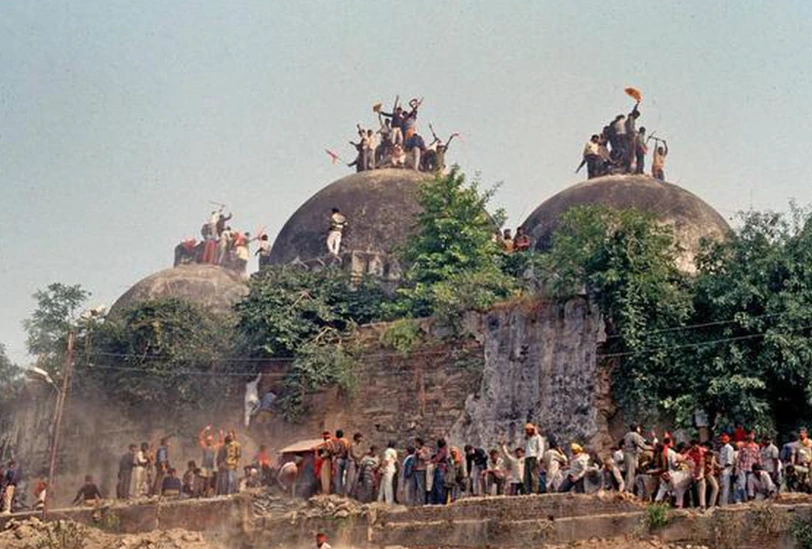
The timing and naming of the mosque evoke painful memories of December 6, 1992, when Hindu activists belonging to the Vishva Hindu Parishad, Bharatiya Janata Party, and Rashtriya Swayamsevak Sangh demolished the 16th-century Babri Masjid in Ayodhya, Uttar Pradesh. The original mosque was built in 1528 by Mir Baqi, a commander of Mughal emperor Babur.
The demolition triggered devastating communal riots across India that resulted in approximately 2,000 deaths, predominantly Muslims. The Mumbai riots alone in December 1992 and January 1993 claimed around 900 lives and caused property damage estimated at Rs 9,000 crore.
The Ayodhya dispute remained in courts for decades until the Supreme Court’s 2019 verdict awarded the entire disputed site to Hindus for construction of a Ram temple, while ordering an alternative five-acre plot for a mosque. The Ram temple was consecrated in January 2024.
Political Fallout and Accusations
The proposed mosque construction has become a flashpoint ahead of West Bengal’s 2026 Assembly elections. Kabir, a serial defector who has moved between Congress, TMC, and BJP before returning to the ruling party, announced plans to resign as MLA by December 8 and launch his own political party on December 22.
BJP leaders have seized upon the controversy to attack the TMC government. Union Minister Giriraj Singh alleged that the TMC was laying “the foundation stone of Bangladesh” in West Bengal and that the Mamata Banerjee government survives on “support of Bangladeshis and Rohingyas.”
TMC leaders have countered by accusing Kabir of being a BJP agent. “The BJP has some role to play in his recent activities. We also feel that the BJP is trying to ignite divisive politics by keeping Kabir in the forefront,” Hakim stated. Congress MP Imran Masood similarly described Kabir as “a BJP agent” engaged in spreading hatred.
Murshidabad’s Sensitive Demographics
The controversy unfolds in Murshidabad district, where Muslims constitute approximately 66.27% of the total population according to 2011 census data, making it one of three Muslim-majority districts in West Bengal alongside Malda and Uttar Dinajpur. The district has a rich historical legacy as the former capital of Bengal under the Nawabs before power shifted to Calcutta following the Battle of Plassey.
The region witnessed communal tensions earlier this year during protests against the Waqf Amendment Act. The proposed mosque’s location at Rejinagar in Beldanga Block I has heightened administrative concerns about maintaining communal harmony.
Land Dispute and Opposition
The project has also sparked a property dispute. The landowner at the proposed construction site has publicly declared refusal to sell the land or allow construction of a Babri Masjid on the property, erecting a boundary wall in defiance. Kabir has vowed to “give his life” if necessary to ensure the mosque is built.
The estimated cost of the proposed project is Rs 125 crore. According to Kabir, the development plan extends beyond the mosque to include a college, hospital, and rest house across 20 bighas of land, with construction expected to take three years.
Religious Leaders Express Concerns
Several Muslim religious leaders have distanced themselves from Kabir’s initiative. Eidgah Imam and All India Muslim Personal Law Board member Maulana Khalid Rasheed Farangi Mahali criticized the politicization of religious matters: “No religious issue should be turned into a political battle. Anyone wishing to build a place of worship must obtain permission from state authorities in accordance with the law.”
He further noted that naming the mosque after Babur carries “clear political overtones” that weaken “the true spirit of belief,” suggesting Kabir should have chosen a different name to avoid controversy.
Defiant Stance and Future Plans
Despite suspension from the TMC and widespread criticism, Kabir has remained defiant. He welcomed the High Court’s decision as a “befitting reply” to petitioners seeking to block the event. The rebel MLA had warned that if authorities attempted to stop the ceremony, National Highway 12 could be blocked, with lakhs of people expected to attend.
Kabir has also escalated attacks on Chief Minister Mamata Banerjee, declaring she would not remain in power after the 2026 Assembly elections. “The Chief Minister should be an ex-Chief Minister. In 2026, the Chief Minister will not become the Chief Minister, will not be sworn in, and will be branded as an ex-Chief Minister,” he told reporters.
Implications for West Bengal Politics
The Babri Masjid foundation ceremony represents a significant flashpoint in West Bengal’s political landscape ahead of crucial state elections. The incident highlights the complex interplay of religious sentiments, historical grievances, and electoral calculations in a demographically diverse state.
Political analysts view the controversy as part of broader efforts to mobilize religious vote banks, with accusations flying between TMC and BJP about who is engaging in divisive politics. The event’s symbolic timing on the anniversary of the original mosque’s demolition and its explicit naming have amplified sensitivities across religious communities.
As construction of the mosque proceeds, the episode is likely to remain a contentious issue in Bengal politics, testing the state’s commitment to communal harmony while raising questions about the intersection of religion and politics in India’s electoral democracy. The coming months will reveal whether this controversy remains localized or expands into wider political and social ramifications across West Bengal and beyond.
Note: This article incorporates multiple perspectives on a sensitive communal issue. The views expressed by various political leaders and religious figures have been reported as stated in public statements.