Introduction: The Economics of War
War is among humanity’s greatest tragedies resulting in immeasurable human suffering, displacement, and the destruction of entire civilizations. Yet from a purely economic standpoint, armed conflict consistently generates extraordinary financial opportunities for specific industries. While most sectors suffer deep uncertainty during wartime, a select group of companies spanning defense contracting, energy, intelligence technology, and advanced materials experience record-breaking revenues, rapidly growing order backlogs, and rising stock valuations.
In 2026, the geopolitical landscape remains deeply volatile. The ongoing Russia-Ukraine war has entered its fourth year. Middle East tensions have intensified following strikes and counterstrikes between the US, Israel, and Iran in early 2026. NATO is undergoing its most significant military transformation since the Cold War. Meanwhile, China’s military modernization continues to reshape the Asia-Pacific balance of power. The cumulative effect: global defense spending has surged past $2.63 trillion for the first time in recorded history.
This report provides a detailed analysis of the ten companies that are currently profiting most from these conditions, incorporating the latest 2025-2026 earnings reports, contract awards, and strategic developments. It also examines emerging sectors, regional players, and the significant ethical debate surrounding war-driven investment.
The 2026 Global Defense Spending Landscape
Record-Breaking Military Expenditure
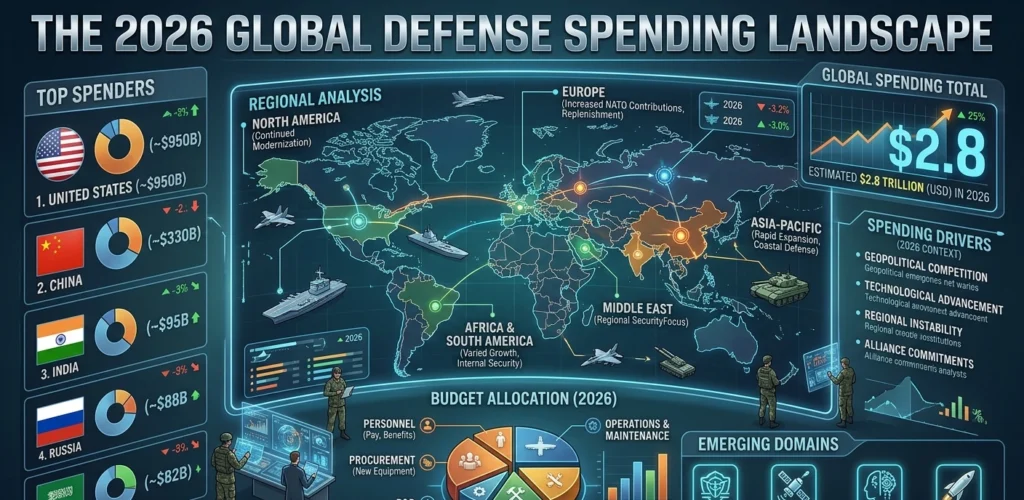
According to the International Institute for Strategic Studies (IISS), global defense spending reached $2.63 trillion in 2025, up from $2.48 trillion in 2024 a year on year increase of approximately 6%. Europe has been the most dramatic driver of growth, with European military spending rising 12.6% over the prior year alone.
The US remains the dominant spender by an overwhelming margin. In 2025, US defense expenditure was estimated at approximately $980 billion roughly 62% of NATO’s total defense budget, far exceeding any other alliance member. The top global military spenders in 2025 were:
| Country | 2025 Defense Budget | Note |
| United States | $860 billion | 62% of NATO total |
| China | $245 billion | Fastest-growing major power |
| Russia | $157-161 billion | +3% from 2024 |
| United Kingdom | $80.5 billion | NATO commitments |
| Germany | $72.6 billion | +18% in 2025 record surge |
| Saudi Arabia | $72.5 billion | Middle East tensions |
| India | $60 billion | Rapid modernization |
| France | $58.7 billion | European leadership role |
| Japan | $58 billion | Indo-Pacific security |
| Ukraine | $53 billion | Active wartime spending |
The NATO 5% GDP Mandate
In one of the most consequential shifts in alliance history, NATO members agreed in 2025 at the strong insistence of US President Trump to raise defense spending targets from 2% of GDP to 5% of GDP by 2035. Of this, 3.5% is earmarked for direct defense spending, with the remaining 1.5% covering security-related expenditures. This single policy shift is expected to pump hundreds of billions in additional annual spending into the global defense industry for the next decade.
Germany has already demonstrated the fastest reversal among NATO members. Once a persistent laggard on defense contributions, Germany increased its military spending by 18% in 2025 alone prompting the Trump administration to publicly praise the country’s transformation. Nordic nations Denmark, Finland, Norway, and Sweden collectively reached $53.7 billion in 2025, more than double their 2020 combined totals.
Why Certain Companies Win During War
Not all companies benefit from armed conflict. The winners share several structural advantages:
- Government as the anchor customer: Defense contractors derive the bulk of revenues from governments, which unlike private consumers, do not reduce spending during recessions.
- Long-duration contracts: Major defense programs span 10 to 30 years, creating revenue visibility that most industries can only dream of. Lockheed Martin’s F-35 program, for example, is expected to run through 2070.
- High barriers to entry: The regulatory complexity, capital requirements, and classified technical know-how required in defense make competition extremely difficult for new entrants.
- Combat-proven demand signals: Equipment that performs well in active conflicts receives accelerated procurement orders. The success of Patriot missile systems in Ukraine, for example, has generated a wave of new orders globally.
- Supply disruption premiums: Wars disrupt global energy and commodity supply chains, benefiting producers of oil, gas, critical minerals, and rare earth elements.
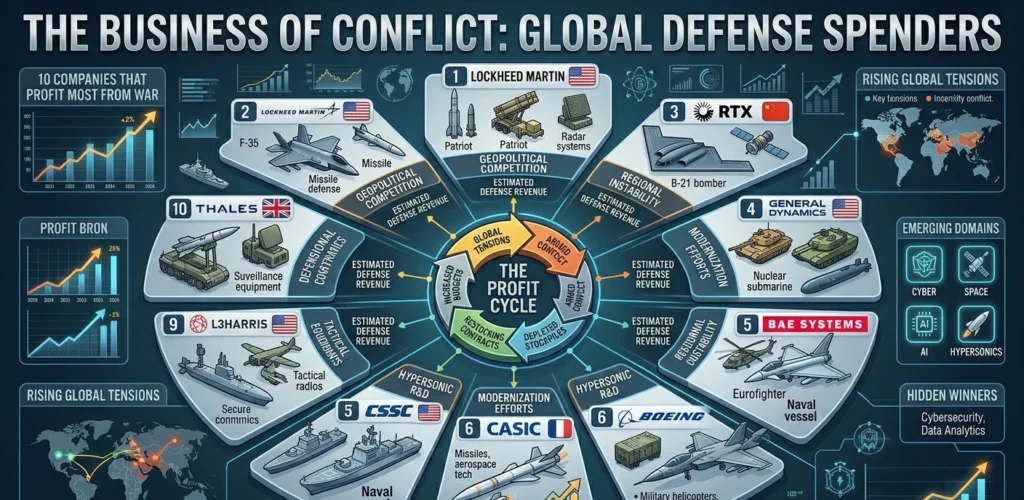
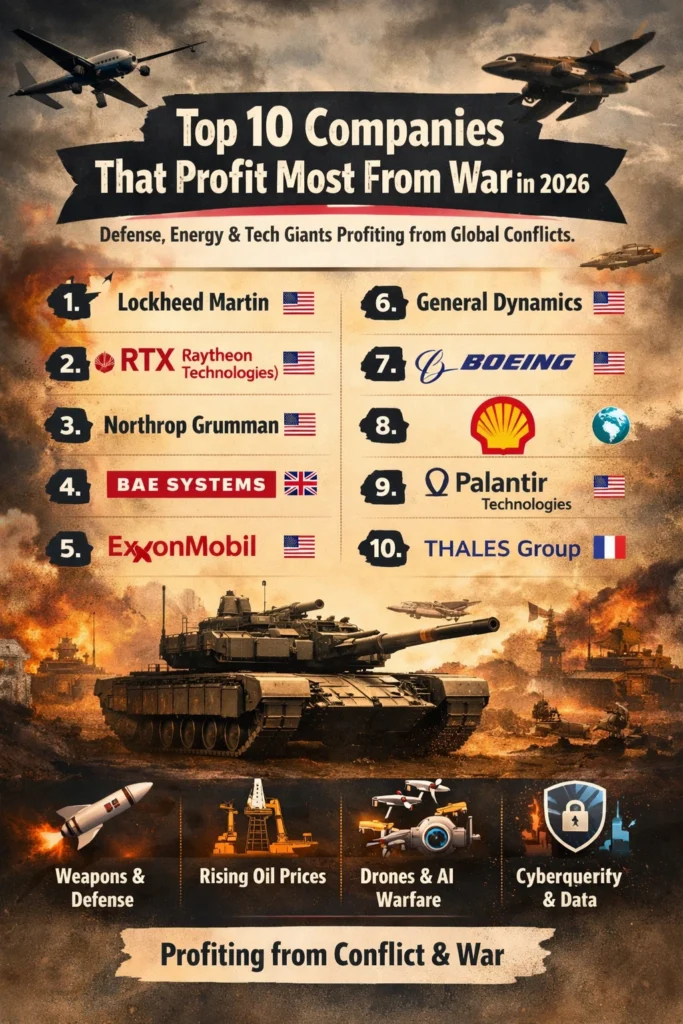
Top 10 Companies Profiting Most From War in 2026
1. Lockheed Martin (NYSE: LMT)
Lockheed Martin remains the world’s largest defense contractor by revenue, and 2025 was arguably its best year in history. The Bethesda, Maryland-based company reported full-year 2025 revenues of $75 billion a 6% increase year on year along with a record backlog of $194 billion at year-end. This backlog represents the company’s pipeline of contracted future work, providing multi-year revenue certainty that few companies in any industry can match.
| 2025 Revenue | $75.0 billion (+6% YoY) |
| 2025 Net Earnings | $5.0 billion ($21.49 per share) |
| Record Backlog (end 2025) | $194 billion |
| Free Cash Flow 2025 | $6.9 billion |
| 2026 Revenue Guidance | $77.5 billion to $80 billion |
| R&D + Capex Increase 2026 | +35% to $5 billion |
| Key Products | F-35 fighter jet, Patriot missiles, missile defense systems |
The F-35 program continues to be the crown jewel of Lockheed’s portfolio. In 2025, the company delivered a record 191 F-35s. Agreements were finalized for 296 additional jets across production lots 18 and 19, with international partners including Israel, Poland, and Taiwan continuing to order advanced variants. Lockheed’s Missiles and Fire Control segment has been the fastest-growing division, driven by soaring global demand for precision strike systems. The company is increasing capital expenditure and R&D spending by 35% in 2026, specifically targeting missile production capacity expansion and next-generation systems development.
2. RTX Corporation (NYSE: RTX)
Formerly known as Raytheon Technologies, RTX Corporation has emerged as Europe’s preferred air defense supplier as the continent undergoes its most significant rearmament since World War II. The company’s Raytheon division specializes in the Patriot missile defense system, which has become the definitive standard for NATO-aligned air defense.
| Key Division | Raytheon (missiles, radar, air defense) |
| Patriot Contracts Won in 2025 | $1.7B (Spain), $529M (Netherlands replenishment), $168M (Romania) |
| Long-Term Patriot Contract | $50 billion sustainment contract through 2045 |
| Countries Operating Patriot | 19 nations globally |
| 2026 Revenue Guidance | $23.0-23.5 billion (7% organic growth) |
| Shareholder Returns | Billions returned via buybacks and dividends in recent years |
RTX secured a landmark $50 billion umbrella contract from the US Defense Logistics Agency covering Patriot system sustainment through 2045 providing what analysts describe as ‘unprecedented long-term revenue visibility.’ With 19 countries now operating the Patriot platform and many more in procurement negotiations, RTX’s Raytheon division is structurally positioned to benefit from European rearmament for the rest of the decade.
3. Northrop Grumman (NYSE: NOC)
Northrop Grumman is the stealth technology leader of the modern US defense sector, with key roles in the B-21 Raider next-generation stealth bomber, autonomous drone systems, space-based surveillance, and increasingly in AI-assisted warfare platforms. The company reported 2025 full-year sales of $42 billion, with fourth-quarter 2025 sales surging 10% year-on-year to $11.7 billion.
| 2025 Full-Year Revenue | $42.0 billion (+2% YoY; +3% organic) |
| Q4 2025 Revenue | $11.7 billion (+10% YoY) |
| 2025 Net Earnings | $4.2 billion ($29.08 per diluted share) |
| Operating Cash Flow 2025 | $4.8 billion |
| Record Backlog | $95.7 billion (record level) |
| 2026 Outlook | Mid-single digit sales growth expected |
| Strategic Focus | B-21 bomber, autonomous drones, space defense, AI warfare |
CEO Kathy Warden described the company as positioned to ‘deliver differentiating technology at speed and scale’ for the nation and its partners. Northrop’s record backlog of $95.7 billion, combined with strong demand for next-generation stealth and autonomous systems, gives it multi-year revenue visibility. The company’s role in AI-driven warfare particularly in connecting sensor data with autonomous targeting systems positions it at the leading edge of what military analysts call ‘decision-speed warfare.’
4. BAE Systems (LON: BA.)
BAE Systems is Europe’s largest defense contractor and is experiencing a historic boom driven by European rearmament and NATO expansion commitments. The UK-based company manufactures submarines, warships, armored vehicles, electronic warfare systems, and advanced cybersecurity platforms. With the UK committed to maintaining its status as NATO’s second-largest military power, BAE has an exceptionally strong domestic base from which to operate.
| Headquarters | London, United Kingdom |
| Revenue (2025) | Approximately £25+ billion |
| Strategic Products | Astute-class submarines, Type 26 frigates, Challenger tanks, Typhoon jets |
| Key Growth Driver | European NATO rearmament and UK defense budget expansion |
| Cyber Division | One of the world’s largest defense cyber businesses |
| Key Markets | UK, US, Australia, Saudi Arabia, Qatar |
The AUKUS submarine agreement (US-UK-Australia) is one of the most significant long-term contracts in BAE’s history, committing the company to building nuclear-powered submarines for Australia over a multi-decade timeline. This alone represents hundreds of billions in potential future revenue. BAE has also been a key beneficiary of surging demand from the Gulf states, where Saudi Arabia and the UAE have significantly increased procurement of BAE-manufactured systems in response to regional tensions.
5. General Dynamics (NYSE: GD)
General Dynamics operates across five key business segments: Aerospace (Gulfstream jets), Marine Systems (submarines, surface ships), Combat Systems (tanks, armored vehicles), Technologies (IT and cybersecurity for military), and Mission Systems. The company reported full-year 2025 revenues of $52.6 billion with net earnings of $4.2 billion.
| 2025 Full-Year Revenue | $52.6 billion |
| 2025 Net Earnings | $4.2 billion ($15.45 per diluted share) |
| Q4 2025 Revenue | $14.4 billion |
| Year-End Backlog | $118 billion |
| Book-to-Bill (Full Year) | 1.5x (meaning orders significantly exceed deliveries) |
| Capital Expenditure 2025 | $1.2 billion (+27% from 2024) |
| Key Programs | Virginia-class submarines, Abrams tanks, Stryker vehicles, Gulfstream jets |
General Dynamics’ Marine Systems division is particularly well-positioned. The US Navy’s modernization plans are enormous targeting construction of additional Ford-class aircraft carriers, multiple Virginia-class submarines, and dozens of destroyers. The shipbuilding budget has nearly doubled since 2021, and Congress has consistently allocated more funding for naval construction than even the President has requested. General Dynamics, through its Electric Boat subsidiary, is the primary builder of US nuclear submarines.
6. L3Harris Technologies (NYSE: LHX)
L3Harris Technologies, formed from the 2019 merger of L3 Technologies and Harris Corporation, deserves inclusion in this updated list over Boeing’s defense division given its extraordinary 2025 performance. CEO Christopher Kubasik called 2025 the company’s ‘best year ever’ reporting record orders, expanding margins, and $2.8 billion in adjusted free cash flow up over 20% year-on-year.
| 2025 Revenue | $21.9 billion (+5% organic growth) |
| Operating Margin | 15.8% adjusted operating margin |
| Free Cash Flow 2025 | $2.8 billion (+20%+ YoY) |
| 2026 Revenue Guidance | $23.0-23.5 billion (7% organic growth) |
| Stock Performance | Approximately +89% over five years; +40% in 2025 |
| Share Price (late 2025) | Approximately $346 |
| Key Products | Night vision, communications, electronic warfare, ISR systems |
L3Harris operates across some of the most critical and specialized niches in modern warfare night vision systems, secure communications, electronic warfare, and intelligence, surveillance, and reconnaissance (ISR) platforms. Its products are used extensively in the Ukraine and Middle East conflicts, and the company has been expanding aggressively into allied nation markets as European and Asia-Pacific defense buyers seek to modernize their ISR capabilities.
7. Boeing Defense (NYSE: BA)
While Boeing’s commercial aviation division has faced well-publicized challenges, its Defense, Space & Security (BDS) segment remains a critical supplier to the US military and its allies. Boeing manufactures the F/A-18 Super Hornet, the AH-64 Apache helicopter, the P-8 Poseidon maritime patrol aircraft, Chinook heavy-lift helicopters, and various satellite and space systems.
| Defense Segment | Boeing Defense, Space & Security (BDS) |
| Key Products | F/A-18, Apache, Chinook, P-8 Poseidon, KC-46 tanker, satellites |
| Revenue Diversification | Commercial + Defense defense buffers commercial weakness |
| International Sales | Strong in UK, Australia, India, Middle East |
| Satellite Division | Growing role in military communications and surveillance |
| Key Contract Areas | Electronic warfare, space systems, naval reconnaissance |
Boeing’s defense segment acts as a crucial financial buffer during periods when its commercial business faces headwinds. In times of heightened geopolitical tension, the defense division provides stable government-backed revenues. The company is also investing heavily in autonomous systems and AI-enabled military platforms, attempting to remain competitive with more focused peers like Northrop and L3Harris in the technology-intensive domains of modern warfare.
8. Palantir Technologies (NYSE: PLTR)
Palantir is arguably the most remarkable defense technology story of 2025-2026. Once regarded primarily as a data analytics company with government contracts, Palantir has become the AI backbone of modern warfare and its financial results reflect this transformation in extraordinary fashion.
| Q4 2025 Revenue | $1.41 billion (+70% YoY) |
| US Government Revenue Q4 2025 | $570 million (+66% YoY) |
| Full-Year 2025 Revenue | $4.48 billion |
| 2026 Revenue Guidance | $7.18-7.20 billion (+61% growth) |
| Stock Performance | Approximately +1,820% over three years |
| Market Capitalization (2026) | Approximately $362 billion |
| Pentagon Status | Core AI provider across all US military branches (Project Maven) |
| Operating Margin Q4 2025 | 41% |
Palantir operates Project Maven the AI backbone of US military operations that processes drone footage and satellite imagery for real-time targeting decisions across operations in the Middle East. The Pentagon has designated Palantir as the ‘core AI provider’ across all US military branches, cementing its position as essentially irreplaceable infrastructure for American warfare. CEO Alex Karp called Q4 2025 results ‘indisputably the best results in tech in the last decade.’
The company has secured a $10 billion Army framework agreement and is expanding Project Maven into allied nations across the Middle East and Europe. With a backlog of $11.2 billion and analyst consensus pointing to continued strong growth, Palantir represents the clearest example of how digital intelligence has become as valuable as kinetic firepower in modern conflict.
9. ExxonMobil (NYSE: XOM)
ExxonMobil represents a different category of war profiteer. While it does not manufacture weapons or military systems, the American energy giant benefits enormously from the oil price surges and supply chain disruptions that accompany major armed conflicts. War is among the most powerful drivers of energy price volatility, and ExxonMobil as one of the world’s largest producers of crude oil and natural gas is structurally positioned to profit.
| Revenue Driver | Oil price surges during geopolitical instability |
| Conflict Exposure | Middle East, Russia-Ukraine war affect global supply |
| LNG Expansion | Benefiting from Europe’s shift away from Russian gas |
| Strategic Assets | Gulf of Mexico, Guyana, Middle East, Texas Permian Basin |
| Dividend Growth | Consistent dividend increases treated as defensive income stock |
| Energy as Strategy | Oil explicitly used as geopolitical leverage by producing nations |
The Russia-Ukraine conflict has had a transformative effect on European energy markets. Europe’s urgent shift away from Russian natural gas has created unprecedented demand for US liquefied natural gas (LNG) exports, driving a boom in American LNG production capacity. ExxonMobil is one of the primary beneficiaries. Additionally, as Middle East tensions escalate including the February 2026 Iranian retaliatory strikes on US military assets oil markets have priced in growing risk premiums, supporting elevated crude prices.
10. Thales Group (EPA: HO)
Thales Group, headquartered in France, is one of Europe’s most strategically important defense and technology companies. Specializing in radar systems, avionics, satellite communications, cybersecurity, and electronic warfare, Thales operates at the intersection of traditional military hardware and cutting-edge digital defense.
| Headquarters | La Defense, Paris, France |
| Revenue 2025 | Approximately €20+ billion |
| Key Products | Radar systems, air traffic control, satellite comms, night vision, electronic warfare |
| Key Growth Driver | European defense buildup, NATO modernization contracts |
| Cybersecurity Division | Major European provider of military-grade cybersecurity |
| Space Division | Military satellite communications and imagery |
| Key Markets | France, UK, Middle East, Asia-Pacific |
Thales is particularly important in the context of European strategic autonomy France’s stated ambition to reduce dependence on American military technology. As European nations build out their own indigenous defense capabilities, Thales is a primary beneficiary of contracts that specifically require European technology. The company’s cybersecurity division has also grown dramatically as governments invest in protecting digital military infrastructure against state-sponsored cyberattacks a domain where Russia, China, and Iran have all demonstrated aggressive capabilities.
Emerging War-Profit Sectors in 2026

1. Drone Warfare — The Game Changer
The Russia-Ukraine war has been described by military analysts as the world’s first large-scale ‘drone war,’ and the lessons have fundamentally reshaped procurement priorities across every major military on the planet. Drones offer an unprecedented combination of affordability, scalability, and lethality that is disrupting the traditional economics of warfare.
- Cost asymmetry: A $500 commercial drone carrying a small explosive can destroy a tank worth $3-5 million.
- Drone companies seeing explosive revenue growth: Firms like AeroVironment (AVAV), Ondas Holdings (ONDS), and Shield AI have seen revenues and valuations surge dramatically. Ondas’ stock surged over 1,080% in the past year as of early 2026.
- Ondas subsidiary Airobotics secured a $20 million initial purchase order for a national autonomous border protection program in early 2026, representing the early phase of a multi-year framework that could deploy thousands of autonomous systems.
- Defense IPO boom: New drone and autonomous systems companies entering public markets at record pace, with many offerings oversubscribed by institutional investors.
- Counter-drone systems: Every drone boom creates demand for counter-drone technology radar, electronic jamming, interceptor missiles multiplying the revenue opportunity.
2. AI and Autonomous Systems
Artificial intelligence has become the defining technology of 21st-century warfare. From autonomous targeting and battlefield coordination to predictive logistics and cyber offense/defense, AI is transforming every dimension of military operations. The financial implications are profound.
- Palantir’s Project Maven processing drone footage and satellite data for real-time military targeting has been designated as core infrastructure across all US military branches.
- The shift toward AI-driven warfare is creating what analysts call a ‘new defense technology stack’: AI companies provide the intelligence layer, autonomous hardware companies provide execution capability.
- US commercial AI revenue for Palantir grew 137% year-on-year as battlefield applications migrate into government and commercial intelligence use cases.
- AI-enabled electronic warfare, communications jamming, and adversarial AI (AI that attacks enemy AI systems) represent entirely new procurement categories entering defense budgets.
3. Cybersecurity and Electronic Warfare
Modern wars are fought simultaneously in the physical and digital domains. The conflict in Ukraine has featured some of the most sophisticated cyberattacks in history targeting power grids, financial systems, satellite communications, and military command and control networks. Every major government is dramatically expanding cybersecurity investment as a result.
- Defense-grade cybersecurity spending growing faster than any other defense category in several NATO budgets.
- Companies like BAE Systems, Thales, L3Harris, and Northrop Grumman all have significant and growing cyber divisions.
- Electronic warfare (jamming enemy communications, blinding enemy radar, disrupting GPS) is now considered as important as kinetic firepower in modern conflict planning.
4. Space and Satellite Defense
Space has become the newest domain of warfare. Control of satellite networks now determines battlefield communications, GPS precision for weapons guidance, early warning missile detection, and real time intelligence gathering. Following Russia’s interference with satellite communications in Ukraine and China’s demonstrated anti-satellite capabilities, every major military power is investing heavily in space-based defense.
- Companies: Northrop Grumman, L3Harris, Thales, Boeing, and a growing number of commercial space startups.
- Key capabilities: Hardened communications satellites, missile early warning systems, hypersonic detection, and space-based ISR.
- Commercial space companies like SpaceX (Starlink) have demonstrated that commercial satellite networks can provide critical military communications infrastructure.
5. Critical Minerals and Rare Earth Supply Chains
Wars disrupt global commodity markets. But the growing demand for advanced military technology from electric drone batteries to rare earth magnets in guided missiles has created a new category of strategic investment: critical mineral supply chains.
- Lithium, cobalt, titanium, and rare earth elements are essential for defense electronics, electric propulsion, and advanced sensors.
- Supply disruptions caused by war, sanctions, and trade restrictions have significantly raised prices and profits for producers of these materials.
- The US, EU, and allied nations are investing heavily in diversifying away from Chinese-dominated rare earth supply chains creating sustained long-term demand for alternative producers.
India: The Emerging Defense Powerhouse
The Strategic Context
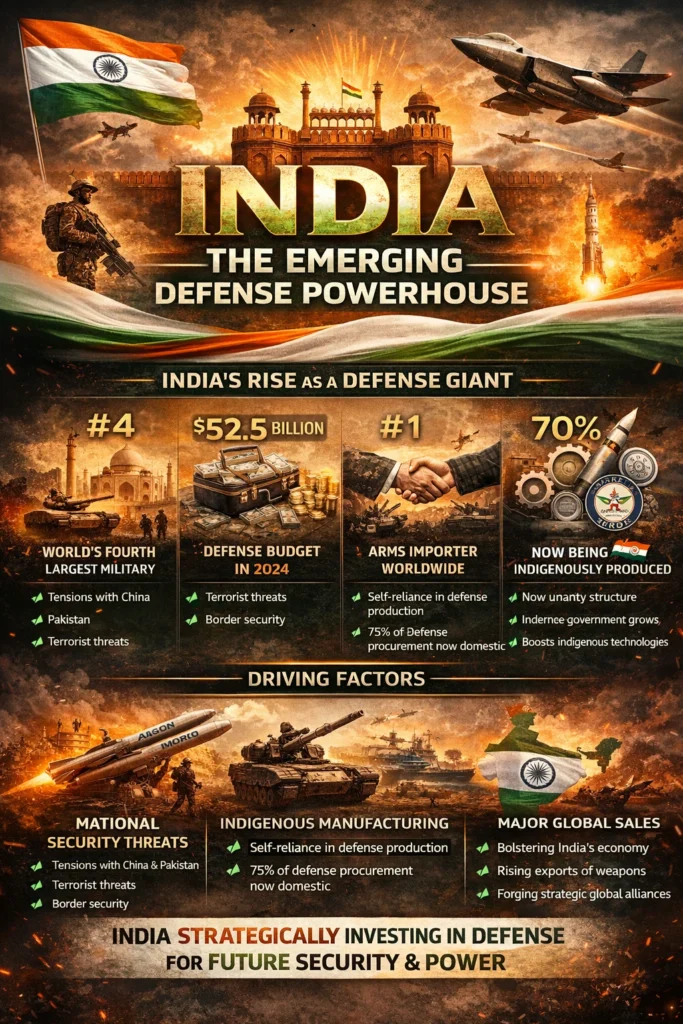
India occupies a unique position in the global defense landscape. It shares contested borders with two nuclear-armed rivals China and Pakistan making defense investment a non-negotiable strategic priority. At the same time, Prime Minister Modi’s Atmanirbhar Bharat (Self-Reliant India) initiative is driving a historic shift from defense importation to domestic production and export.
The 2026 Union Budget allocated approximately Rs 6.8 lakh crore (approximately $81 billion) to defense roughly 13% of total government expenditure and 2.0-2.1% of GDP. Critically, the capital outlay for new equipment, weapons systems, and modernization increased by approximately 8% year-on-year, and domestic procurement as a share of capital acquisition was raised to a record level.
Key Indian Defense Companies
Hindustan Aeronautics Limited (HAL)
HAL is India’s flagship aerospace and defense manufacturer. Its products include the Tejas Light Combat Aircraft, the Advanced Light Helicopter Dhruv, the Light Combat Helicopter Prachand, and licensed production of the Sukhoi Su-30MKI. In 2025, contracts were signed for 156 Light Combat Helicopters, and the company’s long-term pipeline includes the Indian Multi-Role Helicopter (IMRH) and the Advanced Medium Combat Aircraft (AMCA) program.
- HAL’s order book exceeds Rs 1 lakh crore, with an anticipated order pipeline of Rs 1.6-1.7 trillion over the next three years.
- The company is expanding manufacturing lines with an annual capex plan of Rs 30 billion through FY30.
- Broker estimates project HAL earnings growing at 7% CAGR through FY28, with potential for acceleration as export orders materialize.
Bharat Electronics Limited (BEL)
BEL is India’s premier defense electronics company, manufacturing radar systems, communication equipment, electronic warfare systems, missile guidance systems, and avionics. Its order book as of late 2025 stood at Rs 75,600 crore providing revenue visibility of over three years. Analysts from Nuvama describe BEL as their top pick in the Indian defense sector.
- BEL committed to order inflows of Rs 270 billion for FY26, with potential to reach Rs 570 billion if major pending orders (QRSAM, LRSAM) are finalized.
- BEL’s civilian business covering EVs, smart cities, and metro systems provides additional diversification reducing pure defense dependency.
- The company is a key player in India’s Akash surface-to-air missile system, which has attracted significant export interest.
Emerging Indian Defense Players
Beyond HAL and BEL, several companies deserve investor attention. Mazagon Dock builds warships and submarines for the Indian Navy and is a primary beneficiary of India’s naval modernization push. Bharat Dynamics Limited (BDL) specializes in guided missiles and is targeting an export share of 25% of revenues by FY29-30. Solar Industries is pivoting from industrial explosives to high-tech munitions, with a target of defense revenue contributing 50% of total revenues by FY28.
India’s Defense Export Ambitions
India has set an ambitious target of reaching Rs 50,000 crore (approximately $6 billion) in defense exports by 2029 up from approximately Rs 21,000 crore in FY2024 25. The country is already supplying defense equipment to the Philippines, Armenia, and several Middle Eastern nations. The success of Indian-made precision weapons (including SCALP missiles, HAMMER bombs, and loitering munitions) in Operation Sindoor demonstrated the effectiveness of Make in India military equipment to the world, generating a wave of international interest.
The government has supported this export push by allowing up to 74% foreign direct investment via the automatic route (and 100% via government approval), attracting significant international capital into Indian defense manufacturing.
Investing in Defense: Opportunities, Risks, and Ethics
The Investment Case For Defense Stocks
- Government-guaranteed revenue: Defense revenues are backed by sovereign states the most credit-worthy customers in any market.
- Multi-decade contract visibility: Major programs like the F-35, Virginia-class submarines, and B-21 bomber provide revenue pipelines extending 20-50 years.
- Structural demand growth: The combination of the NATO 5% GDP commitment, active conflicts, and rising global tensions creates a sustained super-cycle in defense spending.
- Pricing power: Defense contractors operating in high-barriers-to-entry markets typically have significant pricing power with their government customers.
- Dividend stability: Many major defense companies Lockheed, General Dynamics, RTX maintain decades-long track records of consistent and growing dividend payments.
- Inflation protection: Defense contracts typically include cost-escalation provisions that protect contractor margins from inflation.
Risks and Challenges
- Geopolitical normalization: A peace agreement in Ukraine or reduction in Middle East tensions could reduce the urgency of procurement, slowing revenue growth.
- Government budget pressure: Rising national debt and competing social spending priorities could eventually force governments to moderate defense budget growth.
- Execution risk: Complex, cutting-edge defense programs frequently experience cost overruns and delivery delays, damaging contractor earnings and relationships.
- Regulatory and export control risk: Arms export regulations can be tightened or restricted, limiting market access. ITAR restrictions complicate international business.
- Technology disruption: Rapid evolution of drone, AI, and autonomous systems could make legacy platforms and contractors less relevant.
- Concentration risk: Over-reliance on a small number of large government contracts creates vulnerability to program cancellations.
The Ethical Dimension
No analysis of defense investment can be complete without addressing the profound ethical questions it raises. The companies profiled in this report earn their revenues from systems designed to kill and the conflicts that drive their stock prices leave behind devastated cities, millions of displaced civilians, and generational trauma.
Investors, analysts, and institutions are increasingly grappling with these questions:
- ESG and defense: Most ESG (Environmental, Social, Governance) frameworks traditionally excluded defense companies from ‘ethical’ portfolios. However, the Russian invasion of Ukraine prompted several European ESG funds to reconsider, arguing that companies enabling legitimate national defense serve an ethical purpose.
- The ‘shield vs. sword’ distinction: Some investors distinguish between companies that primarily manufacture defensive systems (missile defense, cybersecurity, ISR) and those focused on offensive weapons (precision strike, bombs, artillery).
- Deterrence theory: The most common ethical defense of defense investment argues that strong military capability deters aggression, ultimately preventing wars rather than enabling them.
- The opportunity cost argument: Critics respond that the trillions spent on military hardware represent resources that could fund education, healthcare, and climate solutions.
There is no universally correct answer to these questions. They represent genuine moral complexity where thoughtful people can reach different conclusions. What this report emphasizes is that investors should make these decisions with full awareness of both the financial and ethical dimensions not one or the other.